Showers Pass Waterproof Socks Review: Are They Worth It?
Showers Pass Waterproof Socks Review
Wet feet can quickly turn an enjoyable hike, run, bike ride, or winter adventure into an uncomfortable experience.
Showers pass waterproof Socks are designed for exactly these conditions, combining a waterproof membrane with a sock-like fit that can be used with regular outdoor footwear.
Based on long-term real-world testing and product information from Showers Pass, these socks have been used in rain, streams, rivers, snow, mud, glacier water, and wet trails. The strongest evidence comes from testers who deliberately exposed the socks to cold water and continued using them during demanding outdoor activities.
The biggest takeaway is simple: they can keep your feet dry when water remains below the sock opening, but they are not designed to prevent water from entering over the cuff during deep immersion.
What Are Showers Pass Waterproof Socks?
Showers Pass waterproof socks are outdoor socks designed to create a barrier between your feet and wet conditions. Instead of relying on a conventional waterproof hiking boot, the socks can be worn with lower-profile footwear such as hiking shoes or trail runners.
The basic construction contains three elements:
- A knitted exterior sock
- A waterproof breathable membrane
- A knitted interior lining
The manufacturer describes the membrane as seamless and formed around a 3-D foot shape. After the layers are bonded together, the socks are pressure-tested.
This construction is important because the product is intended to feel more like a normal sock than a bulky waterproof boot.
How Waterproof Are Showers Pass Socks?
Waterproofing is the most important reason to consider these socks, and the testing provides several useful examples.
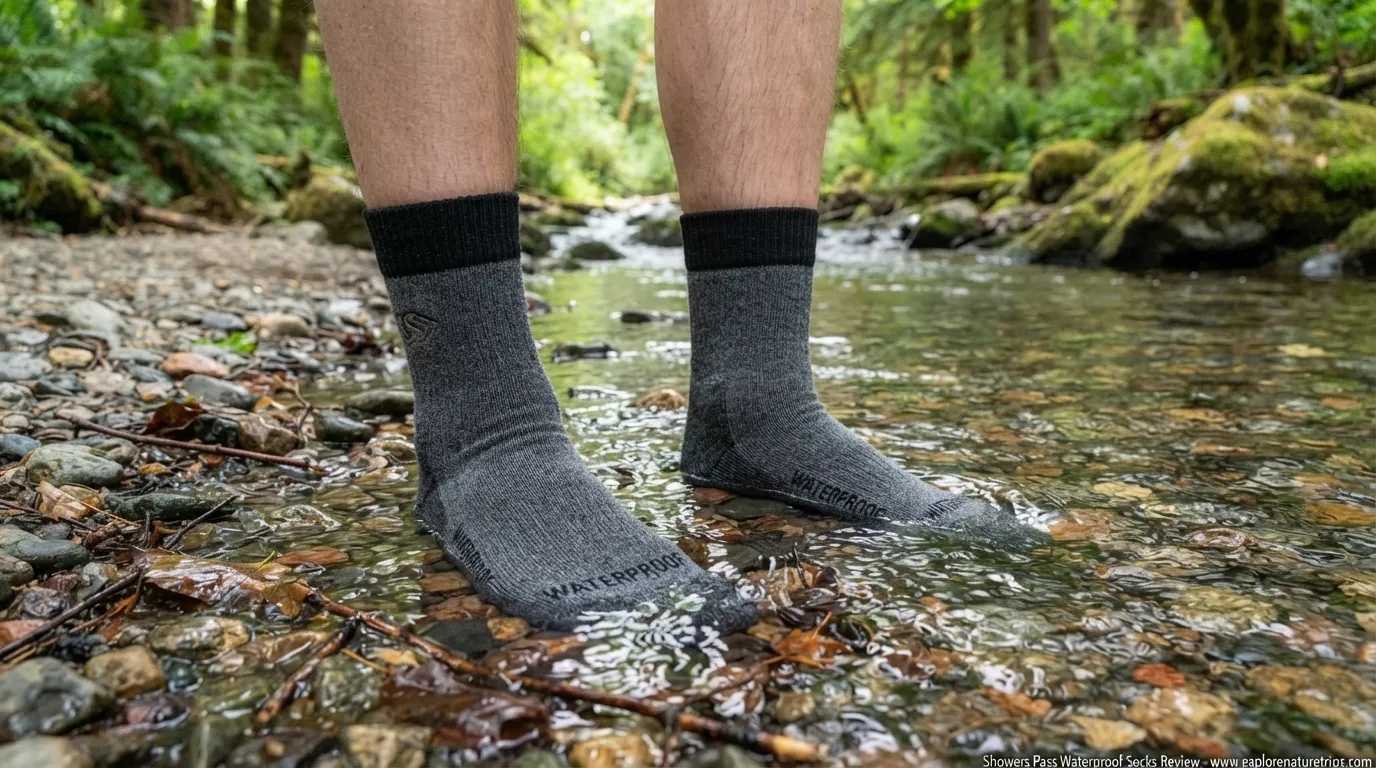
One long-term reviewer reported owning 2 pairs for several years and using them in rain, streams, rivers, snow, mud, and glacier water. During one particularly demanding test, he stood in approximately 1 foot of ice-cold water for several minutes and reported that his feet remained dry.
The socks were also used during desert river crossings and rainy hikes, showing that their usefulness isn’t limited to one type of environment.
Another review provides an even more demanding example. During the Silverton 55K Ultra, the reviewer reached approximately 12,000 feet and spent a couple of hours above the tree line. He later crossed water twice without his feet becoming wet.
However, there was an important limitation.
The final crossing involved a fast-moving river that reached approximately waist height. Water entered the socks from above.
The Important Waterproofing Limitation
This is probably the most useful point to understand before buying.
The waterproof membrane does not extend above the sock opening.
If water remains below the cuff, the socks can provide excellent protection. If water rises above the cuff, water can enter from the top.
So these socks are highly useful for:
- Rain
- Wet grass
- Mud
- Snow
- Snowmelt
- Shallow streams
- Wet trails
- Normal water crossings
They are not a substitute for a waterproof boot or wader when you expect deep immersion.
The 3-Layer Construction Explained
The three-layer design is central to how the socks work.
1. Knit Exterior
The outer layer provides the first layer of protection and contributes to the sock’s durability.
The available models use different exterior materials and thicknesses depending on whether the priority is lightweight performance, warmth, or durability.
2. Waterproof Membrane
The middle layer is the key waterproof barrier.
Showers Pass identifies its membrane as an Artex ultra-thin PTFE waterproof breathable membrane. The manufacturer’s description says the membrane is designed to stretch while maintaining its waterproof properties.
This layer is what separates the socks from ordinary hiking or running socks.
3. Knit Interior
The inner layer sits directly against the foot.
Depending on the model, Showers Pass uses materials such as Coolmax or Merino Wool.
Coolmax is positioned as the lighter, moisture-wicking option, while Merino Wool models are intended to provide more warmth.
Are Showers Pass Waterproof Socks Comfortable?
Comfort appears to be one of the strongest aspects of the design.
The independent reviews describe the socks as having a regular-sock-like shape, rather than feeling like a rigid waterproof boot liner.
The reported comfort features include:
- Slight compression
- No internal seams
- Moisture-wicking lining
- A comfortable fit
- Reduced bunching
- Lower potential for friction and blistering
- Breathable construction
- Wide toe-box design on the manufacturer’s guide
- Padded toe
- Padded heel
One tester specifically noted that the socks worked well with normal 3-season hiking shoes and trail runners.
This can be useful for hikers who don’t want to switch to heavy waterproof footwear simply because conditions are wet.
Are They Warm Enough for Winter?
This depends heavily on the model and activity.
One important independent observation is that the socks are lightly insulated in some configurations. During cold-weather hiking, the reviewer found exposure to cold water and snow tolerable for approximately 15 minutes at a time while moving and generating body heat.
That does not mean every Showers Pass model provides only 15 minutes of warmth. Rather, it highlights an important distinction:
Waterproof does not automatically mean highly insulated.
For short winter hikes, snowshoeing, wet running, or changing conditions, a lightweight waterproof sock may be appropriate.
For extended snow travel, standing on ice, or prolonged exposure to extreme cold, a warmer model may make more sense.
Merino Wool vs. Coolmax
The manufacturer’s range includes different lining options.
| Lining | Best suited to |
|---|---|
| Coolmax | Lightweight use, moisture management, warmer-weather activities |
| Merino Wool | Colder conditions and additional warmth |
If your primary concern is keeping your feet comfortable during cold-weather activities, a Merino Wool version is worth considering.
If weight, breathability, and moisture management are more important, Coolmax may be the better fit.
Showers Pass Waterproof Socks: Model Comparison
The manufacturer’s UK guide provides a useful comparison of several models.
| Model | Height | Weight | Warmth | Durability | Thickness |
|---|---|---|---|---|---|
| Crosspoint Waterproof Mountain Wool Blend | 9.5″ | 4.2 oz | 5-Star | 5-Star | 2.4 mm |
| National Geographic Waterproof Mid-Calf Wool Blend | 9.5″ | 4.2 oz | 5-Star | 5-Star | 2.4 mm |
| Crosspoint Waterproof Wool Crew | 9.5″ | 4.7 oz | 4-Star | 4-Star | 1.9 mm |
| Crosspoint Ultra-Light Wool Blend | 7.5″ | 3 oz | 3-Star | 4-Star | 1.55 mm |
| Crosspoint Waterproof Crew | 9.5″ | 4.5 oz | 3-Star | 5-Star | 1.75 mm |
| Lightweight Waterproof Crosspoint Classic | 9″ | 3.7 oz | 3-Star | 4-Star | 1.75 mm |
| Crosspoint Essentials Waterproof | 7.5″ | 2.6 oz | 2-Star | 2-Star | 1.75 mm |
The table shows why choosing a model based only on the word “waterproof” isn’t enough.
There is a meaningful difference between a 2.6-ounce lightweight model and a 4.7-ounce wool model. Likewise, thickness ranges from 1.55 mm to 2.4 mm, while sock height ranges from 7.5 to 9.5 inches.
Which Showers Pass Sock Should You Choose?
Your activity should determine the model.
For Hiking and Winter Activities
A warmer wool-based model makes more sense when temperatures are low and warmth is important.
The Mountain Wool Blend stands out in the manufacturer’s comparison with 5-star warmth and 5-star durability, a 9.5-inch height, and 2.4 mm thickness.
For Running and Cycling
A lighter option may be more comfortable when you’re moving quickly and don’t want unnecessary bulk.
The lighter models range down to 2.6 oz, with some models measuring only 1.55–1.75 mm thick.
For Wet-Weather Everyday Use
If you’re primarily dealing with rain, wet grass, puddles, and muddy trails, a mid-weight waterproof model can provide a useful balance between protection and comfort.
How Do They Perform in Real Outdoor Conditions?
The strongest part of the available reviews is the variety of environments where the socks were tested.
The long-term reviewer reported using them around:
- Sombrio Beach
- Vancouver Island
- The Canadian Rockies
- Coyote Gulch
- The Catskills
- Sol Duc Falls
- Bryce Canyon National Park
- Harriman State Park
- Hudson Highlands State Park
The conditions included rain, streams, rivers, wet snow, mud, thunderstorms, and glacier water.
That matters because waterproof socks can perform differently depending on whether you’re dealing with occasional splashes or continuous exposure.
The reviews suggest that the socks are particularly valuable when conditions are unpredictable.
You might start a hike in dry weather and later encounter rain, snowmelt, mud, or a shallow stream. In those situations, having waterproof socks can provide an additional layer of protection without requiring a completely different footwear system.
Showers Pass Socks for Running
Running is one of the more interesting use cases.
The Huck Adventures review describes the socks as a go-to choice for wet and snowy runs. The reviewer also used them during the demanding Silverton 55K Ultra.
During the race, the socks survived two water crossings without the reviewer’s feet becoming wet.
That is a strong practical example because the socks were being used while running rather than simply standing in water for a short demonstration.
They’re particularly useful for runners dealing with:
- Rain
- Slush
- Snow
- Mud
- Wet trails
- Cold puddles
However, runners should still remember that the sock opening needs to remain above the water.
Showers Pass Socks for Hiking
For hiking, the main advantage is flexibility.
Instead of wearing a heavy waterproof boot whenever rain is possible, you can potentially combine waterproof socks with 3-season hiking shoes or trail runners.
This is particularly attractive during:
- Spring hiking
- Snowmelt season
- Rainy hikes
- Muddy trails
- Stream crossings
- Shoulder-season backpacking
The socks can also make sense for hikers who prefer lightweight footwear but still want protection from wet conditions.
What About Durability?
Long-term use is one of the more convincing aspects of the available review evidence.
One reviewer reported owning 2 pairs for several years and continued using them across multiple trips and outdoor environments.
The manufacturer also rates different models differently for durability. Some models receive a 5-star durability rating, while lighter models may receive lower ratings.
This suggests an important trade-off: the lightest waterproof sock isn’t necessarily the best choice if your priority is maximum long-term ruggedness.
For demanding hiking, work, fishing, or repeated outdoor use, looking at the durability rating alongside weight is more useful than choosing the lightest model automatically.
How Much Do Showers Pass Waterproof Socks Cost?
Price varies by model.
The independent review discussed a price of approximately $36 per pair at the time of that review, while the manufacturer’s current product-selection information listed several Cross Point models around $47–$52.
Examples from the manufacturer’s guide include:
| Model | Listed price |
|---|---|
| Cross Point Waterproof Socks: Classic Wool | $49 |
| Cross Point Waterproof Socks: Sport | $52 |
| Cross Point Superlight Waterproof Socks | $49 |
| Cross Point Waterproof Socks: Classic FX | $47 |
| Cross Point Waterproof Socks: Mountain | $52 |
Prices can change, so the exact cost should be checked before purchasing.
At this price level, these aren’t bargain socks. Their value comes from adding waterproof protection without requiring dedicated waterproof footwear for every wet-weather adventure.
Pros and Cons
Pros
- Strong waterproof performance in rain and shallow water
- Tested in real outdoor environments
- Available in lightweight and warmer versions
- 3-layer construction
- Coolmax and Merino Wool lining options
- Comfortable sock-like fit
- No internal seams
- Slight compression
- Useful with trail runners and hiking shoes
- Suitable for many outdoor activities
- Several models offer high durability ratings
- Available in multiple sizes
- Some models are only 2.6 oz
Cons
- Relatively expensive compared with ordinary socks
- Water can enter from the top if it rises above the cuff
- Lightweight versions may not provide enough warmth for prolonged extreme cold
- Thicker waterproof socks may require more room inside footwear
- Low-heat drying can potentially cause shrinkage
Care and Washing Instructions
Proper care matters because waterproof socks contain a membrane that is different from a standard knitted sock.
The supplied manufacturer guidance recommends:
- Machine wash in cold water.
- Use a gentle liquid detergent.
- Avoid fabric softener.
- Avoid bleach.
- Hang drying is preferred.
- Low-heat tumble drying is possible.
- Turn the socks inside out after approximately 15 minutes when drying.
The manufacturer notes that excessive dryer heat can cause shrinkage.
Following the care instructions is particularly important if you want the socks to maintain their fit and performance over time.
Sizing and Fit
Showers Pass provides a relatively broad size range.
| Category | Listed sizes |
|---|---|
| Men’s | US 6–15.5 |
| Women’s | US 7–15 |
Fit is especially important with waterproof socks because a poor fit can create discomfort, bunching, or excessive pressure.
The reviews describe a comfortable shape with slight compression and reduced bunching, while the manufacturer highlights a 3-D foot-shaped construction and wide toe box.
When selecting a size, it’s also worth considering the footwear you’ll wear over the socks. A thicker wool waterproof sock can occupy more space than an ultra-light model.
Where Showers Pass Waterproof Socks Make the Most Sense
These socks are versatile enough for many outdoor activities.
Hiking and Backpacking
Excellent for rainy trails, mud, snowmelt, and shallow water crossings.
Trail Running
Useful for wet and snowy runs where maintaining dry feet can improve comfort.
Cycling
They can provide an additional barrier against rain, road spray, and wet conditions.
Fishing and Kayaking
Useful where splashing and shallow water exposure are common, provided the water doesn’t rise above the cuff.
Snowshoeing and Skiing
Warmer wool versions can be more appropriate for colder activities.
Golf and Walking
The waterproof barrier can also be useful when walking through wet grass or playing in damp conditions.
Outdoor Work
The manufacturer specifically lists outdoor work, fishing, hunting, and working in rain among the potential applications.
Are Showers Pass Waterproof Socks Worth It?
For the right user, yes.
The strongest reason to buy them is not simply the waterproof specification. It’s the combination of waterproof protection, normal-sock-like construction, multiple thickness options, and compatibility with regular outdoor footwear.
The real-world testing is particularly encouraging. One reviewer used the socks for several years across multiple environments, while another successfully used them through demanding high-altitude conditions and multiple water crossings.
However, expectations need to be realistic.
They are waterproof socks, not immersion gear. If water rises above the cuff, it can enter from the top. And if you’re spending long periods standing in freezing snow or ice, waterproofing alone won’t provide enough insulation.
For rainy hikes, wet runs, snowmelt, muddy trails, and shallow crossings, they can be a very practical addition to an outdoor kit.
Final Verdict
The Showers Pass Waterproof Socks are a strong option for people who regularly encounter wet conditions but don’t want to rely on heavy waterproof boots.
Their biggest strengths are the 3-layer construction, waterproof membrane, comfortable fit, range of models, and proven performance in real outdoor conditions. Testing has included approximately 1 foot of ice-cold water, several years of use, and demanding conditions at 12,000 feet.
The biggest limitation is equally important: water can enter from the top when it rises above the sock opening.
Choose a lightweight model for activities such as running or cycling, and consider a Merino Wool or Mountain version when warmth and durability are more important. Overall, these socks make the most sense as a flexible wet-weather solution for hikers, runners, cyclists, anglers, and other outdoor users.
FAQs
Are Showers Pass Waterproof Socks actually waterproof?
Yes, the reviews provided report successful use in rain, streams, snow, puddles, and approximately 1 foot of ice-cold water for several minutes. However, water can enter through the top if it rises above the sock cuff.
How long can Showers Pass socks stay waterproof?
There isn’t a single guaranteed time limit. One long-term reviewer reported using 2 pairs for several years, including during repeated wet-weather trips. Performance depends on use, care, wear, and the specific model.
Can you use Showers Pass socks for hiking?
Yes. Hiking is one of their primary use cases. They can be especially useful during rainy conditions, spring snowmelt, muddy trails, and shallow stream crossings.
Are Showers Pass socks good for running?
Yes. One review specifically describes them as a go-to option for wet and snowy runs and reports using them during the Silverton 55K Ultra.
Are they warm enough for snow?
Some models are warmer than others. The Merino Wool and Mountain versions are designed for greater warmth. However, one reviewer found lightly insulated versions comfortable in cold conditions for approximately 15 minutes at a time, rather than for prolonged stationary exposure.
Can I wear them with trail runners?
Yes. One of their main advantages is that they can be paired with normal 3-season hiking shoes or trail runners, rather than requiring heavy waterproof boots.
How do I wash Showers Pass waterproof socks?
Wash them in cold water with gentle liquid detergent. Do not use fabric softener or bleach. Hang drying is preferred, although low-heat tumble drying is possible.
Do Showers Pass waterproof socks keep water out if I walk through deep water?
Only while the water remains below the sock opening. The waterproof protection extends from the toe to just below the cuff. A test involving a waist-deep river showed that water could enter from above.
Are Showers Pass waterproof socks worth the price?
For people who frequently hike, run, cycle, fish, or work in wet conditions, they can be worth considering. Their value comes from combining waterproof protection with regular outdoor footwear, rather than replacing that footwear with a heavy waterproof boot.
Which Showers Pass socks are best for cold weather?
The manufacturer’s comparison gives the Crosspoint Waterproof Mountain Wool Blend a 5-star warmth rating, along with 5-star durability, a 9.5-inch height, 4.2 oz weight, and 2.4 mm thickness.
Hi, I’m Marcus! I love exploring the outdoors and discovering incredible places. Through ExploreNatureTrips blog, I share my travel experiences, useful tips, and recommendations for the best sights, trails, and destinations to visit.