General Sherman Tree: Everything You Need to Know Before Visiting
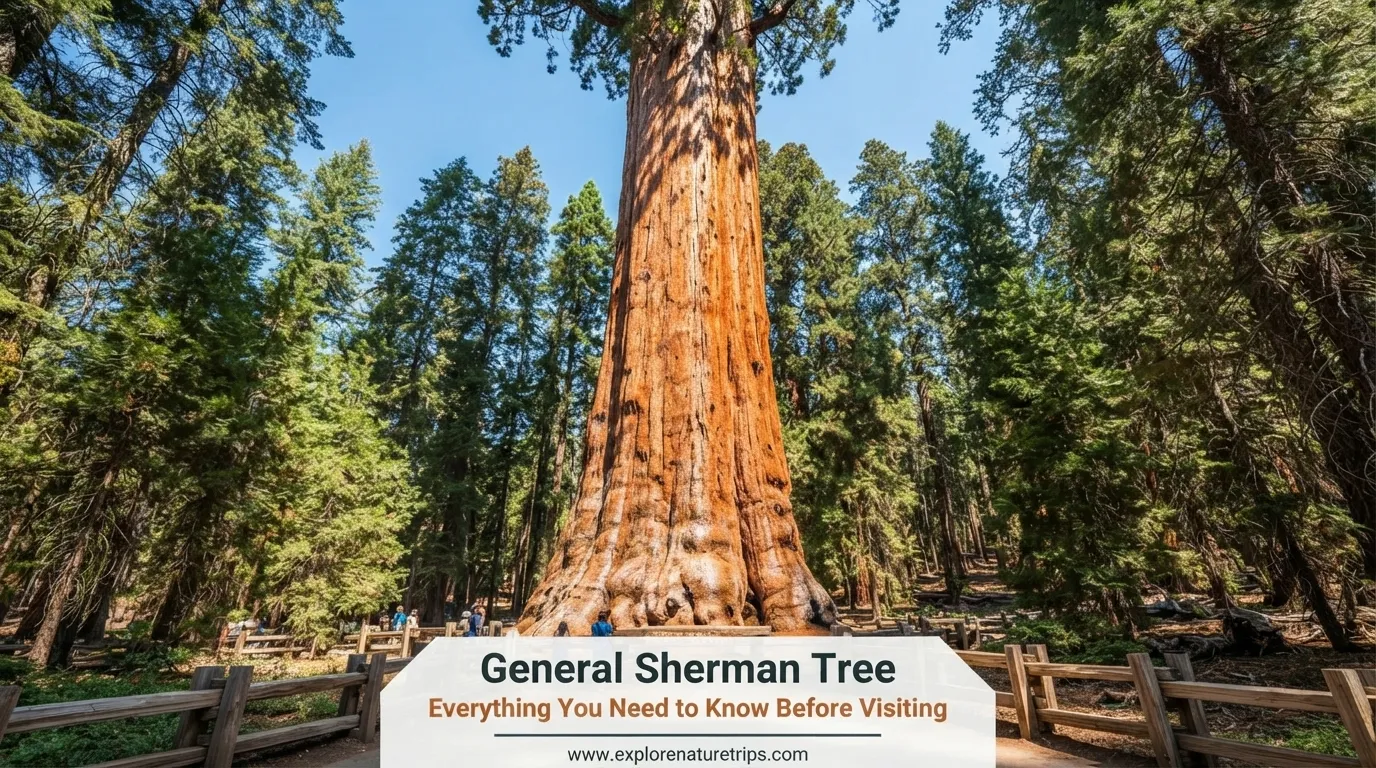
The General Sherman Tree is one of the most remarkable attractions in Sequoia National Park. Located in the Giant Forest, this enormous giant sequoia is best known for its extraordinary size and its place among the world’s largest trees by volume.
Planning a visit does not require a difficult expedition. The main trail is relatively short, but the high elevation, seasonal weather, crowds, parking situation, and return uphill walk are worth understanding before you go.
Before you visit the world’s largest tree, check out everything below you need to know about the General Sherman Tree.
Why Is the General Sherman Tree So Famous?
The General Sherman Tree is a giant sequoia, scientifically known as Sequoiadendron giganteum. Its importance comes primarily from its enormous volume rather than simply its height.
The tree stands approximately 275 feet tall, but its massive trunk is what makes it especially impressive. The sources give its base diameter as approximately 36 to 36.5 feet, while its circumference is around 103 feet.
Its estimated age is generally placed between 2,200 and 2,700 years.
That means the tree was already ancient long before modern California existed in its present form.
One describes its volume as more than 52,500 cubic feet, giving a better idea of just how much wood is contained within the tree.
How Big Is It Compared With a Person?
The scale is difficult to understand from photographs alone.
At roughly 36 feet across at its base, the tree is dramatically wider than an ordinary person. One ives a useful visual comparison: it would take more than 17 people, each approximately 6 feet tall, to surround the trunk with their arms.
This is one reason photographs often fail to communicate its true size.
Where Is General Sherman Tree Located?
The tree is in the Giant Forest area of Sequoia National Park in California.
The nearest community mentioned by the ources is Three Rivers, while larger cities such as Fresno and Los Angeles can require substantially longer drives.
| Starting Point | Approximate Drive Mentioned |
| Three Rivers | About 45 minutes |
| Fresno | About 1.5–2.5 hours |
| Los Angeles | About 4–6 hours |
| Bakersfield | About 3 hours |
| Las Vegas | About 7 hours |
Driving times vary according to the exact starting point and conditions, so these figures should be treated as planning estimates rather than fixed journey times.
How Long Is the General Sherman Tree Trail?
The walk to General Sherman Tree is relatively short compared with many of the longer hikes in Sequoia National Park.
The articles give slightly different measurements, with the main route described as approximately 1.1 to 1.2 miles.
The difference appears to come from how the trail is measured, but the practical takeaway is simple: expect roughly a one-mile-plus round trip.
| Trail Detail | Approximate Figure |
| Distance | 1.1–1.2 miles |
| Elevation gain | About 200 feet |
| Typical time | 30–90 minutes |
| General difficulty | Easy to moderate |
The walk is not technically demanding for most visitors, but the return section includes an uphill climb.
At an elevation of nearly 7,000 feet, even a short walk can feel different from walking at low elevation.
Is the Trail Difficult?
The s generally portray the trail as easy to moderate.
The biggest considerations are not complicated terrain but:
- The uphill return.
- The approximately 200 feet of elevation gain.
- The nearly 7,000-foot elevation.
- Weather conditions.
- Snow and winter road conditions.
- Your own fitness and walking pace.
If you take your time, stop for photographs, and allow yourself to adjust to the elevation, the short distance makes this a manageable introduction to the Giant Forest.
How Much Time Should You Spend There?
The actual walk can take anywhere from approximately 30 minutes to 90 minutes, depending on your pace, photographs, crowds, and stops.
However, visiting only the tree and leaving immediately misses much of the surrounding experience.
For a simple General Sherman visit, allow around 1–2 hours so you are not rushing.
If you add other attractions and trails, the visit can easily become a much longer outing.
The Congress Trail, for example, is described by the s as approximately 2–3 miles, with one source giving around 460–500 feet of elevation gain and approximately 2–3 hours for the hike.
When Is the Best Time to Visit?
The four articles emphasize different seasonal advantages rather than identifying one universally perfect month.
Spring: April to May
Spring can provide:
- Milder conditions.
- Fewer visitors than the busiest summer period.
- Seasonal scenery.
- Opportunities for wildflowers.
One places spring broadly from late March through May, while another highlights April and May.
Summer: June to August
Summer is generally the busiest period.
Advantages include:
- Longer daylight hours.
- Better access to many visitor facilities.
- Ranger programs.
- More predictable access compared with winter.
The downside is crowding.
If visiting during summer, arriving early can make a substantial difference.
Fall: September to November
Fall offers cooler conditions and potentially fewer visitors.
The s highlight:
- Cooler temperatures.
- Autumn scenery.
- Reduced crowds compared with summer.
Winter: December to March
Winter transforms the Giant Forest into a very different landscape.
Snow and winter conditions can affect access. One specifically notes that winter visitors may need chains or a 4×4, depending on conditions.
Parking arrangements can also change during winter.
Because conditions are seasonal, checking current road and park information before setting out is especially important.
What Time Should You Arrive?
Early morning is the strongest recurring practical recommendation across the content.
Explore With Alec specifically recommends arriving before 9 a.m. to reduce crowds.
Average Wild Experience provides an even more useful first-hand example: the author arrived at approximately 7 a.m. in March 2026 and found herself with the second car in the parking area.
That experience illustrates why early arrival can be valuable.
At busy times, the area can become crowded enough that getting an unobstructed photograph may require patience. One mentions photography queues of approximately 15–20 minutes.
Why Visit Early?
An early start can help you:
- Find parking more easily.
- Walk with fewer people around.
- Photograph the tree with less interference.
- Enjoy quieter forest conditions.
- Start additional hikes before the day gets busy.
Where Do You Park?
Parking is an important part of the visit because the area can become busy, especially during popular periods.
The main visitor route begins from the designated General Sherman parking area, while seasonal arrangements may change.
Accessible parking is also discussed by the s for visitors with a disability parking placard.
Some sources describe shuttle services during busier periods, including transportation that can help visitors return toward the parking area.
Because parking and shuttle arrangements can vary seasonally, checking the current arrangements before your trip is a sensible part of planning.
Is General Sherman Tree Accessible?
The main route includes a paved path, making the attraction more accessible than many wilderness hikes.
The s specifically discuss:
- Paved walking surfaces.
- Accessible parking.
- Disability parking placards.
- Wheelchair-friendly shuttle transportation.
- Facilities around the Giant Forest area.
The trail still has an incline, so individual mobility needs should be considered before starting the walk.
How Much Does It Cost to Visit?
One provides specific entrance-fee figures:
| Pass | Price | Validity |
| Private vehicle pass | $35 | 7 days |
| Motorcycle pass | $30 | 7 days |
| Annual Sequoia/Kings Canyon pass | $70 | 1 year |
| America the Beautiful Pass | $80 | 12 months |
The article also notes that an America the Beautiful pass can make financial sense for travelers visiting more than 3 national parks during a year.
Because entrance fees can change, these figures should be checked before traveling.
What Is the History of General Sherman Tree?
General Sherman has a long history connected with the protection and study of giant sequoias.
One states that the tree was discovered in 1879 by James Wolverton, a trapper.
It was subsequently named after General William Tecumseh Sherman, a Union general associated with the American Civil War.
The surrounding area received formal protection when Sequoia National Park was established on September 25, 1890.
Another important date is 1931, when General Sherman was identified as the world’s largest tree by volume.
The broader park’s importance continued to grow, and Explore With Alec notes its designation as a UNESCO World Heritage site in 1984.
Important Historical Dates
| Year / Date | Event |
| 1879 | General Sherman Tree discovered |
| September 25, 1890 | Sequoia National Park established |
| 1931 | Identified as world’s largest tree by volume |
| 1984 | Sequoia National Park became a UNESCO World Heritage site |
| 2024 | Explore With Alec article originally published |
| February 27, 2026 | Explore With Alec article updated |
| March 27, 2026 | Average Wild Experience article published |
Can You See Other Giant Sequoias Nearby?
Yes. The General Sherman visit can be combined with other Giant Forest experiences.
The content mentions:
- President Tree
- Congress Trail
- Moro Rock
- Tunnel Log
- Giant Forest Museum
- Crescent Meadow
- Trail of the Sequoias
- Tharp’s Log Trail
These options allow visitors to turn a short tree visit into a more complete day exploring the surrounding area.
What Is the Congress Trail?
The Congress Trail is one of the most prominent hiking options mentioned throughout the material.
Its reported length varies between approximately 2 and 3 miles, depending on the source and how the route is described.
Explore With Alec gives approximately 460–500 feet of elevation gain and estimates 2–3 hours for the hike.
Average Wild Experience describes extending the outing by approximately 2.2 miles as part of a larger hiking day.
The trail is therefore a good option for visitors who want more than a quick walk to General Sherman.
What Is Moro Rock?
Moro Rock is another nearby attraction mentioned by the s.
The climb is particularly notable for its approximately 400 steps.
For visitors who want to add another physically active attraction to their itinerary, Moro Rock provides a very different experience from the relatively short General Sherman walk.
What Should You Know About Photography?
General Sherman is difficult to photograph because of its enormous height.
Trying to capture the complete tree in a standard horizontal photograph can make it appear smaller than it actually is.
Better Photography Ideas
The experience suggests:
- Use vertical panorama mode.
- Try a wide-angle perspective.
- Move around to find a better viewing angle.
- Arrive before the busiest part of the day.
- Allow extra time if other visitors are waiting for photographs.
The reported 15–20-minute photography queues demonstrate how crowded popular viewpoints can become.
A photograph with a person standing near the tree can also provide useful visual scale.
Why Is the Tree Fenced?
The fence is not simply there to control visitors.
Giant sequoias have extensive but relatively shallow root systems. Repeated foot traffic can compact the soil around those roots.
The content emphasizes staying outside the protected area and respecting the barriers.
That means the best photograph is not worth stepping over a fence or entering a restricted area.
Protecting the root zone helps preserve the tree for future visitors.
What Should You Bring?
For a straightforward visit, the recommendations point toward keeping your gear practical.
Consider bringing:
- Comfortable walking shoes.
- Water.
- Weather-appropriate clothing.
- A camera or phone.
- Extra layers when conditions are cool.
- Navigation information.
- Any required accessibility equipment.
For winter visits, conditions require more careful preparation because snow and road conditions can affect access.
What Should You Check Before Leaving?
A few minutes of preparation can prevent unnecessary problems.
Before driving to General Sherman Tree, check:
- Road conditions
- Weather
- Seasonal parking arrangements
- Shuttle information
- Entrance fees
- Trail conditions
- Any park alerts
- Your planned hiking distance
- Winter equipment requirements
This is particularly important when visiting during winter or during periods of changing weather.
A Simple General Sherman Tree Itinerary
Short Visit: About 1–2 Hours
If your primary goal is simply seeing the tree:
Step 1: Arrive early.
Step 2: Park in the designated area.
Step 3: Walk the approximately 1.1–1.2-mile route.
Step 4: Spend time viewing and photographing the tree.
Step 5: Return carefully along the uphill section.
This is the simplest option for visitors with limited time.
Longer Visit: Half Day
For a more complete experience:
- Visit General Sherman Tree.
- Explore part of the Congress Trail.
- Visit the Giant Forest Museum.
- Add another nearby attraction such as Tunnel Log or Moro Rock.
- Allow additional time for photographs and breaks.
Full-Day Hiking Approach
More ambitious visitors can combine General Sherman with several surrounding trails.
Average Wild Experience describes a personal hiking day of approximately 12 miles, including General Sherman and additional routes such as:
- Congress Trail
- Trail of the Sequoias
- Tharp’s Log Trail
- Crescent Meadow Trail
That is a substantially more demanding day than simply visiting General Sherman, so it should not be treated as the standard itinerary.
General Sherman Tree FAQs
How tall is the General Sherman Tree?
The General Sherman Tree is approximately 275 feet tall. Its enormous trunk is even more notable than its height, with a reported base diameter of roughly 36–36.5 feet.
How old is General Sherman Tree?
The sources estimate the tree’s age at approximately 2,200–2,700 years.
How long is the General Sherman Tree hike?
The main route is approximately 1.1–1.2 miles, with around 200 feet of elevation gain. The walk can take approximately 30–90 minutes depending on pace and stops.
Is General Sherman Tree difficult to hike to?
The walk is generally described as easy to moderate. The main challenge is the uphill return combined with the nearly 7,000-foot elevation.
What is the best time to visit General Sherman Tree?
The content highlights spring, summer, and fall, while early morning is particularly useful for avoiding crowds. Explore With Alec recommends arriving before 9 a.m.
What time did one visitor arrive to avoid crowds?
Average Wild Experience describes a first-hand visit beginning around 7 a.m., when the author found the parking area nearly empty and was the second car.
How much is the General Sherman Tree entrance fee?
One reports $35 for a private vehicle, $30 for a motorcycle, $70 for an annual Sequoia/Kings Canyon pass, and $80 for the America the Beautiful Pass.
Can you take pictures of General Sherman Tree?
Yes. The photography advice recommends vertical panorama mode, wide-angle perspectives, and visiting early because photography queues can reach approximately 15–20 minutes during busy periods.
Can you touch General Sherman Tree?
The content emphasizes staying behind the protective fencing. Visitors should not cross barriers to touch or approach the trunk.
How many steps are at Moro Rock?
The material states that Moro Rock has approximately 400 steps.
When was General Sherman Tree discovered?
The tree is described as having been discovered in 1879 by James Wolverton.
When was Sequoia National Park established?
Sequoia National Park was established on September 25, 1890.
When was General Sherman identified as the world’s largest tree by volume?
The content states that General Sherman was identified as the world’s largest tree by volume in 1931.
Is General Sherman Tree accessible?
The main route includes a paved path, and sources discuss accessible parking and wheelchair-friendly shuttle options. Individual mobility needs should still be considered because the route includes an incline.
Final Tips for a Better General Sherman Visit
The most useful lesson across these experiences is that General Sherman Tree does not require a long hike, but good planning makes the visit considerably better.
Arrive early when possible, especially during summer. Give yourself enough time for the 1.1–1.2-mile walk rather than rushing directly to the tree. Remember that the return involves an uphill section, and the elevation is close to 7,000 feet.
Take photographs, but do not judge the tree’s size only from your camera screen. The 275-foot height and approximately 36-foot-plus base are difficult to capture in a single frame.
If you have additional time, consider extending the outing to the Congress Trail, Giant Forest attractions, or another nearby landmark.
Most importantly, respect the protective barriers. The tree has survived for approximately 2,200–2,700 years, and responsible visitor behavior helps ensure that its surrounding environment remains protected for future generations.

Hi, I’m Marcus! I love exploring the outdoors and discovering incredible places. Through ExploreNatureTrips blog, I share my travel experiences, useful tips, and recommendations for the best sights, trails, and destinations to visit.