Wyoming Road Trip Ideas: Routes, Stops & Travel Tips
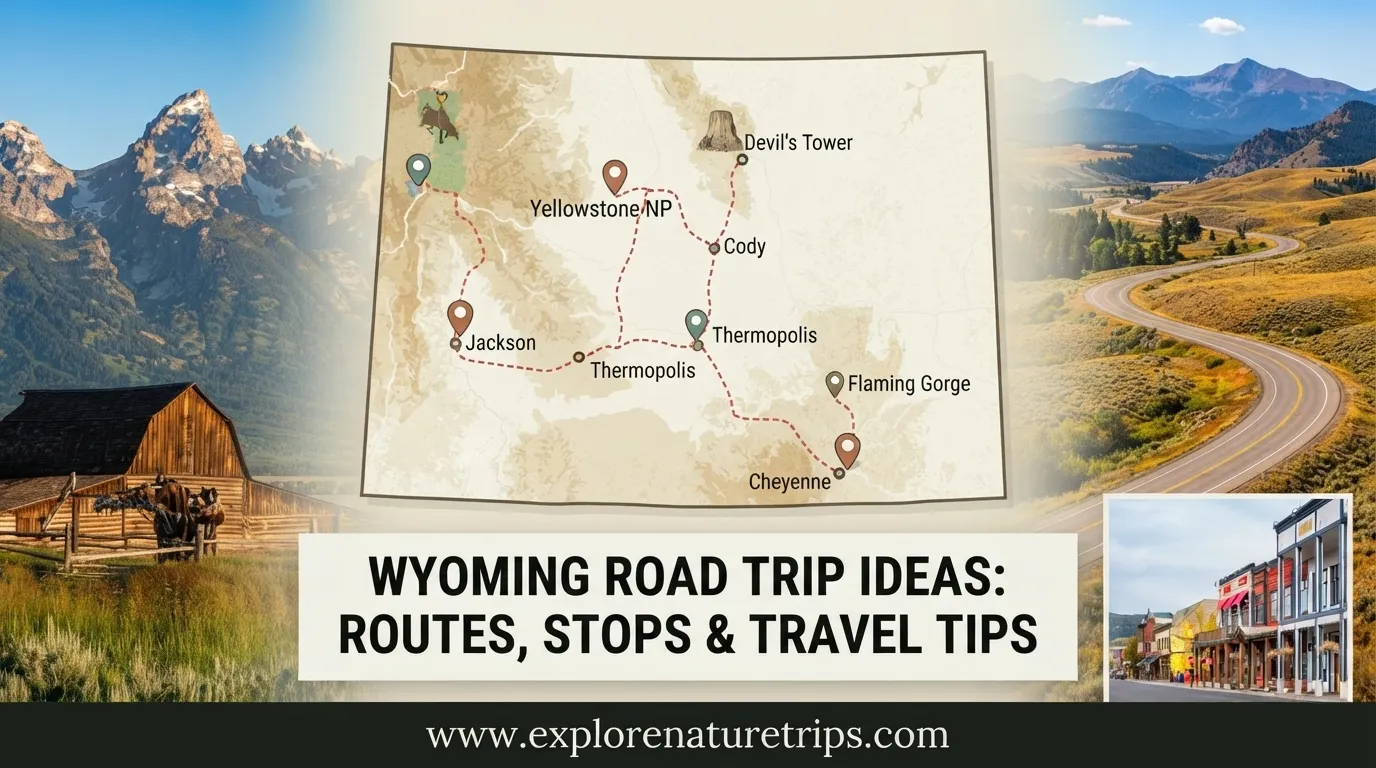
Wyoming is especially well suited to road trips because its attractions are spread across wide-open landscapes, mountain ranges, national parks, small towns, scenic highways, lakes, hot springs, and historic sites. Instead of following only one itinerary, you can choose a route based on the time you have, the season you visit, and the type of experience you want.
The five travel guides reviewed for this article cover everything from a 24-mile, 1.5-hour scenic drive to a 1,426-mile journey through Wyoming’s major natural wonders. They also include shorter weekend routes, an 8-day itinerary, family-friendly options, seasonal road trips, and practical planning resources.
The most important lesson is simple: don’t judge a Wyoming road trip by driving distance alone. A route that takes only a few hours behind the wheel may deserve an entire day once you include viewpoints, wildlife stops, hikes, photographs, meals, and unexpected roadside discoveries.
1-Day Wyoming Road Trip: Rock Springs to Green River
If you have only one day, a short route can still provide a genuine Wyoming road-trip experience.
The Rock Springs to Green River drive covers approximately 24 miles and requires about 1.5 hours of driving time. The main attraction is the Pilot Butte Wild Horse Scenic Tour, where the open landscape and possibility of seeing wild horses make the drive more interesting than simply traveling from one town to another.
Don’t rush this route.
Although the actual driving time is short, you can add scenic stops and spend time exploring Green River. This makes it a useful option for travelers who have a spare day rather than an entire week.
Best for: a quick scenic experience, wildlife watching, and travelers with limited time.
3-Day Wyoming Road Trip: Jackson to Sheridan
For a long weekend, one of the most useful routes connects Jackson, Yellowstone, Cody, Bighorn National Forest, and Sheridan.
The complete route is about 420 miles, with approximately 9 hours 50 minutes of driving time. It combines mountains, wildlife, hiking, small towns, roadside viewpoints, and major natural attractions.
The advantage of this itinerary is variety. You aren’t spending three days looking at one type of landscape. Instead, the route moves between the Grand Tetons, Yellowstone, the Absarokas, and the Bighorn region.
A practical approach is to leave enough time for stops rather than treating the 9 hours 50 minutes as your complete itinerary.
Beartooth Scenic Highway Road Trip
The Beartooth Scenic Highway is a much shorter drive in terms of mileage but deserves more time than the numbers initially suggest.
The route is approximately 68 miles and takes around 1 hour 40 minutes of direct driving. However, the surrounding landscape includes pine forests, glacier-carved lakes, rock formations, mountain scenery, and viewpoints. The route can therefore be expanded into a full-day or even two-day experience.
One important planning detail is its seasonality: the guide specifically recommends it for summer and fall.
This is a good example of why travelers should never build a Wyoming itinerary by adding driving times together and assuming that is enough.
Continental Divide Road Trip
For a broader Wyoming experience, the Continental Divide itinerary connects:
Jackson → Cody → Meeteetse → Thermopolis → Shoshoni → Riverton → Hudson → Lander → Dubois → Jackson
The route covers approximately 500 miles and has around 9.5 hours of driving time.
It combines national parks, small towns, hot springs, hiking opportunities, historic locations, and Native American cultural areas. The route is particularly useful if you want your trip to include more than the state’s best-known national parks.
Yellowstone National Park Road Trip
Yellowstone is one of the central destinations across the content and can easily become the core of a longer Wyoming road trip.
Key stops highlighted in the supplied guides include:
- Old Faithful
- Grand Prismatic Spring
- Yellowstone Lake
- West Thumb Geyser Basin
- Yellowstone Canyon
- Mud geysers
- Fairy Falls
- Lewis Falls
- Moose Falls
- Tower Fall and Upper Falls
The Nature Seeker recommends allowing a full day simply for Yellowstone’s main attractions and advises starting early. Food and water are also important because services can be spread out.
Another specifically recommends checking geyser eruption times when planning the Yellowstone portion of an itinerary.
Grand Teton National Park Road Trip
Grand Teton works particularly well as a companion destination to Yellowstone.
For easier hiking, Taggart Lake is highlighted as a shorter option. For a longer day, Cascade Canyon is approximately 10 miles round trip. More challenging options such as Lake Solitude and Static Peak Divide can reach approximately 10–15 miles.
Other worthwhile stops from the supplied content include:
- Jenny Lake
- Schwabacher Landing
- Mormon Row
- Moulton Barns
- Teton Park Road
Jenny Lake is associated with an approximately 7-mile trail, while the shuttle boat can reduce the amount of walking required.
For photographers, sunrise and sunset are particularly useful around Mormon Row and Schwabacher Landing.
A Practical 8-Day Wyoming Road Trip
Two of the supplied guides use an approximately 8-day structure, making this a useful length for travelers who want more than a weekend but don’t want an extremely long statewide journey.
A practical sequence from the itineraries is:
| Day | Main area |
|---|---|
| Day 1 | Jackson Hole |
| Days 2–3 | Grand Teton National Park |
| Day 4 | Yellowstone geysers |
| Day 5 | West Yellowstone and surrounding attractions |
| Day 6 | Cody |
| Day 7 | Beartooth Pass |
| Day 8 | North Yellowstone |
This structure gives you time to experience major destinations without trying to squeeze every Wyoming attraction into one trip.
The itinerary can also be adjusted depending on whether you prefer hiking, wildlife, museums, scenic driving, or family stops.
Jackson Hole and the Start of Your Road Trip
Jackson Hole is used as a starting point in several of the supplied itineraries.
A 8-day itinerary recommends flying into Jackson and renting a car because attractions are widely distributed and public transportation is limited. The same guide recommends ending the itinerary in Bozeman, Montana, rather than necessarily returning to the starting point.
Jackson itself can be used as a transition between city exploration and the natural landscapes of Grand Teton.
The material also highlights Town Square and the Jackson Hole & Greater Yellowstone Visitor Center.
Cody: A Useful Stop Between Yellowstone and the East
Cody is particularly valuable if you want to add Western history and museums to a nature-heavy road trip.
The supplied content highlights:
- Buffalo Bill Center of the West
- Buffalo Bill Museum
- Plains Indians Museum
- Draper Natural History Museum
- Whitney Western Art Museum
- Cody Firearms Museum
- Old Trail Town
- Heart Mountain Interpretive Center
- Buffalo Bill Scenic Byway
The Buffalo Bill Scenic Byway provides a scenic connection between Cody and Yellowstone, while Cody itself can serve as an overnight stop rather than just a roadside break.
Wyoming Waterfall Road Trip
For travelers who prefer waterfalls, one organizes a 166-mile summer route with approximately 4 hours 20 minutes of driving.
The stops include:
- Osprey Falls
- Undine Falls
- Tower Fall
- Upper Falls
- Fairy Falls
- Kepler Cascades
- Lewis Falls
- Moose Falls
The route is concentrated around Yellowstone, making it an alternative to a standard geyser-focused itinerary.
The benefit is that you can build the day around individual waterfall stops instead of trying to cover an enormous section of Wyoming.
Wyoming Road Trips for Spring
The supplied spring itinerary runs from:
Thermopolis → Saratoga → Jackson Hole → Kelly → Mammoth
It covers approximately 724 miles and about 14 hours of driving time.
The route focuses on thermal springs, blooming landscapes, boardwalk trails, and mountain scenery.
If you choose this style of trip, remember that spring conditions can be cooler and road access can vary. The guides repeatedly emphasize checking conditions and seasonal accessibility before traveling.
Wyoming Road Trips for Summer
Summer is one of the most useful seasons for a Wyoming road trip because several guides identify June through September as the preferred general travel period.
The main advantage is road accessibility and warmer weather. Summer also works well for hiking, scenic drives, camping, waterfalls, lakes, and wildlife-focused stops.
The Beartooth Scenic Highway is another seasonal consideration because the supplied content identifies summer and fall as its useful operating period.
Wyoming Road Trips for Fall
A fall route from the content covers approximately 695 miles and requires about 14 hours of driving.
Suggested stops include:
- Oxbow Bend
- Paintbrush Canyon
- Snake River Overlook
- Paradise Ranch
- Buffalo
- Devils Tower
- Casper Mountain
The recommended period is September and October, making this itinerary particularly useful for travelers interested in autumn scenery and photography.
Wyoming Road Trips for Winter
The winter itinerary is considerably longer, covering approximately 986 miles with about 16 hours 13 minutes of driving time.
The route connects:
Cheyenne → Casper → Gillette → Laramie → Cody
The supplied material emphasizes winter scenery, holiday attractions, and family-oriented experiences.
However, winter requires more planning. Another specifically warns that heavy snowfall can make roads impassable and considers June through September the easiest general period for a Wyoming road trip.
Family-Friendly Wyoming Road Trip
A family-focused route covers approximately 697 miles and around 13 hours of driving.
The route includes:
Jackson → Afton → Cody → Lovell → Meeteetse → Casper → Laramie
Instead of focusing only on hiking and mountains, this itinerary adds candy shops, chocolate, fudge, ice cream, museums, and other attractions that can break up long driving days.
This is a useful strategy for families: don’t make every stop a hike. Mixing outdoor scenery with food, museums, historic locations, and short sightseeing stops can make long road days easier.
Bighorn Mountains and Scenic Drives
The Bighorn region adds a different type of landscape to a Wyoming itinerary.
The content highlights:
- Bighorn Scenic Byway
- Cloud Peak Skyway
- Medicine Wheel
- Highway 14A
- Sheridan
- Lovell
- Dayton
- Bighorn National Forest
The area works well for scenic driving, hiking, wildlife viewing, photography, and roadside stops.
The supplied content also highlights Medicine Wheel, which is more than 80 feet across and has 28 spokes. Access can be affected by snow, with the road described as closed from October through May.
Fremont Lake and Green River Lakes
If you want to move beyond Yellowstone and Grand Teton, the lake destinations in the content provide a quieter alternative.
Fremont Lake is approximately 7 miles from Pinedale and sits at an elevation above 7,000 feet. Activities mentioned include boating, kayaking, fishing, swimming, hiking, and camping.
Green River Lakes offers hiking, fishing, paddling, swimming, camping, and wildlife viewing. The access road is dirt, so travelers should prepare accordingly.
These stops are particularly useful for a road trip that prioritizes outdoor recreation rather than famous attractions.
Flaming Gorge and Southern Wyoming
Flaming Gorge adds another large-scale landscape to a longer itinerary.
The content describes it as Wyoming’s largest reservoir and gives a storage figure of just under 4 million acre-feet of water. Construction information in the same source references 1958 and 1964.
The area is associated with:
- Fishing
- Boating
- Hiking
- Camping
- Scenic viewpoints
Because it is farther from the core Yellowstone–Grand Teton itinerary, it makes more sense as part of an extended Wyoming trip rather than a rushed weekend.
Devils Tower and Wyoming’s Historic Landscapes
Devils Tower National Monument is another useful addition when designing a broader statewide route.
It pairs particularly well with a northeastern Wyoming itinerary that includes Sheridan, Buffalo, Ten Sleep, and other Bighorn-area destinations.
For travelers who want a mix of nature and history, the supplied content also highlights:
- Fort Laramie
- Heart Mountain
- Old Trail Town
- Mormon Row
- Historic small towns
- Oregon Trail locations
This combination prevents a road trip from becoming entirely focused on national parks.
How Much Does an 8-Day Wyoming Road Trip Cost?
One provides a useful budget framework for an approximately one-week trip.
The reported overall budget is around $1,700, excluding transportation to and from Wyoming.
Accommodation examples from that guide include:
| Expense | Approximate amount |
|---|---|
| Average Wyoming hotel | $120/night |
| National parks/Jackson hotels | $250+ per night |
| Vacation rental | $150/night |
| Campsite | $30/night |
| Meal | $20/person |
| Jackson/Grand Teton meal | $50+/person |
| Annual park pass | $80 |
| Individual park pass | $70 |
These are reported figures, not a universal current price list. Costs can vary by location, season, availability, and travel style.
What to Pack for a Wyoming Road Trip
The material repeatedly points toward preparation because Wyoming includes long distances between services.
Useful items include:
- Paper map
- Reusable water bottle
- Snacks
- Small cooler
- Phone/car charger
- Flashlight or headlamp
- First-aid kit
- Basic toiletries
- Walking shoes
- Extra layers
- Travel towel or picnic blanket
A paper map can be particularly useful when mobile service is unreliable in remote areas.
If you are spending time outdoors, organize frequently used items where they can be reached without unpacking the entire vehicle.
How to Plan the Route Without Overloading Your Trip
A common mistake is trying to visit every famous Wyoming attraction in one trip.
The routes demonstrate why that approach doesn’t work well. A 24-mile route can take a day once stops are included, while a statewide natural-wonders itinerary reaches 1,426 miles and approximately 25 hours of driving.
Instead, choose one primary theme:
- National parks: Yellowstone + Grand Teton
- Scenic driving: Beartooth + Bighorn routes
- Family: Jackson + Cody + family attractions
- Waterfalls: Yellowstone waterfall route
- History: Cody + Heart Mountain + historic towns
- Hot springs: Thermopolis and other thermal destinations
- Outdoor adventure: Grand Teton + lakes + hiking areas
- Extended exploration: Continental Divide or natural-wonders route
This makes the itinerary easier to manage and leaves room for unexpected stops.
Wyoming Road Trip Planning Checklist
Before leaving, work through this simple checklist:
| Planning task | What to consider |
|---|---|
| Choose trip length | 1 day, weekend, 8 days, or longer |
| Pick a route | Keep the main attractions geographically connected |
| Check season | Some roads and attractions have seasonal access |
| Calculate driving | Use mileage and driving hours as a baseline |
| Add stops | Viewpoints, meals, hikes, wildlife, and photography |
| Reserve lodging | Especially around major national-park destinations |
| Prepare food/water | Services can be spread out |
| Download/bring maps | Cell service may not be reliable |
| Check road conditions | Particularly during spring, fall, and winter |
| Pack for weather | Conditions can change quickly |
Travel Wyoming’s planning resources also organize trip preparation around maps, airports, road trips, lodging, welcome centers, deals, seasons, outfitters, camping reservations, and permits, making these useful categories to check before departure.
Best Wyoming Road Trip by Trip Length
If you’re unsure which itinerary to choose, use this quick guide:
1 day: Rock Springs → Green River.
3 days: Jackson → Yellowstone → Cody → Bighorn National Forest → Sheridan.
4–5 days: Focus on Yellowstone and Grand Teton rather than trying to cross the entire state.
7–8 days: Combine Jackson, Grand Teton, Yellowstone, Cody, Beartooth Pass, and northern Yellowstone.
Longer trip: Add the Continental Divide, Bighorn Mountains, Thermopolis, Flaming Gorge, Devils Tower, or other regional stops.
The longer your trip becomes, the more valuable it is to choose a route that forms a logical loop or one-way journey rather than repeatedly crossing the same roads.
Frequently Asked Questions
How many days do you need for a Wyoming road trip?
The itineraries range from 1 day to more than a week. A short trip can cover one region, while an 8-day itinerary allows time for Jackson, Grand Teton, Yellowstone, Cody, Beartooth Pass, and northern Yellowstone.
What is the best month for a Wyoming road trip?
The supplied content generally favors June through September because of warmer conditions and better road accessibility. Fall can also be attractive, while winter requires additional planning because snow can affect roads.
How long is the Beartooth Scenic Highway?
The Beartooth Scenic Highway route highlighted is approximately 68 miles with about 1 hour 40 minutes of direct driving time. The guide recommends allowing much longer because of scenic stops.
How far is the Continental Divide road trip?
The featured Continental Divide route is approximately 500 miles and requires around 9.5 hours of driving time without counting extended sightseeing stops.
What is a good Wyoming road trip for families?
The supplied family itinerary covers approximately 697 miles and about 13 hours of driving, connecting Jackson, Afton, Cody, Lovell, Meeteetse, Casper, and Laramie. It mixes outdoor attractions with candy, desserts, museums, and other family-friendly stops.
Is Wyoming suitable for a road trip without a car?
The itinerary strongly recommends a car because attractions are spread out, public transportation is limited, and airports are not available everywhere. Renting a car is therefore presented as the practical way to follow the longer itineraries.
How much should you budget for an 8-day Wyoming road trip?
One reports approximately $1,700 for a week, excluding travel to and from Wyoming. Its example costs include about $120/night for an average hotel, $30/night for camping, and approximately $20 per person per meal, although actual costs vary.
What should you bring on a Wyoming road trip?
The guides recommend practical items such as water, snacks, a paper map, charger, flashlight, first-aid supplies, suitable walking shoes, and extra clothing layers. These become particularly useful on longer stretches between towns and in areas with limited mobile service.
Final Wyoming Road Trip Planning Tips
The best Wyoming road trip isn’t necessarily the longest one.
A 24-mile scenic route can be perfect for a single day, while a 500-mile Continental Divide itinerary can fill several days with hiking, hot springs, towns, and scenic stops. If you want a more comprehensive journey, the supplied road-trip plans demonstrate how an 8-day itinerary can connect Jackson, Grand Teton, Yellowstone, Cody, and Beartooth Pass.
Before you leave, decide what matters most: mountains, wildlife, waterfalls, history, hot springs, family attractions, or scenic driving. Then choose the route that matches that goal.
Most importantly, leave time between the numbers. Wyoming’s mileage and driving hours tell you how long the car may be moving, but the memorable parts of the trip often happen when you pull over, explore a trail, watch wildlife, photograph a landscape, visit a small town, or simply take in the open road.

Hi, I’m Marcus! I love exploring the outdoors and discovering incredible places. Through ExploreNatureTrips blog, I share my travel experiences, useful tips, and recommendations for the best sights, trails, and destinations to visit.
One Comment