New Zealand Road Trip Itinerary: 14 to 21 Days
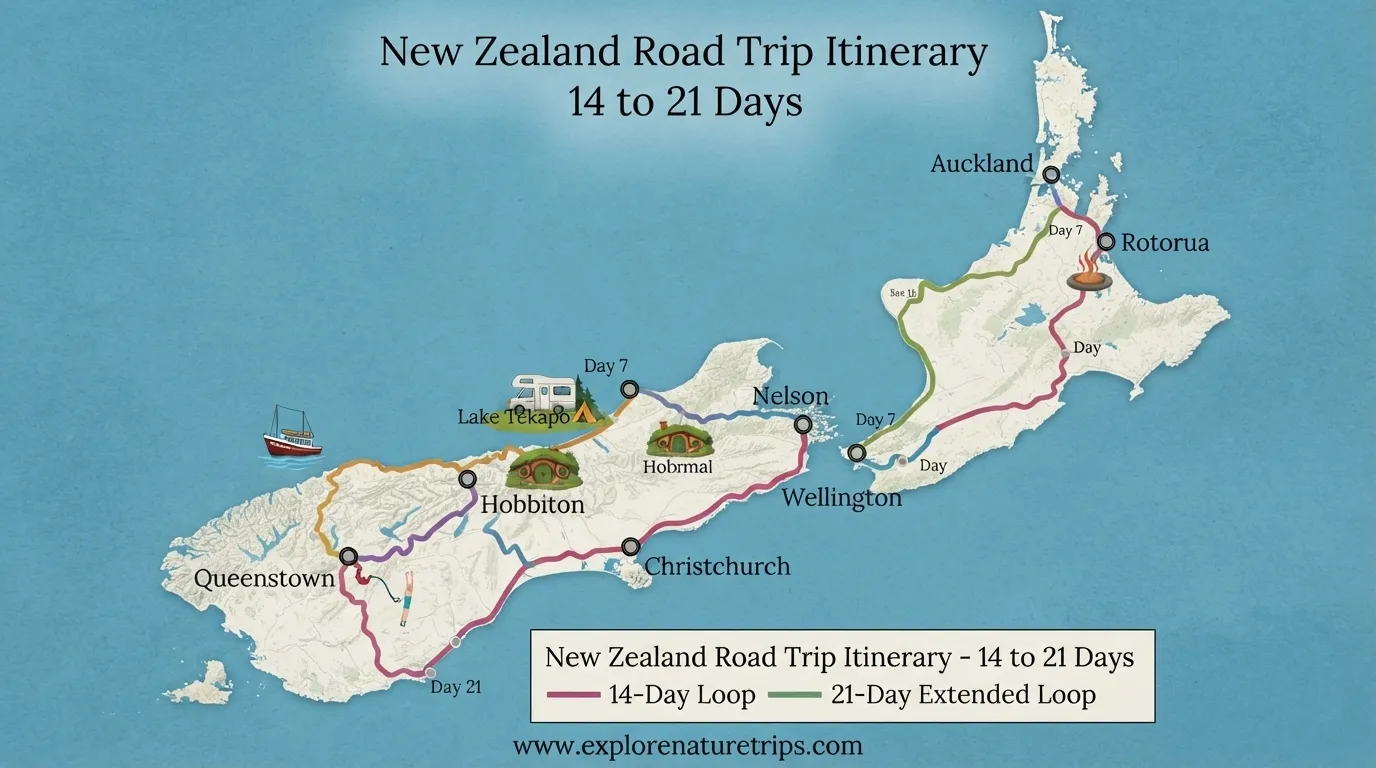
A New Zealand road trip is easiest to enjoy when the route matches the amount of time you actually have. Trying to cover both islands too quickly can turn a scenic vacation into a long series of drives, while allowing enough time creates opportunities for hikes, wildlife, geothermal areas, lakes, mountains, and coastal scenery.
For travelers planning their first major trip, two useful approaches stand out: a 14-day fast itinerary for seeing highlights across both islands and a 21-day itinerary for a more comfortable journey. If you have longer, the trip can be expanded toward 30 days with additional stops and slower travel.
This guide combines those practical route-planning approaches into one easy-to-follow itinerary.
14-Day New Zealand Road Trip Itinerary
A two-week trip requires more careful planning because New Zealand’s two main islands cannot be covered casually in only a few days.
The following route prioritizes major experiences while limiting unnecessary backtracking.
| Day | Location | Main experiences |
|---|---|---|
| 1 | Auckland | City exploration, Sky Tower, waterfront |
| 2 | Waitomo | Glowworm caves |
| 3 | Rotorua | Geothermal attractions and Māori culture |
| 4 | Rotorua | Waimangu, cultural experiences, forest activities |
| 5 | Rotorua → Christchurch | Domestic flight |
| 6 | Oamaru | Victorian precinct, penguins, Steampunk HQ |
| 7 | Oamaru → Twizel / Aoraki | Lake Pukaki and alpine scenery |
| 8 | Aoraki / Mount Cook | Mountain and hiking experiences |
| 9 | Queenstown | Queenstown and nearby adventure options |
| 10 | Queenstown | Milford Sound or Doubtful Sound |
| 11 | Queenstown / South Island | Scenic exploration |
| 12 | Aoraki / Mount Cook | Alpine scenery and onward travel |
| 13 | Tekapo → Christchurch → Auckland | Return journey |
| 14 | Waiheke | Final island experience |
This schedule is intentionally busy. The advantage is that it allows travelers with only two weeks to experience both islands without spending several days on an overland connection.
Important Driving Times for the 14-Day Route
Knowing the approximate journey times helps you understand why transportation choices matter.
| Journey | Approximate time |
|---|---|
| Auckland → Waitomo | 2.5 hours |
| Rotorua → Christchurch flight | 1 hour 55 minutes |
| Christchurch → Oamaru | 3 hours 20 minutes |
| Oamaru → Twizel | 1 hour 45 minutes |
| Oamaru → Aoraki / Mount Cook | 2.5 hours |
| Queenstown → Milford Sound | About 4 hours |
| Te Anau → Milford Sound | About 2 hours |
| Ben Lomond hike with gondola | About 5 hours return |
Days 1–2: Auckland and Waitomo
Start in Auckland, particularly if your international flight arrives there. Use the first day to explore the city and recover from the journey.
Possible highlights include:
- Sky Tower
- Auckland waterfront
- Queen Street
- Viaduct area
- City attractions
On Day 2, drive toward Waitomo.
The drive takes approximately 2.5 hours, making Waitomo a practical next destination.
The major attraction here is the Waitomo Glowworm Caves, which provides a completely different experience from the urban beginning of the trip.
Planning tip: Avoid filling the day with too many additional stops. The cave experience and onward drive already create a useful full-day schedule.
Days 3–4: Rotorua
Continue to Rotorua, one of the strongest stops for geothermal landscapes and Māori cultural experiences.
Spend two days here rather than simply passing through.
Possible experiences include:
- Waimangu Volcanic Valley
- Geothermal landscapes
- Māori cultural experiences
- Te Puia
- Te Pā Tū
- Wai Ariki thermal spa
- Redwoods activities
- Adventure experiences
Rotorua is particularly useful in a two-week itinerary because it combines several different types of experiences in one destination.
Day 5: Rotorua to Christchurch
For a 14-day trip, flying between the islands can save substantial time.
The Rotorua → Christchurch flight is approximately 1 hour 55 minutes.
This is an important strategic choice. A longer overland connection and ferry journey can consume valuable days when the total vacation is only two weeks.
Once in Christchurch, prepare for the South Island portion of the journey.
Day 6: Christchurch to Oamaru
The Christchurch → Oamaru drive takes approximately 3 hours 20 minutes.
Oamaru provides a change of pace after the longer travel day.
Explore:
- Victorian architecture
- Historic precinct
- Whitestone buildings
- Steampunk HQ
- Blue penguin viewing
Oamaru is also useful as an overnight stop because it breaks the journey toward the central South Island.
Days 7–8: Twizel and Aoraki / Mount Cook
Continue toward Twizel and Aoraki / Mount Cook.
The drive from Oamaru to Twizel is approximately 1 hour 45 minutes, while Oamaru to Aoraki / Mount Cook is around 2.5 hours.
Important scenery includes:
- Lake Pukaki
- Aoraki / Mount Cook
- Alpine landscapes
- Mountain viewpoints
- Hiking opportunities
Allowing 2 days around Aoraki / Mount Cook gives the itinerary more breathing room than simply arriving, taking a photograph, and leaving.
Days 9–10: Queenstown and the Fiordland Region
Continue toward Queenstown, one of the major South Island bases.
Queenstown works well for travelers interested in:
- Scenic landscapes
- Adventure activities
- Mountain views
- Hiking
- Lake experiences
Use another day for the Milford Sound or Doubtful Sound area.
Queenstown to Milford Sound takes approximately 4 hours, making this a substantial day if completed as a return journey.
From Te Anau, the journey to Milford Sound is approximately 2 hours, so travelers using this area as a base can structure the day differently.
Days 11–12: South Island Scenic Time
After visiting Queenstown and the Fiordland region, use the next portion of the itinerary for scenic travel and additional time around Aoraki / Mount Cook.
This is where a two-week itinerary needs discipline.
Instead of continuously adding destinations, prioritize the places that matter most to your trip.
Good priorities include:
- Mountain scenery
- Major hikes
- Lakes
- Fiordland
- Scenic drives
- Cultural experiences
This approach keeps the itinerary more manageable.
Days 13–14: Tekapo, Christchurch and Auckland
Move toward Lake Tekapo and then Christchurch.
Day 13 can be used for the Christchurch → Auckland connection, followed by time around Waiheke.
Keep Day 14 relatively light because it is the final day.
A relaxed final day is generally more useful than trying to squeeze another major attraction into an already busy schedule.
21-Day New Zealand Road Trip Itinerary
If you can extend your trip to 21 days, the experience becomes considerably more flexible.
A longer route can connect Auckland, the central North Island, Wellington, Picton, Kaikōura, Christchurch, Aoraki / Mount Cook, Wanaka, Queenstown, Fiordland, the Catlins, Dunedin, Oamaru and Christchurch.
| Day | Base/destination |
|---|---|
| 1 | Auckland |
| 2 | Waipu / Coromandel |
| 3 | Rotorua |
| 4 | Taupō |
| 5 | Tongariro |
| 6 | Wellington |
| 7 | Wellington → Picton |
| 8 | Kaikōura |
| 9 | Christchurch |
| 10 | Lake Tekapo |
| 11 | Aoraki / Mount Cook |
| 12 | Lake Pukaki / Omarama |
| 13 | Wanaka |
| 14 | Queenstown |
| 15 | Glenorchy |
| 16 | Te Anau |
| 17 | Milford Sound |
| 18 | The Catlins |
| 19 | Dunedin |
| 20 | Oamaru |
| 21 | Christchurch |
This longer itinerary is better suited to travelers who want a road-trip experience rather than simply a collection of highlights.
North Island Route
The North Island section can include:
- Auckland
- Waipu
- Coromandel Peninsula
- Rotorua
- Taupō
- Tongariro National Park
- Wellington
This creates a progression from urban attractions to caves, geothermal landscapes, lakes, mountains, and finally the capital.
Auckland
Start with Auckland before moving north or south.
Possible stops include:
- Sky Tower
- Viaduct Harbour
- Wynyard Quarter
- Devonport
- Mount Victoria
The goal is not to spend every available hour sightseeing. A manageable first day is useful after an international flight.
Coromandel and Waipu
The longer itinerary can introduce Waipu Caves and the Coromandel Peninsula.
The Waipu Caves area is approximately 2 hours from Auckland, making it a practical addition when you have enough time.
The Coromandel section can include:
- Hot Water Beach
- Cathedral Cove
- New Chums Beach
These stops add coastal scenery before the route continues toward Rotorua.
Rotorua and Taupō
Rotorua provides geothermal and cultural experiences, while Taupō shifts the focus toward lake and waterfall scenery.
Possible Taupō stops include:
- Lake Taupō
- Huka Falls
- Great Lake Trail
- Māori rock carvings
- Spa Thermal Park
Spending separate days in Rotorua and Taupō prevents the North Island section from becoming overly compressed.
Tongariro National Park
Continue toward Tongariro National Park.
Possible experiences include:
- Tongariro Alpine Crossing
- Taranaki Falls
- Silica Rapids
- Whakapapa Village
- Tawhai Falls
The area deserves flexibility because hiking conditions can influence how much you can realistically accomplish.
Wellington
Finish the North Island portion in Wellington.
Useful stops include:
- Te Papa
- Wellington waterfront
- Cuba Street
- Zealandia
- Mount Victoria
Wellington is also strategically important because it connects the North Island to Picton by ferry.
Wellington to Picton: Ferry or Flight?
This is one of the most important decisions for a New Zealand road trip.
For a longer trip, the Wellington → Picton ferry fits naturally into the itinerary.
The crossing also provides views of the Cook Strait and Marlborough Sounds.
For a strict two-week itinerary, however, an internal flight can make more sense because every travel day matters.
Simple decision rule
- 14 days: consider flying between islands.
- 21 days: the ferry can fit comfortably into the route.
- 30 days: choose based on the experience you want rather than time pressure.
South Island Road Trip
Once you reach Picton, the South Island route can continue through Kaikōura, Christchurch, Lake Tekapo, Aoraki / Mount Cook, Wanaka, Queenstown, Fiordland, the Catlins, Dunedin and Oamaru.
Kaikōura
Kaikōura is a strong stop for wildlife and coastal scenery.
Possible experiences include:
- Whale watching
- Kaikōura Peninsula Track
- Seal colonies
- Coastal viewpoints
Christchurch
Christchurch works as both a destination and a useful transport hub.
Possible attractions include:
- Botanic Gardens
- Hagley Park
- Riverside Market
- Port Hills
- Godley Head
Lake Tekapo
Continue toward Lake Tekapo for lake and mountain scenery.
The area can be used as an overnight base before continuing toward Aoraki / Mount Cook.
Aoraki / Mount Cook
Aoraki / Mount Cook is one of the most important mountain-focused stops on the route.
Possible activities include:
- Hooker Valley Track
- Kea Point
- Tasman Glacier area
- Alpine viewpoints
Give yourself enough time to actually experience the area rather than treating it only as a driving checkpoint.
Wanaka
Next, continue toward Wanaka.
Potential activities include:
- Roy’s Peak
- Isthmus Peak
- Diamond Lake
- Rocky Mountain
- #ThatWanakaTree
Wanaka is particularly useful as a slower transition between the Mount Cook region and Queenstown.
Queenstown
Queenstown provides a natural base for adventure and scenic experiences.
Possible stops include:
- Skyline Gondola
- Queenstown Gardens
- Shotover River
- Moke Lake
If hiking is part of your plan, leave enough time rather than trying to combine every attraction into one day.
Glenorchy
A longer itinerary can dedicate a day to Glenorchy.
Possible stops include:
- Glenorchy Road
- Paradise Valley
- Glenorchy Wharf
- Routeburn Track
The area adds another scenic drive without requiring a major change to the overall route.
Te Anau and Milford Sound
Continue to Te Anau before exploring Milford Sound.
The Te Anau area offers:
- Te Anau Glowworm Caves
- Lakefront scenery
- Lake Mistletoe Track
- Access toward Milford Sound
The Milford route itself includes scenery such as:
- Mirror Lakes
- Eglinton Valley
- The Chasm
- Milford Sound
Because Queenstown → Milford Sound is approximately 4 hours, travelers should avoid underestimating this day.
The Catlins
After Fiordland, a longer itinerary can move toward The Catlins.
Possible stops include:
- Nugget Point Lighthouse
- Purakaunui Falls
- McLean Falls
- Curio Bay
- Cathedral Caves
This region helps break up the major tourist centers with a more nature-focused section of the road trip.
Dunedin and Oamaru
Continue to Dunedin and then Oamaru.
Dunedin highlights can include:
- Larnach Castle
- Baldwin Street
- Otago Peninsula
- Tunnel Beach
Oamaru offers:
- Historic Precinct
- Steampunk HQ
- Little Blue Penguins
- Bushy Beach
From Oamaru, return toward Christchurch to complete the road trip.
14 Days vs 21 Days: Which Is Better?
| Feature | 14 Days | 21 Days |
|---|---|---|
| Both islands | Yes | Yes |
| Pace | Fast | More relaxed |
| Domestic flight useful | Yes | Optional |
| Ferry practical | Less ideal | Yes |
| Scenic detours | Limited | More flexibility |
| Hiking time | Selective | Better |
| Hidden/smaller stops | Limited | Better |
| Backtracking tolerance | Low | Higher |
| Recommended for first-time full-country trip | Possible | Better |
If you only have two weeks, don’t try to reproduce a three-week itinerary. Select your priorities.
If you have 21 days, take advantage of the extra time rather than simply adding more destinations every day.
How to Choose Between a Car, Campervan and Motorhome
Your vehicle choice changes the entire road-trip experience.
Rental Car
A rental car is useful when:
- You prefer hotels or other accommodation.
- You want easier driving.
- You are traveling as a couple or small group.
- You want maximum flexibility without managing a larger vehicle.
Campervan
A campervan works well for travelers who want:
- Greater accommodation flexibility
- Road-trip freedom
- Camping opportunities
- Fewer hotel changes
Some campervan options are discussed in the range up to 6 berths, while smaller 1-berth and 2-berth options are also available.
Buying a Vehicle
For a short trip, purchasing a vehicle may create unnecessary complexity.
One specifically uses 6 weeks as an important threshold when discussing whether buying a vehicle makes sense.
For a 14- or 21-day holiday, renting is therefore the simpler approach for most travelers following this itinerary model.
Freedom Camping and Longer Road Trips
If you choose a campervan, understand the vehicle’s capabilities before planning remote overnight stops.
That suitable self-contained vehicles can sometimes operate for 3 days or more without needing to dump waste or refill water.
That makes vehicle planning important.
Before selecting a remote camping location, check:
- Vehicle requirements
- Water capacity
- Waste capacity
- Overnight rules
- Road access
- Weather conditions
Convenience should never replace responsible travel.
How to Keep the Itinerary Comfortable
A good itinerary isn’t simply a list of attractions.
Use these principles:
- Keep one main experience as the priority each day.
- Avoid scheduling several long hikes after a long driving day.
- Use towns such as Christchurch, Queenstown and Rotorua as practical bases.
- Add flexibility around weather-sensitive activities.
- Don’t underestimate mountain driving.
- Avoid unnecessary backtracking.
- Build your route around the islands rather than jumping randomly between destinations.
A Simple Daily Planning Formula
For each day, choose:
1 major attraction + 1 optional activity + realistic driving time
For example:
Aoraki / Mount Cook + one hike + accommodation check-in
is generally easier to manage than:
three hikes + multiple viewpoints + several towns + a long evening drive.
Best Time to Take the Road Trip
divides the year into four broad seasons:
| Season | Months |
|---|---|
| Summer | December–February |
| Autumn | March–May |
| Winter | June–August |
| Spring | September–November |
Your choice should depend on the type of experience you want.
Summer can work well for longer outdoor days, while winter changes the character of mountain and alpine destinations. Spring and autumn provide different seasonal scenery.
More importantly, build flexibility into the itinerary rather than assuming every outdoor activity will operate exactly as planned.
What to Pack
A practical road-trip packing list should include:
- Waterproof jacket
- Layered clothing
- Hiking shoes
- Reusable water bottle
- Sunscreen
- Insect repellent
- Power adapter
- Camera
- Binoculars
- Car snacks or cooler
Common Mistakes to Avoid
Trying to See Everything in 14 Days
Two weeks can cover major highlights, but it cannot provide the same relaxed experience as three weeks.
Adding Too Many Long Drives
A four-hour drive can effectively become a full travel day once stops, meals ,and unexpected delays are included.
Ignoring Travel Between Islands
The North and South Islands require deliberate planning. Don’t leave the island connection until the last minute.
Treating Every Day Like a Sightseeing Marathon
You need time to enjoy the places you traveled so far to see.
Booking Without Checking the Route
Accommodation that looks cheap or attractive may create unnecessary backtracking. Build the route first, then book stays.
Frequently Asked Questions
Is 14 days enough for a New Zealand road trip?
Yes. 14 days can cover major North and South Island highlights, but the itinerary needs to remain selective and relatively fast-paced.
Is 21 days better than 14 days?
For a complete two-island road trip, 21 days generally provides a more comfortable balance between driving, hiking, sightseeing and rest.
Can I visit both islands in 14 days?
Yes. A two-week itinerary can include both islands, but using a domestic flight between islands can save valuable travel time.
How long should I spend in New Zealand?
A 20–21 day trip is a strong choice for travelers who want a broad North and South Island road trip without rushing every destination.
How long does Auckland to Waitomo take?
The journey is approximately 2.5 hours according to the itinerary planning information used for this route.
How long is the Rotorua to Christchurch flight?
The flight takes approximately 1 hour 55 minutes.
How long does Christchurch to Oamaru take?
The drive is approximately 3 hours 20 minutes.
How long does Oamaru to Twizel take?
The drive takes approximately 1 hour 45 minutes.
How long does Queenstown to Milford Sound take?
The drive takes approximately 4 hours, making it a significant day trip from Queenstown.
Is the Wellington to Picton ferry useful?
Yes. It works particularly well on a 21-day or longer road trip. For a strict 14-day schedule, flying can save time.
Should I rent a car or campervan?
A rental car is convenient for travelers using accommodation, while a campervan provides more flexibility for travelers who specifically want a camping-focused road trip.
Can I do this itinerary in 10 days?
You can create a shorter itinerary, but you should focus on fewer destinations. Trying to fit the entire 21-day route into 10 days would create an unnecessarily demanding schedule.
Final Road Trip Strategy
The best New Zealand road trip itinerary isn’t the one with the most destinations. It is the one that gives you enough time to enjoy the destinations you choose.
For 14 days, focus on Auckland, Waitomo, Rotorua, Christchurch, Oamaru, Aoraki / Mount Cook, Queenstown and the Fiordland region, using a flight between islands to save time.
For 21 days, take the opportunity to slow down and add Wellington, Picton, Kaikōura, Lake Tekapo, Wanaka, Glenorchy, Te Anau, the Catlins, Dunedin and Oamaru.
The most important numbers are simple: 14 days for a fast two-island trip, 21 days for a more comfortable complete route, and up to 30 days when you want substantially more flexibility.
Plan the route first, keep daily driving realistic, and leave enough space for the landscapes and experiences that make a New Zealand road trip worthwhile.

Hi, I’m Marcus! I love exploring the outdoors and discovering incredible places. Through ExploreNatureTrips blog, I share my travel experiences, useful tips, and recommendations for the best sights, trails, and destinations to visit.