Lake Michigan Road Trip: 1,100-Mile Route & 7-Day Guide
A Lake Michigan road trip is a great way to combine big-city attractions, beaches, dunes, lighthouses, forests, small towns, scenic highways, food, and family activities in one journey.
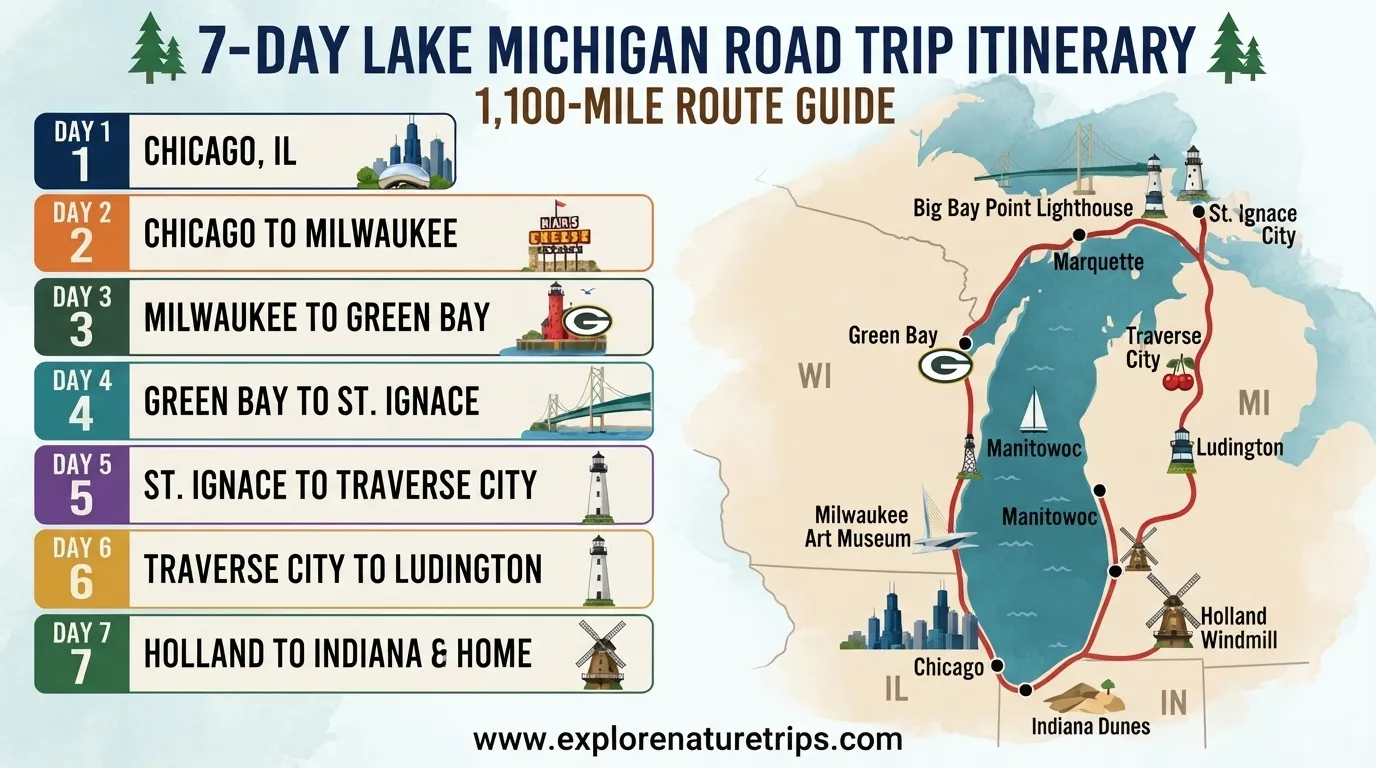
The complete loop around the lake is approximately 1,100 miles and passes through Illinois, Indiana, Michigan, and Wisconsin. Depending on how much time you have, the route can be attempted in about 4 days, explored more comfortably over 5–7 days, or stretched into a 7–10 day vacation. Travelers who prefer slow travel can spend a month or longer exploring individual sections.
Driving the entire loop without meaningful stops takes roughly 15–17 hours, depending on the route and calculation used. However, rushing around the lake misses much of what makes this trip worthwhile. The better approach is to divide the drive into manageable sections and leave time for beaches, trails, towns, food, and viewpoints.
A 7-Day Lake Michigan Road Trip Itinerary
Day 1: Chicago
Start in Chicago, one of the strongest entry points for a Lake Michigan journey.
The city provides an immediate contrast between a large urban skyline and the lakefront. Popular stops mentioned across include:
- Millennium Park
- Chicago Riverwalk
- Navy Pier
- Art Institute of Chicago
- Lake Shore Drive
- Deep-dish pizza
- Chicago-style hot dogs
For families, the Chicago Riverwalk is especially useful because its trail extends approximately 1.25 miles and is paved. Family boat tours are another option, with one architecture cruise taking 90 minutes and a shorter option lasting 45 minutes.
Families can also consider the Shedd Aquarium, which houses approximately 32,000 animals, or the Field Museum, home to the famous 40-foot T. rex skeleton Sue.
Day 2: Chicago to Milwaukee
Leave Chicago and head north toward Milwaukee.
Milwaukee adds a different personality to the journey with lakefront attractions, museums, food, breweries, and easy access to Wisconsin’s shoreline.
Roadtrippers highlights the Milwaukee Art Museum, whose distinctive wing-like structure opens and closes during the day. From Milwaukee, travelers can continue north toward Harrington Beach State Park, which features a 1-mile beach on Lake Michigan.
For families, Milwaukee can also work as a practical overnight stop before continuing toward Green Bay and Door County.
Day 3: Milwaukee to Green Bay and Door County
Continue north through Wisconsin.
Possible stops include:
- Sheboygan
- Kohler
- Manitowoc
- Two Rivers
- Sturgeon Bay
- Door County
- Green Bay
- Lambeau Field
Roadtrippers recommends Highway 42 as a scenic alternative through Two Rivers toward Sturgeon Bay and Door County.
Door County is particularly useful if you prefer a slower day with small-town scenery, food, waterfront stops, and outdoor activities.
For families, the Door County itinerary can include:
- Cave Point
- Eagle Tower
- Peninsula State Park
- Mini golf
- Boat tours
- Cherry stops
- Wineries
These stops are especially suited to travelers who want activities beyond simply driving from one city to another.
Day 4: Green Bay to Michigan’s Upper Peninsula
Cross into Michigan and continue through the Upper Peninsula.
Important stops include:
- Menominee
- Escanaba
- O.B. Fuller County Park
- Sand Point Lighthouse
- Upper Hand Brewery
- Highway 2
- St. Ignace
At O.B. Fuller County Park, Roadtrippers highlights 5 campsites directly on the lake. Nearby, Sand Point Lighthouse was established in 1867.
This section is a good place to slow down. Long stretches of forest, waterfront scenery, and smaller communities create a noticeable change from Chicago and Milwaukee.
Day 5: Mackinaw City, Mackinac Area and Traverse City
One of the most memorable engineering landmarks on the route is the Mackinac Bridge.
The bridge stretches nearly 5 miles, with approximately 1.4 miles suspended. Crossing it connects the Upper and Lower Peninsulas and marks a major transition in the road trip.
Possible stops include:
- Mackinaw City
- Colonial Michilimackinac
- Old Mackinac Point Lighthouse
- Mackinac Island
- Harbor Springs
- Petoskey
- Traverse City
If you are traveling during the attraction season, check opening dates before committing to a specific schedule. Colonial Michilimackinac is listed as opening May 6 and closing October 11 in the 2026 planning guide.
Day 6: Traverse City and Sleeping Bear Dunes
Traverse City makes an excellent base for exploring Northern Michigan.
The area connects travelers with:
- Grand Traverse Bay
- Old Mission Peninsula
- Leelanau Peninsula
- Wineries
- Cider houses
- Cherry orchards
- Leland’s Fishtown
- Sleeping Bear Dunes
The M-22 scenic route is one of the major driving highlights. The Milwaukee Magazine itinerary describes it as approximately 116 miles, running through areas including the Leelanau Peninsula, Leland and Manistee.
Nearby Sleeping Bear Dunes National Lakeshore offers some of the trip’s most dramatic scenery. The dunes rise approximately 450 feet above Lake Michigan, making this a destination where you should allow time for walking, viewpoints, and photography rather than treating it as a quick roadside stop.
Day 7: Ludington, Holland and Indiana Dunes
Continue south toward Ludington and western Michigan.
At Ludington State Park, the Big Sable Point Lighthouse can be reached by a 1.8-mile hike through the dunes. The park also provides opportunities for swimming, fishing, kayaking, biking, and camping.
Continue toward:
- Holland
- South Haven
- Benton Harbor
- New Buffalo
- Indiana Dunes National Park
- Chicago
Holland combines lakeshore scenery with Dutch heritage. Windmill Island Gardens is one of its signature attractions, while Holland State Park provides access to the famous Big Red Lighthouse.
Indiana Dunes: A Strong Final Nature Stop
Indiana Dunes National Park is one of the most useful stops near the end of a Chicago-centered loop.
The park protects more than 15,000 acres according to Roadtrippers and includes approximately 15 miles of shoreline and more than 50 miles of hiking trails according to The Nature Seeker.
Possible activities include:
- Beach walks
- Hiking
- Dune climbing
- Wildlife viewing
- Photography
- The 3 Dune Challenge
- Diana of the Dunes Dare
The park is also only about 1 hour from Chicago, making it convenient for travelers who want one final nature-focused stop before completing the loop.
Best Time for a Lake Michigan Road Trip
Your travel season can significantly change the experience.
May to June
Late spring provides:
- Fewer crowds
- Mild temperatures
- Wildflowers
- Dune hiking opportunities
- Early seasonal attractions
However, the lake can still be cold for swimming, and some attractions operate reduced schedules.
July to August
Summer is the busiest period and generally offers:
- Warm water
- Long daylight hours
- Beach activities
- Festivals
- Full attraction schedules
The trade-off is heavier traffic, higher prices, and greater demand for waterfront accommodation.
September to October
Early fall can be an excellent compromise.
You may get:
- Fewer crowds
- Cooler temperatures
- Fall foliage
- Scenic M-22 drives
- Lower accommodation demand
- Good attraction availability through much of the season
The 2026 planning guide notes that Colonial Michilimackinac closes October 11, while Windmill Island Gardens closes October 4, so late-season travelers should check individual schedules carefully.
November to April
Winter brings a completely different experience, but many seasonal attractions close during this period.
The Michigan portion also has shorter daylight hours, so morning departures become particularly important. Sand Point Lighthouse, for example, is listed as closing at 4 p.m.
Don’t Miss These Scenic Drives
M-22
M-22 is one of the most attractive driving sections in Northern Michigan.
The route is approximately 116 miles and connects scenery around Traverse City, the Leelanau Peninsula, Leland, and Manistee.
Allow extra time for viewpoints and small-town stops instead of treating it purely as a transport route.
Tunnel of Trees
The Tunnel of Trees is approximately 20 miles long and runs between Cross Village and Harbor Springs.
It is particularly appealing during fall when the surrounding forest becomes part of the experience.
Blue Star Highway
Another scenic option is the Blue Star Highway, described in the Milwaukee Magazine itinerary as approximately 45 miles long.
It connects areas around Saugatuck, Benton Harbor and St. Joseph and provides access to beaches, breweries, orchards, and other local stops.
Lake Michigan Time Zone Tip
One of the easiest details to overlook is the time-zone change.
Illinois, Wisconsin,n and northwestern Indiana use Central Time, while Michigan uses Eastern Time. When crossing into Michigan, set the clock one hour forward. When returning toward Indiana or Wisconsin, set it back one hour.
This matters if you have timed tours, lighthouse visits, ferry plans, or attraction reservations.
A simple planning rule is:
Crossing into Michigan = +1 hour.
Chicago Traffic Planning
If Chicago is part of your itinerary, timing your departure can save considerable frustration.
The 2026 local guide identifies 3:30 p.m. to 7 p.m. on weekdays as a particularly difficult period for northbound I-94 traffic. Friday summer afternoons can be especially challenging.
If your itinerary allows, consider leaving Chicago before noon or after 7 p.m. rather than building your schedule around the afternoon peak.
Lake Michigan Road Trip With Kids
A family road trip requires a slightly different strategy from an adults-only itinerary.
The Milwaukee Magazine family trip involved children aged 5 and 7 and lasted 8 days. The family used an alphabet road game from A to Z to keep children engaged during the drive.
MummyTravels also structures its itinerary around children, with 2 days in Chicago followed by stops through Wisconsin and Door County.
Family-friendly ideas
- Keep driving days manageable.
- Schedule regular outdoor breaks.
- Mix museums with beaches and parks.
- Use simple road games.
- Reserve popular restaurants when possible.
- Keep snacks and drinks accessible.
- Avoid making every stop another long hike.
- Leave flexibility for weather and children’s energy levels.
A successful family itinerary does not need to maximize the number of attractions. It should balance driving, play, food, rest, and exploration.
What to Pack
A Lake Michigan route can involve beaches, dunes, forests, cities, es and changing weather, so a flexible packing list is useful.
Road-trip essentials
- Comfortable walking shoes
- Lightweight layers
- Swimwear
- Rain jacket or windbreaker
- Sunglasses
- Hat
- Sun protection
- Reusable water bottle
- Snacks
- Picnic supplies
- Phone/camera storage
- Hiking footwear
People Also Ask
How long is a Lake Michigan road trip?
The complete loop is approximately 1,100 miles. Driving without stops can take roughly 15–17 hours, but a practical vacation is better planned for at least 5–7 days.
How many states does the Lake Michigan loop cover?
The complete route passes through 4 states: Illinois, Indiana, Michigan, and Wisconsin.
Is 7 days enough for a Lake Michigan road trip?
Yes. 7 days provides a useful balance between driving and sightseeing. It allows time for Chicago, Wisconsin, Michigan’s Upper Peninsula, Northern Michigan, western Michigan, and Indiana Dunes without requiring a nonstop schedule.
What is the best month for a Lake Michigan road trip?
Identify May–June, July–August, and September–October as useful seasonal windows for different travel styles. Summer provides the strongest beach experience, while early fall offers fewer crowds and colorful scenery.
Is Lake Michigan in more than one time zone?
Yes. The route crosses 2 time zones. Illinois, Wisconsin, and northwestern Indiana use Central Time, while Michigan uses Eastern Time.
What is the most scenic road around Lake Michigan?
M-22 is one of the standout scenic drives, covering approximately 116 miles through Northern Michigan. The 20-mile Tunnel of Trees is another memorable section, particularly during fall.
Is Lake Michigan a good road trip for families?
Yes. Itineraries specifically demonstrate family-oriented trips lasting 7–8 days, with museums, beaches, wildlife parks, boat tours, mini golf, food stops and outdoor activities incorporated into the route.
What should you not miss on the route?
For a first trip, prioritize Chicago, Milwaukee, Door County, Mackinac Bridge, Traverse City, Sleeping Bear Dunes, Ludington, Holland, and Indiana Dunes. These destinations provide a mix of cities, scenery, beach parks,s and cultural experiences drawn from the five itineraries.
Final Planning
A Lake Michigan road trip works best when you treat the 1,100-mile loop as a collection of experiences rather than a mileage challenge.
A 7-day itinerary is a strong starting point: spend time in Chicago, move through Milwaukee and Wisconsin, cross Michigan’s Upper Peninsula, explore Northern Michigan, follow scenic roads such as M-22, visit Sleeping Bear Dunes and western Michigan beaches, and finish through Indiana Dunes.
Most importantly, build extra time into the itinerary. The best parts of the journey are often the unexpected beach, lighthouse, small town, scenic viewpoint, local meal, or short trail that makes you want to stay longer.

Hi, I’m Marcus! I love exploring the outdoors and discovering incredible places. Through ExploreNatureTrips blog, I share my travel experiences, useful tips, and recommendations for the best sights, trails, and destinations to visit.