
Joshua Tree National Park Guide: Hikes, Tips & Itinerary
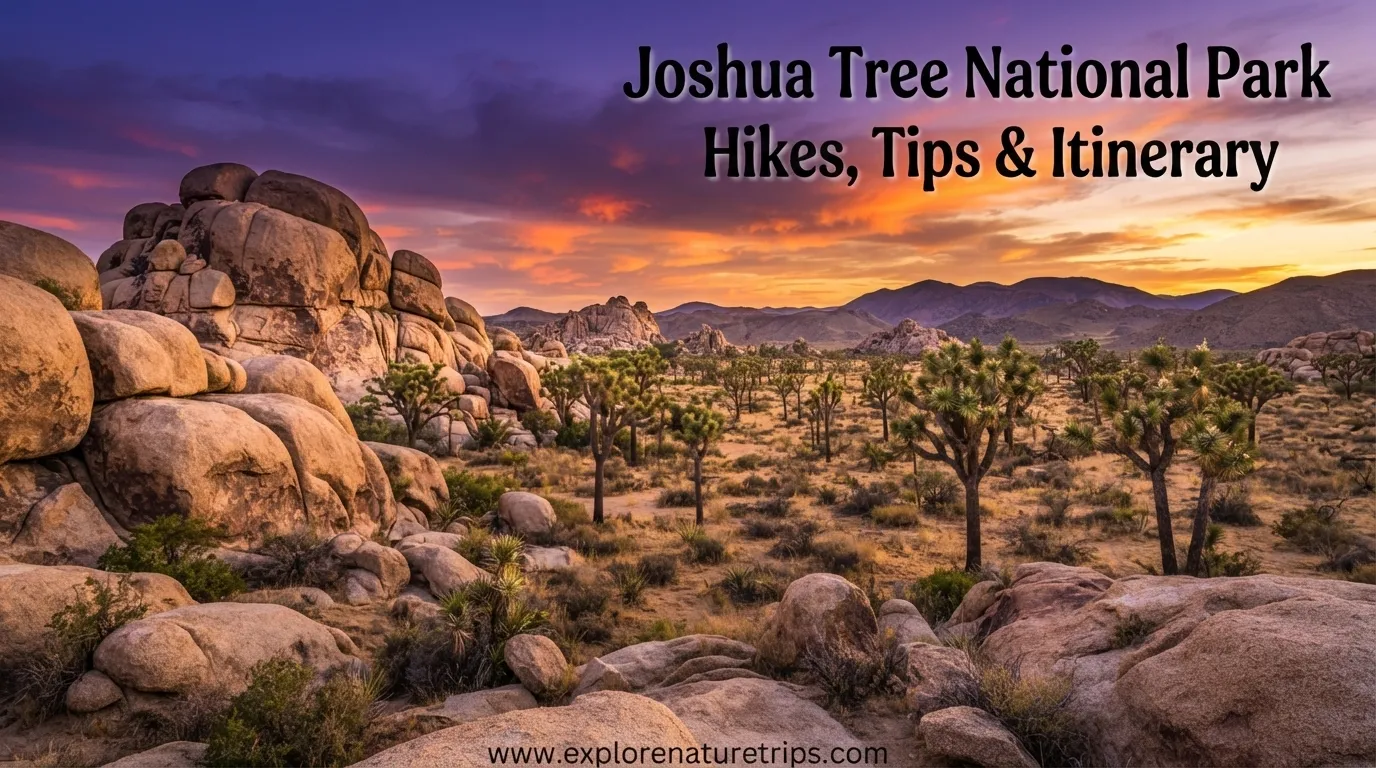
Joshua Tree National Park is a desert destination where the Mojave Desert and Colorado Desert meet. Its combination of twisted Joshua trees, enormous granite formations, cactus gardens, open desert, historic mining sites, and exceptionally dark skies gives the park a character that is very different from California’s other major outdoor destinations.
The park covers approximately 1,235 square miles (3,200 square kilometers), while another visitor guide describes it as covering more than 790,000 acres. Elevation varies dramatically, from roughly 536 feet in the Colorado Desert to more than 5,800 feet in the mountain areas.
For a first visit, don’t treat Joshua Tree as simply a scenic drive. Several of the most rewarding experiences require getting out of the vehicle and walking among the rocks, trees, desert plants, and historic sites.
When Is the Best Time to Visit Joshua Tree?
The most comfortable periods highlighted by the guides are March through May and October through November. These months generally provide a better balance between daytime hiking conditions and cooler desert nights.
Spring is especially appealing for hiking and exploring the park before summer heat becomes intense. Fall brings comfortable daytime conditions, although nights can become surprisingly cold.
One visitor reported daytime temperatures already reaching the mid-80s°F in May, while a November camping trip experienced nighttime temperatures in the 20s°F. That contrast illustrates why packing layers matters even when the daytime forecast looks pleasant.
Seasonal Conditions
| Season | What to Expect |
|---|---|
| March–May | Comfortable hiking period; spring desert scenery |
| June–August | Very hot daytime conditions; early starts are preferable |
| September–November | Cooling temperatures; October and November are particularly appealing |
| December–February | Pleasant days can occur, but nights may be very cold at higher elevations |
National-Parks.org gives lower-elevation summer daytime temperatures around 100–110°F, while winter nights can fall to approximately 35–48°F in lower areas and 25–40°F at higher elevations.
A Simple Rule for Planning
If hiking is a priority, March, April, or October are particularly useful choices based on the firsthand experiences described by Destination Daydreamer.
Summer visitors should plan outdoor activities around the cooler parts of the day and carry enough water because shade is limited across much of the park.
How to Get to Joshua Tree National Park
Joshua Tree is a driving-oriented park, so having a vehicle is important for seeing multiple areas. One California Through My Lens guide notes that there is no shuttle system for getting around the park.
Approximate Airport Driving Times
| Airport | Approximate drive |
|---|---|
| Palm Springs Airport | 40–45 minutes |
| John Wayne Airport | 2 hours |
| Los Angeles Airport | 2.5 hours |
| Hollywood Burbank Airport | 2.5 hours |
| San Diego Airport | 2.75 hours |
Los Angeles is commonly described as about 2.5 hours away, although actual travel can be considerably longer during heavy traffic. One firsthand account describes a trip that normally takes around 2 hours stretching to almost 4 hours.
Download maps before entering remote areas and consider carrying a paper map as a backup because mobile service can be unreliable.
How Many Days Do You Need?
For a quick overview, 1 day can cover several famous sights. However, 2 full days or 2–3 nights gives you much more flexibility.
Destination Daydreamer recommends at least 2 full days if you want to combine the national park with the nearby towns, while National-Parks.org also presents 2–3 days as a useful timeframe for a broader visit.
Suggested Time Breakdown
| Trip length | Best use |
|---|---|
| 1 day | Major viewpoints, short walks and famous formations |
| 2 days | Major sights + several hikes + sunset/stargazing |
| 3 days | More hiking, climbing, history and nearby towns |
| 4–5 days | Slower exploration and additional desert experiences |
The key advantage of staying longer is not simply seeing more attractions. It allows you to visit during better light, spend time outside the vehicle, and avoid turning the trip into a rushed checklist.
Best Things to Do in Joshua Tree National Park
Explore Hidden Valley
Hidden Valley is one of the strongest choices for a first visit. Large rock formations surround the area, creating an enclosed desert landscape filled with Joshua trees and boulders.
The short trail makes it accessible to visitors who don’t want a strenuous hike, while the surrounding rocks also appeal to climbers and photographers.
See Skull Rock
Skull Rock is one of the park’s most recognizable formations. Natural indentations in the granite give the rock its skull-like appearance.
One of its biggest advantages for visitors is convenience: it can be viewed close to the road, so you don’t need a long hike to experience it.
Visit Keys View
Keys View is one of the park’s signature viewpoints. From the viewpoint area, visitors can look across the Coachella Valley toward distant mountains.
The short walk from the parking area is approximately 0.1 mile, making it an easy addition to a day of sightseeing.
Sunset is particularly attractive here, but arriving early can help you find parking and choose a good viewing position.
Walk Through the Cholla Cactus Garden
The Cholla Cactus Garden provides a completely different landscape from the boulder-filled areas farther north.
The trail is approximately 0.25 mile and relatively flat. Destination Daydreamer notes that cholla may bloom between January and August, although flowering naturally depends on conditions.
Visit Barker Dam
The Barker Dam Trail is an easy walk of about 1 mile according to Destination Daydreamer.
Along the route, visitors encounter boulder formations, Joshua trees, pictographs, and the historic dam. The site also provides an opportunity to connect the landscape with the area’s ranching history.
Explore Oasis of Mara
Oasis of Mara offers something different from the park’s rocky landscapes.
The paved walk is approximately 0.5 mile and leads from the visitor center toward palm trees and informational displays associated with the area’s history.
National-Parks.org notes that the park contains 5 desert palm oases, making these water-associated landscapes an important part of Joshua Tree’s ecological story.
Best Joshua Tree Hikes
Joshua Tree offers everything from short walks to demanding mountain climbs. Choosing the right trail is more important than trying to complete as many as possible.
Easy Trails
| Trail | Distance | Experience |
|---|---|---|
| Hidden Valley | 1 mile loop | Rocks, Joshua trees and scenery |
| Barker Dam | 1–1.3 miles | History, boulders and pictographs |
| Oasis of Mara | 0.5 mile | Palms and desert history |
| Cholla Cactus Garden | 0.25 mile | Cactus landscape |
| Arch Rock | About 1.2–1.4 miles | Rock formations |
Distances vary slightly between the guides because some describe different route measurements or trail configurations.
Ryan Mountain
Ryan Mountain is one of the park’s more demanding popular hikes.
- Distance: 3 miles round trip
- Elevation gain: approximately 1,050 feet
- Shade: Very limited
- Summit: 360-degree views
The climb provides a different perspective from the lower desert trails, but the elevation gain and exposure make water, sun protection, and appropriate timing important.
Panorama Loop
The Panorama Loop Trail is approximately 6.4 miles with around 1,194 feet of elevation gain.
Because the trail offers limited shade, proper hydration and sun protection are particularly important.
Lost Horse Mine
Lost Horse Mine combines hiking with the park’s mining history.
Two route options highlighted by Destination Daydreamer are:
- 4 miles round trip to Lost Horse Mine
- 6.5 miles round trip via Lost Horse Loop
The mine dates from the late 1800s to early 1900s and provides a look at the area’s historic mining period.
49 Palms Oasis
The 49 Palms Oasis Trail is approximately 3 miles round trip.
The palms were planted by miners in the early 1900s to mark the location of a natural spring. Because much of the approach has little shade, visitors should carry sufficient water.
Joshua Tree for Rock Climbers and Bouldering
Joshua Tree is not only a hiking destination. It is also a major climbing area.
Destination Daydreamer reports more than:
- 8,000 climbing routes
- 2,000 boulder problems
That scale makes climbing one of the park’s defining recreational activities.
Beginners can consider guided experiences rather than attempting unfamiliar climbing techniques without instruction.
The combination of granite formations, boulders, and desert surroundings makes the activity feel integrated with the landscape rather than separated from it.
Geology Tour Road
The Geology Tour Road is another way to experience the park beyond the standard paved sightseeing route.
The road extends approximately 18 miles and includes 16 stops/information points according to Destination Daydreamer’s guide. Farther sections may require a 4×4 vehicle.
This is best treated as an experience that requires additional preparation rather than a casual shortcut.
Check the road conditions before committing to a remote route, carry adequate supplies, and avoid assuming that a standard passenger vehicle can safely travel every section.
Joshua Tree’s Mining and Human History
Joshua Tree’s scenery isn’t only geological. Mining and ranching history are visible throughout the landscape.
California Through My Lens highlights that the park contains more than 200 mines, including:
- Lost Horse Mine
- Desert Queen Mine
- Silver Bell Mine
Historical locations such as Keys Ranch and Samuelson Rocks add another layer to the visit.
The history of Joshua Tree extends further back, with Indigenous peoples connected to the desert landscape before later settlement and mining activity. The park’s cultural story is therefore much broader than its famous Joshua trees and rock formations.
Where to Stay Near Joshua Tree
The three main communities surrounding the park are:
- Joshua Tree
- Twentynine Palms
- Yucca Valley
They are all relatively close to park access points and offer different combinations of hotels, vacation rentals, camping, and unique desert accommodation.
Camping Options
Jumbo Rocks Campground is highlighted for its large surrounding rock formations.
Hidden Valley Campground is noted as first-come, first-served in Destination Daydreamer’s guide.
Cottonwood Campground provides access to the Cottonwood Spring area and is another camping option.
It specifically notes that Jumbo Rocks and Cottonwood require reservations during peak season from September through May, while Hidden Valley is first-come, first-served.
Always verify current campground rules before a trip because reservation policies can change.
Stargazing in Joshua Tree
Joshua Tree’s dark desert environment makes nighttime one of the most memorable parts of the experience.
Good planning matters because there is limited artificial light inside much of the park. A useful evening kit includes:
- Headlamp or flashlight
- Extra batteries
- Warm layer
- Chair or blanket
- Offline map
- Water
- Camera or phone tripod
A red light can also help preserve night vision.
Stargazing can be combined with sunset rather than treated as a completely separate activity: arrive before sunset, watch the landscape change, then stay after dark as the sky becomes clearer.
Food and Nearby Town Experiences
There is no food service throughout the park, so visitors should plan meals and water before heading into remote areas.
Nearby options mentioned by the park include:
- Crossroads Cafe
- Jelly Donut
- Algoberto’s Taco Shop
- Natural Sisters Cafe
- Pie for the People
- Pappy and Harriet’s
The Joshua Tree Farmers’ Market is described as taking place every Saturday from 8 AM to 1 PM.
Pioneer Town
About 10 miles from Joshua Tree, Pioneer Town was built in 1940 as a movie set and has developed into a distinctive desert attraction with old-West-style buildings and businesses.
It works well as an add-on after spending the main part of the day inside the national park.
A Practical 2-Day Joshua Tree Itinerary
Day 1 — Classic Joshua Tree
Morning
- Enter the park early
- Visit Hidden Valley
- Explore nearby rock formations
- Take the Barker Dam walk
Afternoon
- Continue toward Skull Rock
- Stop at additional roadside formations
- Visit the Cholla Cactus Garden
Evening
- Drive toward Keys View
- Watch sunset
- Stay for stargazing if conditions are suitable
Day 2 — Hiking and History
Morning
Choose one larger activity:
- Ryan Mountain
- Lost Horse Mine
- Panorama Loop
- 49 Palms Oasis
Afternoon
- Explore another historical or geological attraction.
- Visit a nearby town
- Have a meal outside the park
Evening
- Return to Joshua Tree or Twentynine Palms
- Relax or enjoy another night-sky session
This structure leaves enough flexibility to adjust your day according to temperature, hiking ability, and energy rather than forcing every attraction into one schedule.
What to Pack for Joshua Tree
Desert conditions reward preparation.
Essentials
- Plenty of water
- Sun protection
- Hat
- Sunglasses
- Comfortable hiking shoes
- Lightweight layers
- Warm layer for nighttime
- Snacks
- Offline maps
- Phone/camera
- Headlamp or flashlight
- First-aid supplies
Do not underestimate the temperature difference between daytime and nighttime. A warm afternoon does not guarantee a warm evening, particularly during colder months and at higher elevations.
Water Is Especially Important
One of the most important practical points from this is that visitors should not depend on finding water inside the park.
Carry what you need before starting remote hikes or drives. This is especially important during hot weather and on exposed trails such as Ryan Mountain and Panorama Loop.
Joshua Tree National Park FAQs
How many days should you spend in Joshua Tree National Park?
Two full days or 2–3 nights is a strong starting point for seeing major attractions, hiking, enjoying sunset, and exploring nearby communities. A single day works for a highlights-focused visit, while longer stays allow a slower pace.
What are the best months to visit Joshua Tree?
The strongest months identified by the guides are March–May and October–November. March, April, and October are particularly attractive for visitors prioritizing comfortable outdoor exploration.
Is Joshua Tree very hot?
It can be. National-Parks.org describes summer daytime temperatures in lower elevations reaching approximately 100–110°F. Shade is limited in many areas, so early starts, hydration, and sun protection are important.
What are the easiest hikes in Joshua Tree?
Good shorter options include Hidden Valley, Barker Dam, Oasis of Mara, Cholla Cactus Garden, and Arch Rock. Trail distances vary from roughly 0.25 mile to around 1.4 miles depending on the route.
Is Ryan Mountain difficult?
Ryan Mountain is more demanding than the park’s short walks. The trail is approximately 3 miles round trip with about 1,050 feet of elevation gain and little shade.
Can you go rock climbing in Joshua Tree?
Yes. Joshua Tree is a major climbing and bouldering destination, with Destination Daydreamer reporting more than 8,000 climbing routes and 2,000 boulder problems. Beginners can consider guided climbing experiences.
What towns are closest to Joshua Tree National Park?
The three main nearby communities highlighted in the guide are Joshua Tree, Twentynine Palms, and Yucca Valley. Each provides accommodation and places to eat outside the park.
Is Joshua Tree good for stargazing?
Yes. The park’s dark desert environment makes stargazing one of its major attractions. Staying after sunset can transform the experience from a daytime sightseeing trip into a completely different desert adventure.
Does Joshua Tree have historical sites?
Yes. The park contains historic mining and ranching locations, including Lost Horse Mine and Keys Ranch. California Through My Lens also highlights the park’s extensive mining history, mentioning more than 200 mines.
Final Planning Advice
Joshua Tree is easiest to enjoy when you resist the temptation to see everything at once. Choose a few short walks, one longer hike if conditions allow, a major viewpoint for sunset, and enough time to experience the desert after dark.
The most useful combination for a first visit is simple: 2 days, comfortable weather, plenty of water, offline navigation, appropriate layers, and an early start.
The park’s greatest strength is its variety. Within one trip, you can walk through Joshua Tree woodland, scramble around granite boulders, explore mining history, watch the sunset from a high viewpoint, and finish the day beneath a dark desert sky.

Hi, I’m Marcus! I love exploring the outdoors and discovering incredible places. Through ExploreNatureTrips blog, I share my travel experiences, useful tips, and recommendations for the best sights, trails, and destinations to visit.
2 Comments