West Coast Road Trip Ideas: 19 Scenic Routes & Itineraries
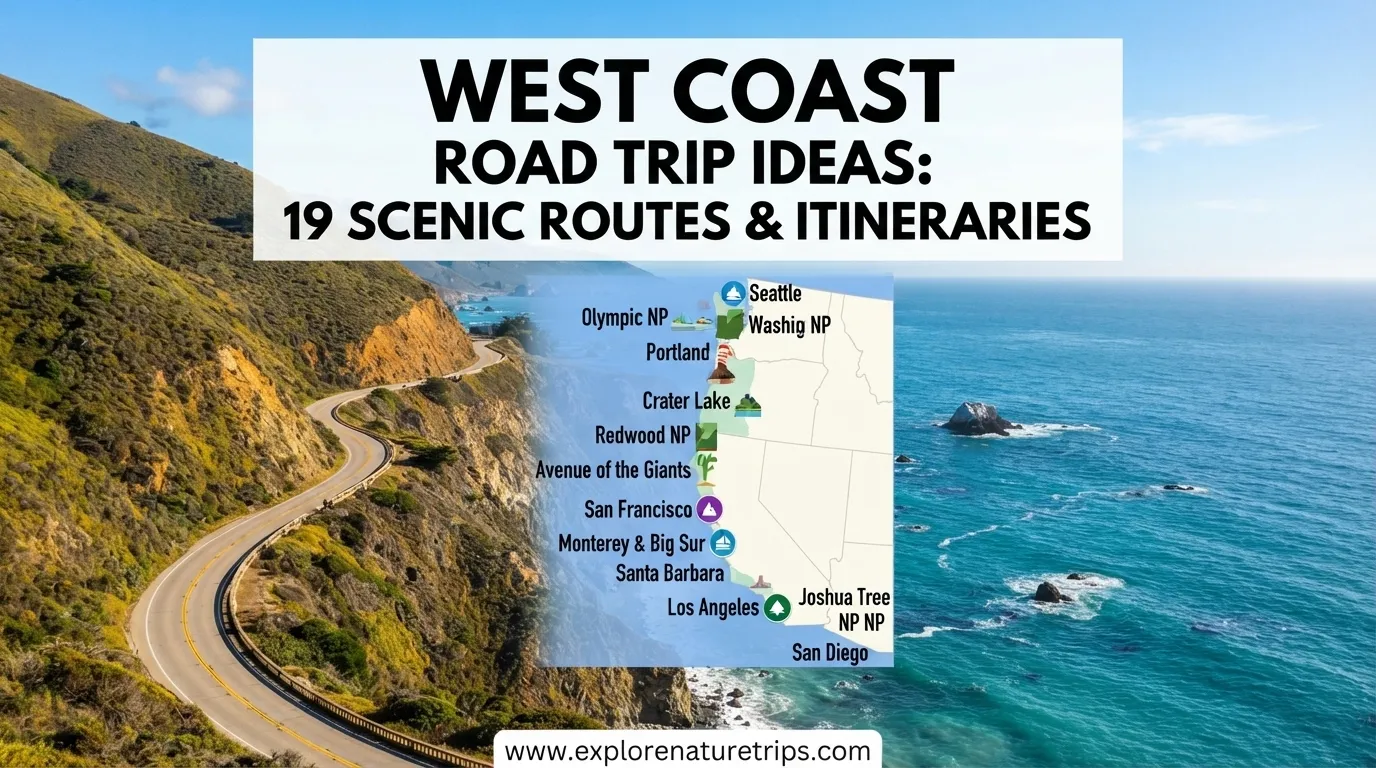
A West Coast road trip can be a short coastal escape, a week-long national park adventure, or a month-long journey through California, Oregon, Washington, and beyond.
The biggest mistake is trying to see everything at once. The West Coast combines Pacific beaches, redwood forests, mountain passes, deserts, wine country, waterfalls, national parks, and major cities, so choosing a focused route usually creates a much better experience.
For first-time travelers, a practical approach is to choose one of four styles:
| Trip style | Good for | Suggested time |
|---|---|---|
| Coastal road trip | Beaches, viewpoints, towns | 7–14 days |
| National park trip | Hiking and scenery | 10–21 days |
| Pacific Northwest trip | Forests, mountains, waterfalls | 5–10 days |
| Grand West Coast loop | A little of everything | 21–30 days |
The routes below give you options at different distances and trip lengths rather than forcing every traveler into the same itinerary.
1. Pacific Coast Highway: San Francisco to San Diego
For a classic California road trip, the Pacific Coast Highway is difficult to beat.
The suggested San Francisco-to-San Diego journey covers about 600 miles and requires at least 12 hours of driving without allowing meaningful time for stops.
That is why rushing through it in one day is a poor strategy. Give yourself at least 3 days, while 1–2 weeks allows considerably more time for beaches, viewpoints, hikes, restaurants, and coastal towns.
A north-to-south direction is particularly useful because the Pacific-side views are easier to enjoy.
Key stops
- San Francisco
- Pacifica
- Half Moon Bay
- Santa Cruz
- Monterey
- Carmel-by-the-Sea
- Big Sur
- Bixby Creek Bridge
- Pfeiffer Beach
- McWay Falls
- San Simeon
- Hearst Castle
- Morro Bay
- San Luis Obispo
- Santa Barbara
- Solvang
- Los Angeles
- Malibu
- Santa Monica
- Huntington Beach
- Torrey Pines
- San Diego
Best for: first-time visitors, photographers, couples, coastal scenery, and travelers who want a mixture of cities and nature.
2. Big Sur Scenic Drive
Big Sur deserves more than a quick photo stop.
The famous section between the Bixby Bridge area and Hearst Castle is about 76 miles, and driving continuously takes roughly 2 hours. In practice, you should allocate an entire day.
The landscape changes constantly, with cliffs, beaches, forests, viewpoints, and hiking opportunities appearing along Highway 1.
Fog can also change considerably depending on the season and time of day, so do not judge the route entirely by the weather when you first arrive.
What to prioritize
- Bixby Creek Bridge
- Coastal viewpoints
- Big Sur hiking areas
- Pfeiffer Beach
- McWay Falls
- Scenic pullouts
- Small coastal stops
Best tip: avoid treating Big Sur as merely a road between two cities. The stops are part of the destination.
3. San Diego to Los Angeles Coastal Route
If you only have a weekend, you do not need a huge itinerary.
The San Diego-to-Los Angeles coastal route is approximately 124 miles and takes just under 2 hours of direct driving.
With stops, however, it can easily become a 3-day weekend or week-long coastal escape.
Worth considering
- La Jolla
- Encinitas
- San Juan Capistrano
- Laguna Beach
- Crystal Cove
- Newport Beach
- Santa Monica
One unusual fact highlighted in the research is that more than 6,000 swallows migrate to San Juan Capistrano from Argentina in spring.
Best for: short vacations and travelers who want beaches without committing to a long road trip.
4. Los Angeles to Yosemite
This route provides a dramatic transition from Southern California’s urban environment to the Sierra Nevada.
The distance is approximately 408 miles, and a useful trip length is 3–5 days.
Rather than spending the entire trip behind the wheel, divide the journey between Los Angeles, intermediate stops, and Yosemite.
Yosemite highlights
- Tunnel View
- Bridalveil Fall
- El Capitan
- Half Dome
- Yosemite Valley
Allow at least one full day for a major destination instead of attempting to photograph everything during a quick drive-through.
5. Eastern Sierra and Mount Whitney
Travelers who prefer mountains over beaches can head toward California’s Eastern Sierra.
The route from Los Angeles toward the Eastern Sierra is approximately 225 miles.
One of the major landmarks is Mount Whitney, which reaches 14,505 feet. The round-trip hiking route is around 22 miles, making it a serious undertaking rather than a casual roadside attraction.
Important stops
- Red Rock Canyon
- Lone Pine
- Alabama Hills
- Independence
- Big Pine
- Bishop
- Mammoth
A trip of approximately 1 week gives you much more flexibility.
Important: high-elevation hiking requires more preparation than ordinary sightseeing. Weather, fitness, altitude, permits, and trail conditions should be checked before committing to a major hike.
6. California Gold Country
Highway 49 offers a different type of road trip.
Instead of concentrating on beaches and national parks, this route focuses on California’s Gold Rush history, historic towns, museums, mines, local restaurants, and small businesses.
The route can cover approximately 112 miles, with direct driving taking around 2.5 hours.
Suggested stops
- Angels Camp
- Placerville
- Coloma
- Auburn
- Grass Valley
- Nevada City
Allow around 4–5 days if you want to explore rather than simply drive through.
7. San Diego to Palm Springs Loop
For desert scenery, combine San Diego with Palm Springs and Anza-Borrego.
The loop covers roughly 370 miles.
You can technically complete it in 3 days, but 5–6 days provides a more relaxed pace.
The strongest season is November through March, when temperatures are generally more comfortable than during the hottest part of the year.
Route ideas
- San Diego
- Anza-Borrego Desert State Park
- Julian
- Galleta Meadows
- Palm Springs
- Temecula
- La Jolla
This is particularly useful if you want a West Coast road trip without spending every day beside the ocean.
8. Southern California National Park Loop
A compact national-park adventure can connect:
Los Angeles → Palm Springs → Joshua Tree → Mojave National Preserve → Death Valley → Los Angeles
The complete route is approximately 573 miles.
Allow 5–7 days, with roughly 1–2 days for each major park.
Death Valley’s Badwater Basin sits approximately 282 feet below sea level, creating one of the region’s most distinctive landscapes.
Why choose this route?
It combines:
- Desert geology
- Joshua trees
- Mountain scenery
- Salt flats
- Dark skies
- Scenic drives
- National park experiences
Summer heat can be extreme, so season and daily timing matter considerably on desert routes.
9. California’s Lost Coast
The Lost Coast is a strong choice for travelers who want something less developed.
The coastline stretches for roughly 75 miles in an area where Highway 1 moves inland rather than following the ocean.
A suggested route can include Eureka, the Avenue of the Giants, Shelter Cove, Fort Bragg, and Mendocino.
The driving route is approximately 235 miles, making 2–3 days a reasonable starting point.
The Avenue of the Giants itself provides a scenic drive of about 31 miles.
Best for: solitude, redwoods, coastal scenery, and travelers who want to escape California’s busiest attractions.
10. Redwood National and State Parks
Redwood country is one of the best places to slow down.
Some redwoods are more than 2,000 years old, and some exceed 300 feet in height—roughly comparable to a 30-story building.
The experience is less about ticking off attractions and more about walking beneath enormous trees, exploring trails, visiting viewpoints, and appreciating the scale of the forest.
Combine redwoods with
- Humboldt County
- Avenue of the Giants
- Northern California coast
- Oregon Coast
- Eureka
If you have limited time, prioritize a few trails instead of trying to cover every park.
11. Oregon Coast Road Trip
The Oregon Coast is one of the most flexible West Coast routes because you can make it a short trip or spend an entire week exploring.
One route is approximately 338 miles, stretching through places such as Astoria, Seaside, Cannon Beach, Tillamook, Yachats, and Florence.
A 3–4 day trip works for major highlights, while photographers, hikers, and campers can easily use a full week.
Top experiences
- Cannon Beach
- Haystack Rock
- Coastal viewpoints
- Tide pools
- Forests
- Seafood
- Small coastal towns
- Beaches
- Hiking
Early mornings and sunsets are especially useful for travelers interested in photography.
12. Portland to Cannon Beach
If your schedule is short, you do not need to drive the entire Oregon Coast.
Portland to Cannon Beach is about 80 miles.
Cannon Beach itself stretches approximately 9 miles, with Haystack Rock rising around 235 feet above the beach.
You can visit as a day trip, but staying overnight gives you more time to enjoy the beach after many day visitors have left.
13. Columbia River Gorge
The Columbia River Gorge combines waterfalls, forests, viewpoints, and mountain scenery.
Multnomah Falls is the headline attraction, dropping approximately 620 feet.
The region contains 90+ waterfalls, so stopping only at the most famous one means missing much of what makes the gorge interesting.
Add nearby attractions
- Multnomah Falls
- Columbia River viewpoints
- Hood River
- Fruit Loop
- Mount Hood
- Bonneville Lock & Dam
This works well as a Portland extension or as part of a larger Oregon itinerary.
14. Portland to Bend
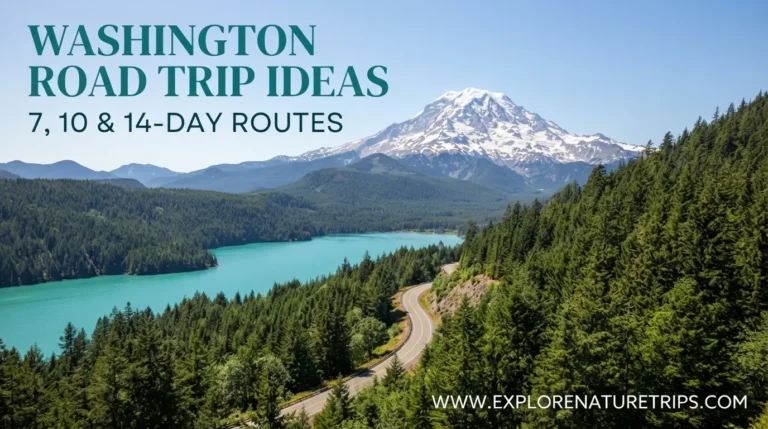
A route through central Oregon can combine the Columbia River Gorge, Mount Hood, Painted Hills, Smith Rock, and Bend.
The route is approximately 364 miles, with about 8 hours of direct driving.
Give yourself 3–4 days, excluding additional time in Portland.
At Smith Rock, Bend is approximately 40 miles away, making the two destinations relatively easy to combine.
Mount Hood also adds high-elevation scenery; the Magic Mile chairlift reaches roughly 7,000 feet.
15. Portland to Seattle
This route is approximately 175 miles, requiring just under 3 hours of direct driving.
The real value comes from adding Mount St. Helens and Mount Rainier rather than treating the trip as a simple city-to-city transfer.
Route
Portland → Mount St. Helens → Mount Rainier → Seattle
Mount St. Helens famously erupted on May 18, 1980, after a major sequence of events that began with increased volcanic activity in March. The eruption killed 57 people.
For hiking, the Skyline Trail at Mount Rainier is approximately 8.4 miles round trip, while the Alta Vista Trail is about 1.8 miles.
Seattle’s Space Needle reaches approximately 605 feet.
Allow at least 3 days, with another 2 days if you want meaningful time in Portland and Seattle.
16. Olympic Peninsula Road Trip
Washington’s Olympic Peninsula is ideal for travelers who want beaches and rainforest in the same trip.
A shorter Olympic beach route is approximately 126 miles, and a 2-day weekend can cover the main highlights.
Key stops
- Kalaloch Beach
- Ruby Beach
- Second Beach
- Rialto Beach
- Cape Flattery
- Olympic National Park
Second Beach is approximately 4 miles round trip, while the Hole-in-the-Wall/Rialto hike is also around 4 miles round trip.
The combination of rainforest, rugged beaches, mountains, and wildlife makes this one of the most diverse short road trips in Washington.
17. Seattle and the San Juan Islands
The San Juan Islands offer a slower alternative to a conventional highway road trip.
There are approximately 170+ islands, while 3—San Juan, Orcas, and Lopez—are among the main visitor destinations.
Ferry planning matters here.
Depending on the island, crossings can take approximately 1 hour to 1.5 hours, with the Orcas route around 1 hour 20 minutes and the San Juan route around 1.5 hours.
Arriving at the ferry terminal approximately 1 hour before departure is a useful planning buffer.
A Seattle-area itinerary can cover around 155 miles one way before the ferry portion.
For a comfortable experience, allow approximately 5 days.
18. Northeast Oregon Road Trip
Northeast Oregon is an excellent option when you want to get away from the most crowded West Coast destinations.
A loop through Baker City, Joseph, Lake Wallowa, Imnaha, Hat Point, and back to Baker City covers approximately 323 miles.
Baker City has more than 100 historic houses.
The Eagle Cap Wilderness contains 18 peaks above 9,000 feet, while viewpoints around Hat Point overlook canyon walls rising nearly 8,000 feet above the Snake River.
Allow 3–4 days, or longer if camping and hiking are central to your plans.
19. The Grand West Coast Road Trip
If you have around 30 days, you can combine many of the regions above into a much larger loop.
A comprehensive itinerary can connect:
San Diego → Los Angeles → Big Sur → Yosemite → San Francisco → Lake Tahoe → Redwoods → Oregon Coast → Crater Lake → Bend → Portland → North Cascades → San Juan Islands → Olympic Peninsula → Seattle
This is not a route to rush.
A month gives you the opportunity to combine cities, beaches, forests, mountains, waterfalls, national parks, and smaller towns without spending every day driving.
For travelers with less time, break this itinerary into smaller sections rather than removing every rest day.
Choosing the Right Route for Your Trip
Your available time should determine your route—not the other way around.
| Available time | Recommended approach |
|---|---|
| 2–3 days | San Diego–Los Angeles or Portland–Cannon Beach |
| 3–5 days | Big Sur, Oregon Coast, Portland–Seattle |
| 5–7 days | Southern California parks, San Diego–Palm Springs |
| 7–10 days | Pacific Coast Highway section |
| 10–14 days | California coast + redwoods + Oregon |
| 21 days | Multiple national parks and Pacific Northwest |
| 30 days | Large West Coast loop |
This also prevents one of the biggest road-trip problems: spending most of your vacation behind the wheel.
How Much Does a West Coast Road Trip Cost?
Your budget depends heavily on the vehicle, accommodation, season, and how frequently you eat at restaurants.
The gives the following useful planning ranges:
| Expense | Approximate range |
|---|---|
| Rental car | $30–$100/day |
| RV rental | $100–$300/day |
| Gas | $4.50–$5.50/gallon |
| Hostel dorm | Around $50/night |
| Airbnb | Around $120/night |
| Hotel room | Around $200/night |
| Campground | Around $5–$20/night |
| Sandwich | Around $6–$9 |
| Coffee | Around $4+ |
| Beer | Around $7–$10 |
| Dinner for two | Around $35–$75 |
These should be treated as planning figures, not guaranteed prices. Rental rates, fuel prices, lodging, and park fees can change by season and location.
Ways to Reduce Your Road Trip Budget
A cheaper West Coast trip does not necessarily mean a worse trip.
Camping can dramatically reduce accommodation expenses, especially when combined with grocery shopping and occasional restaurant meals.
Some rental cars may be available for around $25/day in favorable circumstances. Vehicle relocation services can sometimes advertise rates as low as $1/day, although availability and restrictions vary.
A few practical habits can make a bigger difference than chasing the absolute cheapest rental:
- Book accommodation outside the most expensive tourist areas.
- Camp where practical.
- Buy breakfast and snacks from grocery stores.
- Use hostels in major cities.
- Avoid unnecessary backtracking.
- Choose one region instead of trying to see the entire coast.
- Compare rental-car and campervan costs before booking.
- Build fuel costs into the itinerary before choosing distant detours.
Is the America the Beautiful Pass Worth It?
For a national-park-heavy itinerary, the America the Beautiful Pass can be useful.
The pass is listed at $80 and provides access to more than 2,000 federally managed recreation sites, including all 63 U.S. national parks.
For comparison, Joshua Tree National Park is given as an example at approximately $30 per vehicle.
If your itinerary includes several paid national parks, the pass can potentially pay for itself after roughly 3–4 visits.
Always verify current entrance fees and pass conditions before your trip because prices and rules can change.
Best Time for a West Coast Road Trip
There is no single perfect month for the entire West Coast.
Different regions behave very differently.
Summer
Summer generally provides warm, dry conditions along much of the coast, but it can also mean:
- Higher accommodation prices
- More traffic
- Crowded attractions
- Wildfire concerns
- Extreme desert heat
Spring
Spring can be excellent for:
- California coast
- Waterfalls
- Wildflowers
- Oregon landscapes
- Valley scenery
The Skagit Valley Tulip Festival in Washington takes place in April, making spring particularly attractive around La Conner.
Autumn
Fall can offer a strong balance between comfortable weather and scenery.
Wine-country landscapes, mountain colors, and fewer crowds can make September and October particularly appealing depending on the region.
Winter
Winter works well for coastal California and desert routes, while high mountain areas can experience substantial snow.
For the San Diego–Palm Springs desert loop, November through March is specifically useful because summer temperatures can become uncomfortable.
How Many Miles Should You Drive Each Day?
Do not measure a successful road trip by how many miles you can cover.
Driving 500 miles in a day simply to reach another destination can turn an exciting vacation into a long series of gas stations and highway stops.
A better approach is to divide long routes into manageable sections.
For example, a 600-mile Pacific Coast Highway journey can technically be completed in roughly 12 hours of driving, but allocating 3 days or more creates space for viewpoints, meals, short hikes, photography, and unexpected stops.
The best road trips leave some room for spontaneity.
Coastal Road Trip or National Park Road Trip?
Choose based on what you actually enjoy.
| If you prefer… | Choose |
|---|---|
| Beaches and ocean views | Pacific Coast Highway |
| Forests and giant trees | Redwoods |
| Desert landscapes | Joshua Tree / Death Valley |
| Waterfalls | Columbia River Gorge |
| Mountain hiking | Yosemite / Mount Rainier |
| Small coastal towns | Oregon Coast |
| Wine and food | Napa / Sonoma / Walla Walla |
| Wildlife and beaches | Olympic Peninsula |
| Historic towns | Gold Country |
| Remote landscapes | Lost Coast / Northeast Oregon |
| Big cities | San Diego / Los Angeles / San Francisco / Seattle |
What Should You Pack?
Your packing list should reflect the route rather than simply the season.
For a varied West Coast trip, consider:
- Comfortable walking shoes
- Hiking footwear
- Light layers
- Warm layer for mountains
- Rain protection
- Sun protection
- Reusable water bottle
- Phone charger
- Car charger
- Navigation backup
- Basic first-aid supplies
- Daypack
- Snacks
- Camera equipment if needed
For desert destinations, water and sun protection deserve particular attention.
For mountain routes, do not assume summer weather in a nearby city means the same conditions at elevation.
Practical Road Trip Mistakes to Avoid
Trying to See Everything
California alone can fill an entire trip. Adding Oregon and Washington without increasing the number of days often creates unnecessary driving.
Ignoring Distances
A location that looks close on a map can require several hours once mountain roads, coastal routes, traffic, and stops are considered.
Planning Every Minute
Keep some flexibility. Weather, road conditions, fatigue, and unexpected viewpoints can change your plans.
Forgetting Ferry Reservations
The San Juan Islands require additional planning because ferries become part of the itinerary.
Treating Hiking Like Sightseeing
A 22-mile Mount Whitney round trip is completely different from a short viewpoint walk. Match hikes to your fitness, preparation, permits, and conditions.
Underestimating the Desert
Death Valley, Joshua Tree, Mojave, and Anza-Borrego can be dramatically hotter than coastal California. Plan driving and outdoor activities accordingly.
Frequently Asked Questions
What is the best West Coast road trip for first-time visitors?
The California coast from San Francisco to San Diego is one of the most versatile choices. The approximately 600-mile route combines major cities, beaches, Big Sur, coastal towns, viewpoints, and cultural attractions.
How many days do you need for a West Coast road trip?
There is no single answer. A short coastal trip can work in 3 days, while a broader California itinerary may need 7–14 days. A national-park-focused trip can use 21 days, and a comprehensive route can fill approximately 30 days.
Is 10 days enough for a West Coast road trip?
Yes, if you focus on one region. A 10-day itinerary can cover a substantial section of the Pacific Coast Highway or combine selected California and Pacific Northwest destinations.
What is the most scenic West Coast road trip?
Big Sur and the Pacific Coast Highway are among the strongest choices for coastal scenery. For forests and mountains, the redwood region, Olympic Peninsula, Yosemite, and the Columbia River Gorge provide very different landscapes.
Is the Pacific Coast Highway better northbound or southbound?
For the California coastal route, north-to-south is often preferred because it places the Pacific Ocean and many viewpoints on the more convenient side of the road.
How much does a West Coast road trip cost?
Costs vary substantially, but planning figures from the researched routes include $30–$100/day for a rental car, $5–$20 for some campgrounds, approximately $50 for hostel accommodation, and around $120–$200 for typical Airbnb or hotel accommodation.
What is the cheapest way to travel the West Coast?
Camping, hostels, grocery shopping, economical rental cars, and limiting unnecessary long-distance driving can reduce costs. A focused regional itinerary is usually cheaper than attempting the entire West Coast.
Can you do a West Coast road trip in winter?
Yes. Coastal California and desert areas can work well in winter, while the Cascades and Sierra Nevada may have substantial snow. Always check seasonal road conditions before traveling through mountain areas.
Is the America the Beautiful Pass worth buying?
If you plan to visit several national parks, it can be worthwhile. The researched price is $80, and it covers more than 2,000 federally managed recreation sites, including all 63 national parks.
What is the best West Coast road trip for nature lovers?
There are several strong choices. The redwood region is ideal for ancient forests, Olympic Peninsula combines beaches and rainforest, Yosemite offers mountain scenery, and the Oregon Coast provides beaches, forests, and waterfalls.
How far is Big Sur?
The highlighted Bixby Bridge-to-Hearst Castle section is approximately 76 miles and takes about 2 hours without substantial stops. A full day is much more appropriate for sightseeing.
What is the best Oregon road trip?
The Oregon Coast is a flexible option, with a route of roughly 338 miles and 3–4 days recommended for major highlights. The Columbia River Gorge and Portland-to-Bend route are excellent alternatives.
Final Road Trip Strategy
The best West Coast road trip is not necessarily the longest one.
A 3-day traveler can enjoy San Diego, Los Angeles, or Cannon Beach. Someone with 7 days can explore a meaningful section of California or Oregon. With 10–14 days, you can combine several major destinations without rushing. A 21-day itinerary opens the door to multiple national parks, while 30 days gives you enough time for a grand California–Oregon–Washington loop.
The key is to choose a route that matches your available time, driving tolerance, budget, and interests.
Rather than collecting destinations like checklist items, leave enough time to stop at a viewpoint, take an unexpected trail, eat in a small town, watch a sunset, or simply enjoy the road. That flexibility is what turns a long drive into a memorable West Coast road trip.

Hi, I’m Marcus! I love exploring the outdoors and discovering incredible places. Through ExploreNatureTrips blog, I share my travel experiences, useful tips, and recommendations for the best sights, trails, and destinations to visit.