Washington Road Trip Ideas: 7, 10 & 14-Day Routes
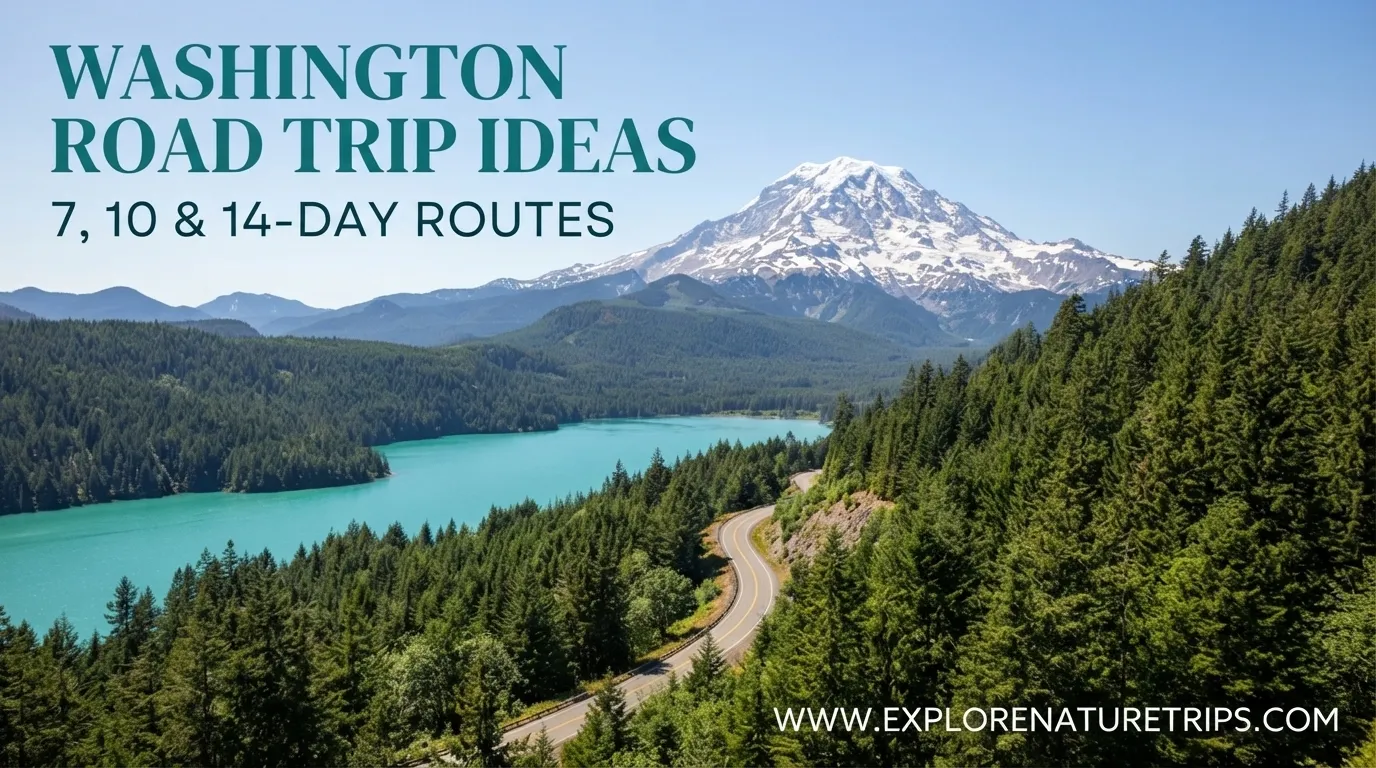
Washington is unusually rewarding for a road trip because a single journey can combine Pacific beaches, temperate rainforest, alpine mountains, glacial lakes, scenic highways, islands, waterfalls, wine country, and lively cities.
The biggest planning mistake is trying to see everything in only a few days. The five Washington road-trip guides reviewed for this article repeatedly organize trips around the same major regions: Olympic National Park, Mount Rainier National Park, North Cascades National Park, San Juan Islands, Leavenworth, Seattle, and scenic Highway 20.
Your ideal route depends mainly on how many days you have and whether your priority is hiking, scenery, beaches, wildlife, small towns, or a mixture of everything.
Best Time for a Washington Road Trip
The strongest seasonal window across the five guides is roughly late July through September, with some destinations extending into October.
For higher-elevation hiking, the recommended window is generally:
- Late July–mid-October: strong hiking period
- August–September: particularly reliable for mountain access
- September–early October: especially attractive for a less crowded late-season trip
- June–September: useful window for several mountain and coastal routes
- April–October: suitable for lower-elevation and wine-country routes
Conditions vary substantially by elevation. One specifically notes that mountain areas can remain snowy into summer and describes a July 23 snowstorm during a Mount Rainier visit. Another recommends planning for snow-free higher mountain trails from around mid-July, while noting that early snow can return in October.
For that reason, build some flexibility into your schedule rather than making every day dependent on one high-elevation hike.
The Classic Olympic Peninsula Road Trip
The Olympic Peninsula is one of the most varied parts of a Washington road trip. Within the same general journey, you can visit rainforest, mountain viewpoints, lakes, beaches, waterfalls, and coastal communities.
Important entities include:
- Olympic National Park
- Port Angeles
- Lake Crescent
- Hurricane Ridge
- Hoh Rainforest
- Ruby Beach
- Rialto Beach
- La Push
- Forks
- Cape Flattery
- Quinault Rainforest
- Neah Bay
A practical Olympic Peninsula loop can take around 3–5 days, depending on how deeply you explore.
One sample five-day structure is:
| Day | Main focus |
| Day 1 | Seattle → Port Angeles |
| Day 2 | Hurricane Ridge + Lake Crescent |
| Day 3 | Hoh Rainforest + Ruby Beach |
| Day 4 | Forks + La Push + Cape Flattery |
| Day 5 | Quinault Rainforest → Seattle |
Another guide gives an Olympic Peninsula route of approximately 412 miles and about 7 hours 40 minutes of driving, before allowing time for stops.
That difference demonstrates why mileage alone can be misleading. A route may look short on a map but still require substantial time once viewpoints, hikes, ferries, meals, and park roads are included.
Olympic Peninsula Highlights Worth Building Around
Hurricane Ridge is ideal for mountain scenery without committing to a long hike. One guide lists Hurricane Hill at approximately 3.2 miles with 650 feet of elevation gain.
Lake Crescent works well as a scenic stop between the northern Olympic Peninsula and the western side of the park.
Marymere Falls is another relatively accessible stop, with one guide giving the trail as approximately 1.8 miles round trip and the waterfall at 90 feet.
For rainforest scenery, the Hoh Rainforest deserves substantial attention. One itinerary recommends arriving before sunrise to reduce the chance of crowds and waiting.
The Hoh area includes several short walking options:
- Hall of Mosses: 1 mile round trip
- Spruce Nature Trail: 1.2 miles
- Ancient Groves: 0.5-mile loop
- Hoh River Trail: 17 miles
You do not need to complete the longest trail to experience the rainforest.
Pacific Coast: Beaches, Tide Pools and Sea Stacks
The western Olympic Peninsula adds an entirely different landscape.
Key coastal entities include:
- Rialto Beach
- Ruby Beach
- La Push
- Hole-in-the-Wall
- Shi Shi Beach
- Cape Flattery
The guides emphasize low tide when exploring tide pools and Hole-in-the-Wall. Check the tide timing before committing your schedule to a particular coastal stop.
Ruby Beach is also useful for travelers staying around Kalaloch, with one guide placing it roughly 10 minutes from the camping area.
For photographers and sunset seekers, the combination of driftwood, sea stacks, ocean views, and changing coastal light makes the Olympic coast particularly valuable.
Mount Rainier: Paradise and Sunrise
Mount Rainier National Park is another major anchor for a Washington road trip.
The two recurring areas are:
- Paradise
- Sunrise
Other entities appearing in the guides include:
- Reflection Lakes
- Narada Falls
- Christine Falls
- Silver Falls
- Longmire
- Tipsoo Lake
- Sourdough Ridge
- Mount Fremont Lookout
- Berkeley Park
- Grove of the Patriarchs
- Snow Lake
One highlights Mount Rainier at 14,410 feet, while another describes it simply as over 14,000 feet.
Paradise
Paradise is one of the most practical places to dedicate a full day.
The Skyline Loop is approximately 6 miles, making it a substantial hiking option rather than a quick viewpoint stop.
For travelers who prefer shorter walks, the Paradise area also offers scenic viewpoints and waterfall stops.
One guide recommends arriving very early because Mount Rainier can become crowded, particularly during popular periods.
Sunrise
Sunrise sits at approximately 6,400 feet and is described in one guide as the highest point in the park accessible by vehicle.
Popular hiking options include:
- Sourdough Ridge
- Mount Fremont Fire Lookout
- Burroughs Mountain
- Berkeley Park
The Mount Fremont route is approximately 6 miles round trip.
Berkeley Park is especially associated with summer wildflowers, with one specifically mentioning the last week of July as a successful period.
Mount Rainier Waterfall and Forest Stops
The guides also provide useful short-stop options:
| Attraction | Detail |
| Narada Falls | 188 feet |
| Silver Falls | 95 feet |
| Grove of the Patriarchs | 1.5 miles round trip |
| Large trees at Grove area | 300+ feet tall |
| Tree age mentioned | 1,000+ years |
| Snow Lake | 2.5 miles round trip |
These stops can help create a balanced day when everyone in your group does not want a long hike.
North Cascades Highway and Highway 20
For dramatic mountain scenery, Highway 20 through the North Cascades is one of the strongest road-trip corridors in the material.
Important entities include:
- North Cascades National Park
- Diablo Lake
- Ross Lake
- Washington Pass Overlook
- Winthrop
- Mazama
- Methow Valley
- Cascade Pass
- Sahale Arm
- Liberty Bell Mountain
One guide gives the North Cascades Highway section as approximately 127 miles and about 2 hours 30 minutes of driving, excluding stops.
Another route expands this into a broader 448-mile Cascade Loop with approximately 11+ hours of driving, before accounting for sightseeing.
That distinction is important: Highway 20 and the broader Cascade Loop should not be treated as the same trip.
North Cascades Hiking Options
Travelers have several levels of hiking to choose from.
Rainy Lake is approximately 2 miles and is described as an easy paved walk.
Blue Lake is approximately 5 miles round trip, rated around easy to moderate in one guide.
Maple Pass Loop is approximately 7 miles in the material, with another itinerary giving 7.2 miles. It is presented as a more challenging hike with alpine scenery, forests, wildflowers, and lake views.
For experienced hikers, Cascade Pass and Sahale Arm is approximately 12 miles round trip with around 4,150 feet of elevation gain.
That is a completely different commitment from a short viewpoint walk, so choose according to your group’s experience rather than trying to complete every recommended hike.
Leavenworth and the Cascade Foothills
Leavenworth is a useful addition when you want a break from national-park hiking.
The guides associate the area with:
- Bavarian-style architecture
- Restaurants
- Wineries
- River activities
- Alpine scenery
- Icicle Gorge
- Lake Wenatchee
- Plain
- Stevens Pass
The Highway 2 route between Everett and Leavenworth is approximately 100 miles and around 2 hours of driving, before stops.
Seasonal activities mentioned across the material include:
- Summer: river rafting and alpine lakes
- Fall: golden larches and Oktoberfest
- Winter: lights and skiing
This makes Leavenworth one of the more flexible stops if your road trip is not entirely focused on hiking.
San Juan Islands
The San Juan Islands are a strong optional extension, particularly for a longer itinerary.
Key entities include:
- San Juan Island
- Orcas Island
- Lopez Island
- Friday Harbor
- Lime Kiln State Park
- Mount Constitution
A typical short itinerary can use 3 days:
Day 1: Seattle → Anacortes → Friday Harbor
Day 2: Lime Kiln + whale watching
Day 3: Orcas Island + Mount Constitution → Anacortes
One ‘s San Juan route gives approximately 127 miles of driving plus ferry travel and around 7 hours before additional stops and ferry time.
Another guide strongly recommends whale watching as the standout activity and describes it as the most expensive activity in its itinerary.
Because ferry schedules affect the timing, avoid building an overly tight same-day schedule around multiple islands.
The 440-Mile Cascade Loop
The broader Cascade Loop is one of the most useful options for travelers who want a scenic drive rather than a single national park.
One gives it as approximately 440 miles and a 4-day route.
A sample structure is:
| Day | Route |
| Day 1 | Seattle → Wenatchee via Stevens Pass |
| Day 2 | Wenatchee → Winthrop via Lake Chelan and Twisp |
| Day 3 | Winthrop → Whidbey Island via North Cascades Highway and Deception Pass |
| Day 4 | Whidbey Island → Seattle |
The route provides a useful mix of mountain roads, lakes, small communities, and coastal scenery.
Palouse Scenic Byway
If you want to experience eastern Washington rather than staying around the major national parks, consider the Palouse Scenic Byway.
Key entities include:
- Palouse Falls State Park
- Steptoe Butte State Park
- Pullman
- Colfax
- Rosalia
One drives a route of approximately 196 miles and around 4 hours 15 minutes of driving.
The standout numerical landmark is Palouse Falls at 198 feet.
A sample three-day approach includes:
- Day 1: Spokane → Pullman via Steptoe Butte and Palouse Falls
- Day 2: Pullman → Colfax → Palouse
- Day 3: Return via Moscow or Lewiston
Washington Coast Road Trip
A dedicated coast route works well when beaches matter more than inland attractions.
One ‘s three-day structure is:
Day 1: Aberdeen → Kalaloch, with Westport and Ocean Shores
Day 2: Kalaloch → Ruby Beach → Hoh Rainforest
Day 3: La Push → Rialto Beach → return
The recommended seasonal window is primarily June–September.
The route emphasizes beaches, sea stacks, marine life, driftwood, surfing, and coastal scenery rather than maximizing the number of inland attractions.
Columbia River Gorge and Southern Washington
For a different side of the state, one recommends combining southern Washington with the Columbia River Gorge.
Key entities include:
- Vancouver
- Beacon Rock
- Cape Horn
- Stevenson
- Goldendale
- Maryhill Museum
- Stonehenge Replica
The sample route is approximately 3 days, with April–October identified as the best general period in that plan.
This is a good alternative if your priorities include viewpoints, history, scenic driving, and wine rather than only national-park hiking.
Washington Wine Country
The material also identifies Yakima Valley and Walla Walla as a dedicated road-trip option.
The suggested season is April–October, with September harvest season highlighted.
A simple three-day structure:
| Day | Main focus |
| Day 1 | Yakima Valley, Rattlesnake Hills, Red Mountain AVA |
| Day 2 | Walla Walla, Main Street and wineries |
| Day 3 | Prosser and Benton City → return |
Another gives the Yakima-to-Walla Walla route as approximately 131 miles and 2 hours of driving, excluding stops.
A Practical 7-Day Washington Road Trip
If you have only 7 days, do not try to copy a 14-day itinerary at double speed.
A practical structure from the material is:
| Day | Destination |
| 1 | Seattle → Olympic Peninsula |
| 2 | Lake Crescent + Hurricane Ridge |
| 3 | Hoh Rainforest + Pacific beaches |
| 4 | Olympic → Mount Rainier |
| 5 | Mount Rainier / Paradise |
| 6 | Mount Rainier / Sunrise → Seattle |
| 7 | Seattle + departure |
An alternative seven-day approach can replace some Olympic time with North Cascades.
The important principle is to choose fewer destinations and experience them properly.
A Balanced 10-Day Washington Road Trip
Ten days gives you enough time to create a much more comfortable itinerary.
A strong structure based on the material is:
| Day | Destination |
| 1 | Seattle → Port Angeles |
| 2 | Olympic National Park |
| 3 | Olympic National Park |
| 4 | Mount Rainier |
| 5 | Mount Rainier |
| 6 | Leavenworth |
| 7 | Lake Chelan / eastern Washington |
| 8 | North Cascades |
| 9 | North Cascades or Mount Baker |
| 10 | Return/departure |
This structure gives each major landscape enough attention without turning every day into a transfer day.
A 14-Day Washington Road Trip
With 14 days, you can slow down and add optional regions.
One hiking-focused structure includes:
- Days 1–4: Olympic National Park
- Days 5–7: Mount Rainier
- Day 8: Leavenworth
- Day 9: Enchantments
- Day 10: Lake Chelan
- Days 11–12: North Cascades
- Day 13: Mount Baker
- Day 14: Departure
For travelers who are less interested in hiking, another approach substitutes additional time in San Juan Islands and Seattle.
This is where a longer trip becomes more valuable: you can add experiences without removing essential recovery or driving time.
A 5-Day Option for a Shorter Trip
For 5 days, keep the route focused.
A 5-day structure is:
Day 1: Seattle → Olympic Peninsula + Hurricane Ridge
Day 2: Pacific Coast + Hoh Rainforest
Day 3: Olympic → Mount Rainier / Paradise
Day 4: Mount Rainier + Ohanapecosh → Seattle
Day 5: Seattle + departure
Do not attempt the full Cascade Loop, San Juan Islands, Olympic Peninsula, Rainier, and North Cascades in five days.
A 3-Day Option
With only 3 days, the most useful strategy is choosing one main region.
For example:
Day 1: Seattle → Olympic Peninsula / Forks
Day 2: Hoh Rainforest + Pacific beaches
Day 3: Lake Crescent + Hurricane Ridge → Seattle
Alternatively, dedicate all three days to Mount Rainier or another single area.
The shorter the trip, the more important geographic discipline becomes.
How to Plan Your Daily Driving
A good road-trip day should not be measured only by the number of miles.
Before committing to a route, consider:
- How many hours will actually be spent driving?
- Are there ferry crossings?
- Is a trail involved?
- Do you need to arrive before sunset?
- Is the attraction affected by tide timing?
- Could mountain weather change your plans?
- Do you need an early start to avoid crowds?
- Where will you sleep after finishing the day’s activities?
For example, one describes a practical journey of only around 70 miles between locations as taking at least 6 hours because of traffic and ferry-related travel.
That is exactly why Washington road-trip planning should be based on experience time, not just map distance.
Accommodation Planning
Popular areas can fill quickly, especially during summer.
The material mentions:
- Port Angeles
- Forks
- Kalaloch
- Ashford
- Packwood
- Paradise Inn
- Leavenworth
- Winthrop
- San Juan Island
Camping can require especially early planning. One guide reports that a particular Forks-area property was booked almost 1 year ahead, while another notes that San Juan camping can fill very quickly during summer.
For a multi-stop trip, choose accommodation based on the next day’s destination, not simply the cheapest available room.
This can reduce unnecessary backtracking and make early-morning hiking much easier.
Ferry Planning Matters
Ferries appear repeatedly in Washington itineraries, particularly around:
- Anacortes
- San Juan Islands
- Port Townsend
- Coupeville
- Whidbey Island
- Bainbridge Island
- Kingston
One gives the Seattle–Bainbridge crossing as approximately 35 minutes and the Edmonds–Kingston crossing as approximately 30 minutes.
Even when the sailing itself is short, waiting and boarding can affect the day’s schedule. Leave room for the ferry process rather than treating crossing time as the entire journey.
How to Choose the Right Route
Choose Olympic Peninsula if you want the greatest combination of rainforest, beaches, lakes, mountains, and coastal scenery.
Choose Mount Rainier if your priority is a dramatic mountain, alpine viewpoints, wildflowers, and accessible hiking.
Choose North Cascades if you want rugged mountain scenery and more demanding alpine hikes.
Choose San Juan Islands if you prefer islands, ferries, whale watching, and slower coastal exploration.
Choose Leavenworth if you want a town-focused break with mountain scenery, food, river activities, and seasonal events.
Choose the Cascade Loop if the scenic drive itself is a major part of the experience.
Choose Palouse or wine country if you want to explore eastern and southeastern Washington rather than concentrating on the three major national parks.
Common Washington Road Trip Mistakes
Trying to visit everything: Three parks plus islands, Seattle, wine country, and the coast can become exhausting when squeezed into one week.
Ignoring driving time: A short distance does not always mean a short travel day.
Underestimating Olympic National Park: Its attractions are spread across a large peninsula, so moving between rainforest, beaches, mountains, and lakes takes time.
Scheduling only long hikes: Add short viewpoints and easy trails to create a more sustainable itinerary.
Ignoring tides: Coastal attractions such as Hole-in-the-Wall are much more useful when your visit matches suitable tide conditions.
Leaving lodging too late: Summer accommodation and campgrounds can become difficult to secure.
Assuming summer means warm mountain conditions: The experiences demonstrate that higher elevations can still have snow.
Frequently Asked Questions
How many days do you need for a Washington road trip?
A 7-day trip can cover the major highlights, but 10 days provides a better balance. Travelers with 14 days can add more hiking, Seattle, San Juan Islands, Leavenworth, Lake Chelan, or Mount Baker.
What is the best month for a Washington road trip?
The material most consistently favors August and September, with a broader mountain-hiking window extending from late July into October.
Can you visit Washington’s major national parks in 7 days?
Yes, but it will be a compact trip. You will need to limit hiking and accept less time in individual areas. A longer 10–114-dayitinerary provides substantially more flexibility.
Is Olympic National Park worth 3 days?
Yes. The peninsula contains beaches, rainforest, lakes, mountains, waterfalls, and coastal communities spread across different areas. Three to five days provides much more flexibility than a rushed one-day visit.
How long is the Cascade Loop?
One describes the Cascade Loop at approximately 440 miles, while another gives a broader figure of 448 miles depending on the route definition. The suggested itinerary spans about 4 days.
How long is the North Cascades Highway?
The itinerary gives the Highway 20 North Cascades section as approximately 127 miles and around 2 hours 30 minutes of driving before sightseeing stops.
How long is the Skyline Loop at Mount Rainier?
The Skyline Loop is approximately 6 miles according to the itinerary.
What is the best time to hike in North Cascades?
The strongest shared window is generally late July through September, although individual trails and roads can have different seasonal conditions.
Should you include San Juan Islands on a 7-day trip?
Only if the islands are a major priority. With just 7 days, adding them means reducing time elsewhere. They fit much more comfortably into a 10- or 14-day itinerary.
Is Washington good for a road trip without hiking?
Yes. The material includes scenic highways, beaches, waterfalls, viewpoints, islands, wineries, towns, and wildlife experiences. You can build a road trip around shorter walks rather than long hikes.
Final Planning Takeaway
The best Washington road trip is not necessarily the one with the largest number of destinations. It is the one that gives you enough time to actually enjoy each landscape.
For a first trip, 7 days works for a focused overview, 10 days is a strong all-around choice, and 14 days gives you the freedom to explore without turning every morning into a race against the clock.
Build the route around the places that matter most to you, keep realistic driving buffers, reserve popular accommodation early, and leave some flexibility for weather. Washington’s greatest strength is its variety: within one road trip, you can move from Pacific beaches to rainforest, alpine mountains, islands, waterfalls, vineyards, and scenic mountain highways without leaving the state.

Hi, I’m Marcus! I love exploring the outdoors and discovering incredible places. Through ExploreNatureTrips blog, I share my travel experiences, useful tips, and recommendations for the best sights, trails, and destinations to visit.