Petrified Forest National Park Arizona Guide: Trails, Fees & Tips
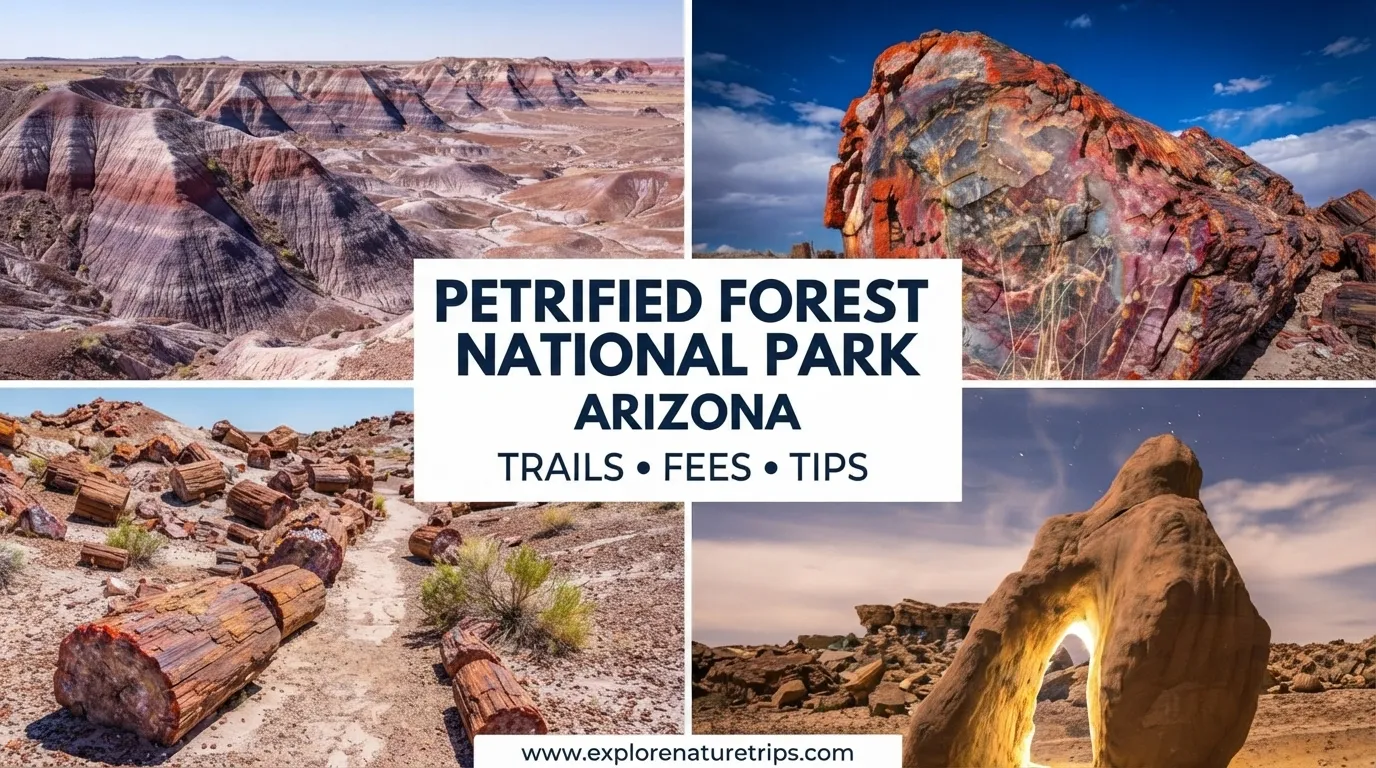
Petrified Forest National Park is one of Arizona’s most unusual landscapes, combining colorful desert scenery, ancient petrified wood, archaeological sites, petroglyphs, and a historic stretch of Route 66. The park is especially rewarding because you can experience several major sights without committing to long hikes.
The park covers roughly 222,000 acres, while its main paved road runs for about 28 miles. Ancient trees found here were transformed into stone roughly 200 million years ago, creating one of the most distinctive geological landscapes in the Southwest.
For a first visit, the easiest strategy is to combine the Painted Desert, Blue Mesa, Puerco Pueblo, Newspaper Rock, Crystal Forest, and Giant Logs rather than trying to explore every trail.
Where Is Petrified Forest National Park?
Petrified Forest National Park is in northeastern Arizona near Holbrook. The park stretches across both sides of Interstate 40, making it a convenient stop for travelers following the historic east-west highway corridor.
There are two primary approaches:
- North entrance: reached from I-40, Exit 311
- South entrance: reached from US-180
Holbrook is approximately 26 miles west of the park area described in the visitor guide. Flagstaff is roughly 115 miles west, while Albuquerque is approximately 210 miles east.
Because the park is arranged largely along a north-south route, your entrance can influence the order in which you see the attractions.
How Much Time Do You Need?
A full day gives you the best balance between scenic stops, short hikes, archaeological sites, and photography.
However, a shorter visit can still work. One ‘s firsthand itinerary covered the principal highlights in approximately 4 hours.
| Available Time | Best Approach |
| 4 hours | Focus on major viewpoints and 2–3 short trails |
| Half day | Add Blue Mesa and either Crystal Forest or Giant Logs |
| 1 full day | Combine the Painted Desert, archaeological sites, Blue Mesa, and southern trails |
| More time | Add longer hikes and spend additional time at overlooks |
A common mistake is treating the park like a destination that requires long hikes everywhere. Many highlights are close to roads and can be explored through short, manageable walks.
Park Hours and When to Arrive
The visitor information from the competing guides lists regular entrance hours of approximately 8 AM to 5 PM.
Travel + Leisure’s guide also describes visitor sweeps later in the day, with approximately 7:30 PM mentioned for summer and 5:30 PM for winter conditions.
Because daylight and operational schedules can change, visitors should verify the current schedule before traveling.
For the best experience, arriving early has several advantages:
- Cooler conditions for hiking
- Softer morning light for photography
- More comfortable walks
- More time for scenic stops
- Less pressure to complete the park before closing
Entrance Fees
The standard fees highlighted are:
| Entry Type | Fee |
| Private vehicle | $25 |
| Motorcycle | $20 |
| Bicycle or pedestrian | $15 per person |
The America the Beautiful annual pass can also be used for eligible federal recreation sites.
One specifically lists the annual pass at $80 in its guide.
Best Time to Visit
Petrified Forest can be visited throughout the year, but conditions change significantly by season.
Spring: March–May
Spring provides generally comfortable conditions for sightseeing and hiking. Wildflowers can also add color to the desert landscape.
April, May, and June are particularly highlighted for wildflower viewing.
Summer: June–August
Summer can become hot, with temperatures reaching the 90s°F.
For hiking, early morning and later afternoon are more comfortable than the hottest part of the day.
Carry enough water and protect yourself from direct sun.
Fall: September–November
Fall brings cooler conditions and can provide a more comfortable sightseeing experience. The changing light can also make the Painted Desert especially attractive for photography.
Winter: December–February
Winter is generally quieter. Cold temperatures, strong winds, and occasional snow can occur, creating a completely different appearance across the desert landscape.
The Painted Desert
The Painted Desert is one of the first major landscapes visitors encounter, particularly around the northern portion of the park.
Its badlands contain layers of reds, pinks, creams, purples, and other earth tones. The coloration is connected to mineral deposits within the landscape, including iron, carbon, and manganese.
Rather than rushing through the viewpoints, allow time to stop at several overlooks. The changing elevation, sunlight, and weather can make nearby formations appear dramatically different.
Painted Desert Rim Trail
The Painted Desert Rim Trail is approximately 1 mile and offers an accessible introduction to the landscape.
It is a good choice if you want to see the Painted Desert without committing to a lengthy hike.
Another approximately 1-mile option mentioned in the material is the Tawa Trail, providing another way to experience the northern scenery.
Blue Mesa Scenic Drive
The Blue Mesa Scenic Drive is one of the park’s standout experiences.
The loop covers approximately 3.5 miles and leads through colorful badlands containing layers of unusual geological formations.
The drive is especially useful for visitors who want impressive scenery without spending hours hiking.
Take advantage of the designated pullouts rather than simply driving through. The different viewpoints provide changing perspectives of the blue, purple, cream, and reddish formations.
Blue Mesa Trail
The Blue Mesa Trail is approximately 1 mile and provides a closer experience with the badlands.
Unlike simply viewing the landscape from an overlook, the trail takes you down into the colorful formations.
Expect uneven desert terrain and exposure to the elements. Even though the distance is short, the environment can make a one-mile hike feel more demanding than the number suggests.
Puerco Pueblo
Puerco Pueblo adds an important archaeological dimension to the park.
The site is described as an approximately 100-room pueblo associated with ancestral communities that lived here around 600 years ago.
The associated trail is only about 0.3 mile, making it one of the easiest ways to combine natural scenery with cultural history.
Look for architectural remains, stone features, and petroglyphs while staying on the designated route.
Newspaper Rock
Newspaper Rock is one of the most notable archaeological stops.
The site contains 650+ petroglyphs, with some carvings estimated at more than 2,000 years old.
Visitors generally view the rock art from a designated viewing area rather than walking directly across the archaeological site.
This is an important stop for travelers interested in the human history of the region rather than only its geology.
The Tepees
The Tepees are colorful, rounded geological formations located along the route toward Blue Mesa.
Their layered appearance provides another example of the park’s unusual geology.
A designated pullout makes it easy to stop, photograph the formations, and continue toward the Blue Mesa area.
Crystal Forest Trail
The Crystal Forest Trail is approximately 0.75 mile and is one of the best short walks for seeing concentrated pieces of petrified wood.
The trail is relatively short, making it useful for:
- Families wanting a manageable walk
- First-time visitors
- Travelers on a half-day schedule
- Visitors who want to see petrified wood without a long hike
The colorful crystalline appearance of the petrified wood is one of the trail’s main attractions.
Giant Logs Trail
The Giant Logs Trail is another short hike, listed at approximately 0.4–0.5 miles in the material.
The trail begins near the Rainbow Forest Museum and showcases large sections of petrified wood.
One of its best-known examples is Old Faithful, a particularly large petrified tree stump described as nearly 10 feet wide at its base.
Although short, the trail can include stairs, so visitors should still wear suitable footwear.
Long Logs and Agate House
Visitors with additional time can continue to the Long Logs and Agate House area.
The material gives:
- Long Logs: approximately 1.6 miles
- Agate House: approximately 2 miles
- Combined route: approximately 2.6 miles
Long Logs provides an opportunity to see an extensive concentration of petrified wood.
Agate House is particularly interesting because the pueblo was constructed using petrified wood.
Agate House
Agate House is an 8-room pueblo constructed from petrified wood.
The archaeological information in the material places its occupation between approximately 1050 and 1300.
This makes the site more than a geological attraction: it demonstrates how ancient communities interacted with and used the unusual resources found throughout the area.
Agate Bridge
Agate Bridge is another distinctive petrified-wood formation.
The feature spans approximately 200 feet across a cut in the landscape.
Visitors should follow the designated viewing arrangements rather than climbing onto the formation.
Jasper Forest
Jasper Forest is another area where visitors can see extensive concentrations of petrified wood.
The guides describe an approximately 2.5-mile round-trip hiking option for visitors wanting a longer experience.
If your schedule is limited, prioritize the shorter Crystal Forest and Giant Logs experiences first. If you have more time, Jasper Forest can provide another perspective.
Historic Route 66
Petrified Forest has a particularly interesting connection with Historic Route 66.
The park contains a historic alignment of the road, including the remains of a 1932 Studebaker associated with the old route.
Travel + Leisure’s 2026 guide also highlights the fact that 2026 marks 100 years of Route 66.
This makes the Route 66 component especially relevant to travelers visiting during the centennial year.
A Simple One-Day Itinerary
If you only have one day, avoid trying to stop everywhere equally.
A practical sequence is:
| Order | Stop | Approx. Focus |
| 1 | Painted Desert | Scenic overlooks |
| 2 | Painted Desert Rim/Tawa area | Short walk |
| 3 | Puerco Pueblo | Archaeology |
| 4 | Newspaper Rock | Petroglyphs |
| 5 | The Tepees | Geological viewpoint |
| 6 | Blue Mesa | 3.5-mile scenic drive |
| 7 | Blue Mesa Trail | 1-mile hike |
| 8 | Crystal Forest | 0.75-mile walk |
| 9 | Giant Logs | 0.4–0.5-mile walk |
| 10 | Rainbow Forest Museum | Final southern stop |
This order can be reversed if you enter from the southern US-180 side.
What to Pack
The desert environment requires more preparation than the short trail distances might suggest.
Bring:
- At least 2 liters of water per person
- Sun protection
- Hat
- Sunglasses
- Comfortable walking shoes
- Light layers
- Snacks
- Small daypack
- Phone or camera
- Offline maps
Cell service can be limited in portions of the park, so downloading important maps before arrival is a sensible precaution.
Hiking Difficulty: What Should You Choose?
| Trail | Distance | Best For |
| Puerco Pueblo | 0.3 mi | Archaeology |
| Giant Logs | 0.4–0.5 mi | Large petrified wood |
| Crystal Forest | 0.75 mi | Colorful petrified wood |
| Blue Mesa | 1 mi | Badlands |
| Painted Desert Rim | 1 mi | Desert views |
| Long Logs | 1.6 mi | Larger petrified-wood concentration |
| Jasper Forest | 2.5 mi round trip | Longer exploration |
| Long Logs + Agate House | 2.6 mi | Extended southern hike |
Distance alone does not determine difficulty. Heat, exposure, stairs, uneven ground, and elevation can all affect how comfortable a trail feels.
Important Visitor Rules
Petrified Forest is both a natural and cultural resource, so responsible behavior matters.
Stay on designated trails. This protects fragile geological and archaeological features.
Do not collect petrified wood. The material may look like an ordinary rock or piece of wood, but it is part of the protected landscape.
Do not disturb petroglyphs or archaeological remains.
Pack out your trash.
Carry sufficient water.
Respect wildlife and maintain appropriate distance.
Following these simple practices helps preserve the park for future visitors.
Where to Stay Near the Park
The material identifies several accommodation options around Holbrook, including:
- Wigwam Motel
- El Rancho Hotel
- Holbrook/Petrified Forest KOA
The Holbrook/Petrified Forest KOA is described as approximately 20 minutes from the park.
The Wigwam Motel is notable for its unusual roadside architecture and belongs to a group of surviving Wigwam Village motels dating from the 1930s–1950s.
Food and Services
The material also identifies food options around the park and Holbrook area, including:
- Painted Desert Diner
- Swaad Stop
- Bienvenidos Restaurant
Because services can be limited while moving between the park’s major areas, carrying snacks and water is useful even if you plan to eat before or after your visit.
Petrified Forest vs. Painted Desert
These names can sometimes be confusing.
The Petrified Forest refers primarily to the area’s fossilized wood and the broader national park.
The Painted Desert refers to the colorful badland landscape, particularly prominent toward the northern portion of the park.
They are not two completely separate destinations requiring different trips. They are major components of the same national park experience.
Is Petrified Forest National Park Worth Visiting?
Yes, particularly if you enjoy destinations where several different experiences can be combined in one visit.
You can see:
- Ancient petrified wood
- Colorful badlands
- Petroglyphs
- Pueblo ruins
- Historic Route 66
- Scenic overlooks
- Short hiking trails
- Geological formations
The biggest advantage is variety. A visitor can spend 4 hours seeing major highlights or dedicate a full day to combining short hikes with scenic drives and archaeological sites.
Frequently Asked Questions
How big is Petrified Forest National Park?
The park covers approximately 222,000 acres, with a main park road extending for about 28 miles.
How old is the petrified wood?
The petrified trees date to roughly 200 million years ago, according to the visitor guides.
How much does Petrified Forest National Park cost?
The guides list $25 per private vehicle, $20 for motorcycles, and $15 per person for pedestrians or bicyclists.
What are the park hours?
The main entrance hours highlighted by the guides are approximately 8 AM to 5 PM. Seasonal visitor-sweep times can extend later in the day.
How long should I spend at Petrified Forest?
A full day is ideal, although the major highlights can be covered in roughly 4 hours with careful planning.
What is the shortest trail?
The Puerco Pueblo Trail is approximately 0.3 mile, while Giant Logs is roughly 0.4–0.5 mile.
How long is Blue Mesa?
The scenic drive is approximately 3.5 miles, while the Blue Mesa Trail itself is about 1 mile.
How many petroglyphs are at Newspaper Rock?
The site contains 650+ petroglyphs, with some estimated to be more than 2,000 years old.
Can I take petrified wood home?
Visitors should not remove petrified wood or other natural or archaeological resources from the park. Enjoy and photograph the material where it belongs.
What should I bring?
Water is the most important item. The guidance recommends at least 2 liters per person, along with sun protection, appropriate footwear, snacks, and navigation resources.
Final Planning Takeaway
Petrified Forest National Park works best when you treat it as a combination of scenic drive, short hikes, geology, archaeology, and history rather than as a single attraction.
For a first visit, prioritize the Painted Desert, Puerco Pueblo, Newspaper Rock, Blue Mesa, Crystal Forest, and Giant Logs. If time permits, add Long Logs, Agate House, or Jasper Forest.
The numbers make planning straightforward: the main road is about 28 miles, Blue Mesa’s scenic loop is 3.5 miles, many signature walks are under 1 mile, and the standard vehicle entrance fee is $25. With an early start, adequate water, and a sensible route, even a single day can provide a strong introduction to this remarkable Arizona landscape.

Hi, I’m Marcus! I love exploring the outdoors and discovering incredible places. Through ExploreNatureTrips blog, I share my travel experiences, useful tips, and recommendations for the best sights, trails, and destinations to visit.