Vermont Road Trip Ideas: 17+ Scenic Stops, Routes & Itinerary Tips
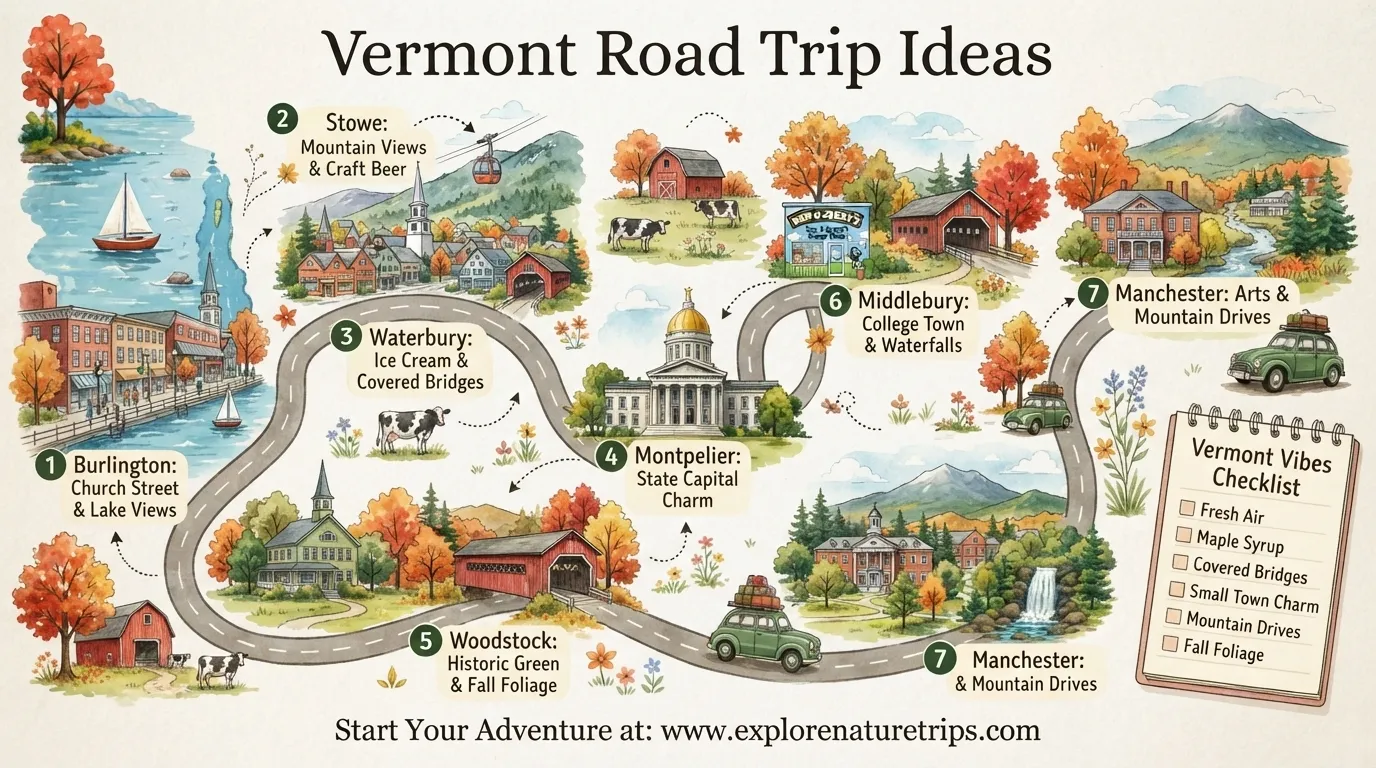
A Vermont road trip is one of the easiest ways to experience the state’s small towns, mountain scenery, covered bridges, waterfalls, farms, lakes, and scenic roads in one journey. Instead of staying in one destination, you can connect several of Vermont’s most memorable places by car and create a trip that fits your schedule.
Whether you have a weekend, 3 days, 7 days, or 11 days, Vermont offers enough variety to build a road trip around scenic drives, hiking, maple syrup, cheese, historic attractions, shopping, and fall foliage. The best approach is not to rush between every attraction. Choose a route, allow time for stops, and leave some flexibility for weather and unexpected discoveries.
This guide brings together the most useful ideas for planning a Vermont road trip, including scenic byways, small towns, waterfalls, covered bridges, viewpoints, practical driving information, and sample itinerary structures.
1. Drive Scenic Route 100
Scenic Route 100 is one of the most useful roads to include when creating Vermont road trip ideas. It connects numerous communities and gives travelers access to mountain scenery, waterfalls, shops, farms, and outdoor attractions.
A particularly useful approach is to treat Route 100 as the backbone of a road trip rather than trying to drive its entire length in one day.
Route 100 Road Trip Tips
- Allow extra time for roadside stops.
- Combine the drive with Woodstock, Stowe, Waterbury, or Killington.
- Stop at local farms and small businesses.
- Expect slower travel when foliage is at its peak.
- Avoid planning every minute of the day.
A scenic road becomes much more enjoyable when you have enough time to pull over, walk around, take photographs, or explore a small town.
2. Explore Stowe
Stowe is an excellent starting point for travelers who want a combination of mountain scenery and small-town experiences.
The downtown area has shops, bookstores, cafés, breweries, and restaurants, while the surrounding area provides access to mountain roads and outdoor activities.
Mount Mansfield rises above the area at more than 4,000 feet, making the Stowe region particularly attractive for travelers who want mountain views.
Things to Do Around Stowe
- Walk around downtown.
- Explore local shops and bookstores.
- Visit cafés and breweries.
- Drive toward Smugglers’ Notch.
- Combine Stowe with Route 100.
- Plan a hiking day if weather conditions are suitable.
If you’re staying in Stowe, don’t feel obligated to spend the entire day driving somewhere else. The town itself can comfortably fill part of an itinerary.
3. Take the Smugglers’ Notch Drive
Smugglers’ Notch is a natural addition to a Stowe-focused road trip.
The narrow mountain landscape creates a very different driving experience from Vermont’s open rural roads. Because conditions can change, check road conditions before heading out, particularly during colder months.
For travelers staying in Stowe, Smugglers’ Notch is only about 10 minutes away according to the itinerary research.
4. Spend Time in Woodstock
Woodstock is one of the strongest small-town stops for a Vermont road trip.
Its appeal comes from the combination of historic architecture, local shops, covered bridges, farms, and a walkable downtown.
Rather than treating Woodstock as a quick photo stop, give yourself enough time to explore.
What to Combine With Woodstock
- Middle Bridge
- Billings Farm & Museum
- Marsh-Billings-Rockefeller National Historical Park
- Jenne Farm
- Quechee Gorge
Woodstock is particularly convenient because several attractions can be reached with relatively short drives.
For example, Billings Farm & Museum is about a 2-minute drive from Woodstock, while Jenne Farm is roughly 20 minutes away.
5. Photograph Vermont’s Covered Bridges
Covered bridges are one of the easiest ways to add character to a Vermont road trip.
The state has 100+ covered bridges, with some dating back to the 1820s. You don’t need to visit dozens of them. Select a few that fit naturally into your driving route.
Good Covered-Bridge Stops
- Middle Covered Bridge
- Taftsville Covered Bridge
- Creamery Covered Bridge
- Cornish-Windsor Covered Bridge
A good strategy is to combine bridges with nearby towns rather than driving long distances simply to photograph one.
6. Stop at Jenne Farm
Jenne Farm is particularly appealing to photographers because of its classic Vermont landscape.
The location became widely recognized through photography, and it has been associated with Vermont imagery for decades.
From Woodstock, the drive is approximately 20 minutes, making it an easy addition to a Woodstock-focused route.
Photography tip: Early morning or late afternoon can provide more attractive light and a quieter atmosphere than the middle of the day.
7. Visit Quechee Gorge
Quechee Gorge is one of the most convenient scenic stops in Vermont because you don’t need a full day to experience it.
The gorge is approximately 165 feet deep, and the main trail is about 2.7 miles.
Why Add Quechee Gorge?
- Easy to combine with Woodstock.
- Short enough for a road-trip stop.
- Good viewpoint opportunities.
- Suitable for travelers who want scenery without a long hike.
Woodstock to Quechee Gorge is approximately 15 minutes, making these two destinations a natural combination.
8. Drive the Mount Ascutney Parkway
For travelers who enjoy mountain drives, Mount Ascutney Parkway is another useful addition.
The parkway is approximately 3.7 miles long and climbs to around 2,800 feet.
The short distance makes it particularly useful when you want a scenic mountain experience without dedicating an entire day to driving.
Best Time for the Parkway
The opening period mentioned in the research is approximately mid-May through mid-October.
During autumn, the drive can become especially attractive because of Vermont’s foliage.
Always check current operating and road conditions before making the drive.
9. Follow the Connecticut River Byway
The Connecticut River Byway is a much larger road-trip concept.
The overall byway is approximately 500 miles and passes through a broader three-state region. However, you don’t need to tackle the entire route.
A useful Vermont-focused section follows Route 5 between Brattleboro and St. Johnsbury.
Recommended Section
| Route | Distance | Suggested Time |
| Brattleboro → St. Johnsbury via Route 5 | 128 miles | 2–3 days |
This approach works well for travelers who want a slower road trip with time for towns, scenery, historic attractions, and roadside stops.
10. Explore Brattleboro
Brattleboro adds a different personality to a Vermont road trip.
Instead of focusing only on outdoor scenery, you can spend time exploring independent bookstores, cafés, local businesses, art, and the Connecticut River area.
It also works particularly well as a starting point for a southern Vermont itinerary.
Brattleboro Works Well For
- Weekend road trips
- Connecticut River routes
- Bookstores
- Local food
- Art and culture
- Scenic drives
11. Visit Bennington
Bennington is another strong southern Vermont stop, particularly for travelers interested in history.
The Bennington Battle Monument is approximately 306 feet tall, while another description compares it to nearly 13 stories.
The Battle of Bennington took place on August 16, 1777, making the area particularly relevant for travelers interested in Vermont’s historical background.
You can combine Bennington with:
- Bennington Museum
- Molly Stark Byway
- Manchester
- Woodford State Park
- Wilmington
12. Drive the Molly Stark Byway
The Molly Stark Byway is a good choice if you want your trip to focus on scenic driving rather than simply checking attractions off a list.
A direct drive through the byway can take roughly 1 hour, while a more relaxed trip with stops can take considerably longer.
This is an important road-trip planning lesson: driving time and sightseeing time are not the same thing.
If you want photographs, hiking, food, and small-town exploration, build extra time into the route.
13. Visit Manchester
Manchester is an excellent place to slow down after spending time on southern Vermont’s scenic roads.
The town works well as part of a route connecting:
Bennington → Molly Stark Byway → Manchester → Green Mountain region
Travelers can combine shopping, historic attractions, outdoor activities, and scenic mountain landscapes without constantly changing hotels.
14. Hike to Lye Brook Falls
If hiking is one of your priorities, Lye Brook Falls is a worthwhile addition.
The hike is approximately 5 miles, making it more substantial than a quick roadside viewpoint.
Plan enough time for the trail instead of treating it as a quick stop between two destinations.
For a hiking-focused road trip, this can be paired with Manchester and the surrounding Green Mountain area.
15. Explore Lake Willoughby
Lake Willoughby provides one of the biggest scenery changes on a Vermont road trip.
The lake stretches for more than 10 miles, with opportunities for scenery, hiking, waterfalls, and seasonal recreation.
Why Lake Willoughby Stands Out
It works particularly well for travelers who want:
- Mountain-and-lake scenery
- Hiking
- Waterfalls
- Photography
- Summer swimming
- A quieter northern Vermont experience
Because this area is farther from some of Vermont’s major tourist centers, it makes more sense as part of a northern route rather than a quick detour from southern Vermont.
16. Add Middlebury for Food and Local Flavor
Middlebury is useful when your Vermont road trip includes an interest in cheese, maple syrup, local businesses, and small-town exploration.
Instead of making every stop about sightseeing, adding food-related experiences creates a more balanced itinerary.
A road trip can combine:
Middlebury → local cheese → maple products → small-town shopping → scenic drive
This is especially enjoyable for travelers who like discovering regional products rather than visiting only major attractions.
17. Explore Burlington and Lake Champlain
Burlington provides a different experience from the smaller towns farther south.
You can combine city exploration with Lake Champlain, Church Street Marketplace, restaurants, shops, and cultural attractions.
Church Street Marketplace is approximately 4 blocks long, making it easy to explore on foot.
Add to a Burlington Day
- Church Street Marketplace
- Lake Champlain
- ECHO Center
- Local restaurants
- Waterfront areas
- Nearby scenic drives
Burlington can also serve as a convenient base for exploring other northern Vermont destinations.
18. Drive the Lake Champlain Byway
For travelers who want a longer northern Vermont route, the Lake Champlain Byway is another strong option.
The route is approximately 185 miles, and a 2–3 day itinerary is more realistic if you want to explore rather than simply drive through.
Potential areas to connect include:
- Burlington
- Vergennes
- Mount Philo
- Shelburne
- Alburgh
- Lake Champlain
This route works particularly well during a longer Vermont trip.
19. Visit Mount Philo State Park
Mount Philo is a useful stop when you’re exploring the Burlington and Lake Champlain region.
The summit elevation is approximately 968 feet, so it doesn’t require the same type of mountain commitment as some of Vermont’s higher peaks.
Its location makes it especially convenient for travelers looking for a viewpoint without dedicating an entire day to a major hike.
Vermont Road Trip Itinerary Ideas
One of the biggest differences between successful road trips and exhausting ones is how many nights you spend in each area.
Instead of changing hotels every night, group nearby destinations together.
3-Day Vermont Road Trip
| Day | Main Area | Suggested Highlights |
| Day 1 | Southern Vermont | Brattleboro → Molly Stark Byway → Bennington |
| Day 2 | Central Vermont | Manchester → Route 100 → Woodstock |
| Day 3 | Woodstock/Quechee | Covered bridges → Billings Farm → Quechee Gorge |
This works well for travelers with limited time.
7-Day Vermont Road Trip
| Day | Destination / Area | Focus |
| Day 1 | Woodstock | Town, covered bridges |
| Day 2 | Middlebury | Maple syrup, local food |
| Day 3 | Burlington | Lake Champlain, Church Street |
| Day 4 | Waterbury & Stowe | Scenic drives, local stops |
| Day 5 | Stowe | Mountain scenery, Smugglers’ Notch |
| Day 6 | Route 100 | Waterfalls, scenic drive |
| Day 7 | Southern/Central Vermont | Flexible sightseeing |
A seven-day trip gives you much more breathing room than a weekend itinerary.
11-Day Vermont Road Trip
For a longer trip, a useful structure is:
| Days | Base / Destination |
| Days 1–2 | Burlington |
| Day 3 | Mount Philo |
| Day 4 | Button Bay |
| Days 5–6 | Stowe |
| Days 7–8 | Montpelier |
| Day 9 | Green Mountain National Forest |
| Days 10–11 | Manchester |
The biggest advantage of an 11-day itinerary is that you don’t have to choose between towns, hiking, scenic drives, and attractions.
Vermont Road Trip Hiking Numbers
If hiking is part of your plan, keep trail distance in mind when scheduling driving days.
| Trail | Approximate Distance |
| Quechee Gorge Trail | 2.7 miles |
| Pogue + Mount Tom Trail | 4.2 miles |
| Lye Brook Falls | 5 miles |
| Camel’s Hump Trail | 6 miles |
| Everett Cave hike | 1 mile |
| Inn-area hiking trails | 15 miles |
Don’t schedule several longer hikes on the same day as multiple long drives unless you’re comfortable spending most of the day outdoors.
How Far Is Vermont From Major Cities?
Vermont is accessible by car from several major northeastern cities.
| Starting Point | Approximate Drive |
| Boston | ~2.5 hours |
| Lincoln, NH | 1 hr 40 min / 76 miles |
| Hartford, CT | 2.5 hrs / 147 miles |
| Lake Placid, NY | 3 hrs / 128 miles |
| Portland, ME | 3 hrs / 181 miles |
| Providence, RI | 3 hrs 15 min / 189 miles |
| New York City | 4.5 hrs / 263 miles |
These are useful planning figures, but actual travel time can vary because of traffic, weather, construction, and seasonal congestion.
Best Time for a Vermont Road Trip
Fall
Fall is arguably the most visually dramatic period for a Vermont road trip.
Peak foliage is generally discussed around late September through mid-October, although exact timing varies by location and year.
Expect higher demand and more traffic around popular scenic roads.
Summer
June through August is useful for hiking, swimming, outdoor activities, events, and generally easier road conditions.
This is a good choice if outdoor activities matter more to you than fall colors.
Spring
Spring brings waterfalls and maple sugaring, but it can also mean mud season.
Road and trail conditions may not be as predictable as during summer.
Winter
Winter changes the character of the trip completely.
Snow, skiing, and winter scenery can be appealing, but icy roads and changing weather require more careful planning.
Vermont Road Trip Packing Essentials
Your packing list should depend on the season and the activities you plan to do.
Basic Road-Trip Items
- Comfortable walking shoes
- Weather-appropriate clothing
- Reusable water bottle
- Phone charger
- Car charger
- Navigation backup
- Snacks
- Sunglasses
- Small first-aid kit
- Daypack
If You’re Hiking
Add:
- Hiking shoes
- Extra socks
- Rain layer
- Water
- Trail snacks
- Offline maps
- Warm layer
Tip: Download important maps before leaving areas with reliable mobile service.
How to Plan a Better Vermont Road Trip
The most useful planning strategy is to organize your trip geographically.
Don’t Chase Every Attraction
Vermont has enough attractions to fill weeks. Trying to visit everything can turn a relaxing road trip into a driving marathon.
Instead, choose one main region per day.
Group Nearby Stops
For example:
Woodstock + Billings Farm + Jenne Farm + Quechee Gorge
makes much more sense than visiting Woodstock, Burlington, and Bennington on the same day.
Leave Buffer Time
Add at least some unplanned time for:
- Scenic viewpoints
- Local cafés
- Farm stands
- Unexpected road stops
- Weather changes
- Longer hikes
Start Early During Peak Season
Popular areas can become crowded, particularly during fall foliage.
Starting earlier can make it easier to find parking, enjoy trails, and photograph popular locations before crowds arrive.
Vermont Road Trip Mistakes to Avoid
1. Packing Too Much Into One Day
A road trip should not feel like a race.
2. Ignoring Seasonal Road Conditions
Winter and spring can change driving conditions significantly.
3. Underestimating Hiking Time
A 5-mile hike is very different from a 10-minute scenic viewpoint.
4. Changing Hotels Every Night
Use regional bases whenever possible.
5. Planning Only Major Attractions
Some of the most enjoyable Vermont experiences come from small towns, farms, covered bridges, local shops, and scenic roads.
6. Forgetting Peak-Season Crowds
Fall foliage can be especially busy. Book accommodation and popular activities ahead of time when possible.
A Simple Vermont Road Trip Planning Formula
If you’re building your own itinerary, use this formula:
Choose a region → select 2–4 major stops → add one scenic drive → leave free time → check road conditions.
For example:
Stowe → Smugglers’ Notch → Route 100 → waterfall → local dinner
is usually more enjoyable than trying to visit eight unrelated attractions in one day.
Some Questions
How many days do you need for a Vermont road trip?
Three days can cover several major highlights, while 7 days provides a much more relaxed experience. An 11-day itinerary is better if you want to explore multiple regions without rushing.
What is the best Vermont road trip route?
There isn’t one single best route. Route 100, the Green Mountain Byway, Molly Stark Byway, Connecticut River Byway, and Lake Champlain Byway are strong choices depending on which part of Vermont you want to explore.
What are the best stops on a Vermont road trip?
Popular options include Stowe, Woodstock, Quechee Gorge, Bennington, Manchester, Burlington, Brattleboro, Lake Willoughby, Middlebury, and Mount Philo.
How long is Route 100 in Vermont?
Route 100 is best thought of as a major north-south scenic road rather than a single attraction. You don’t need to drive the entire route to enjoy it; selecting a section around your other destinations is often more practical.
Is Vermont good for a 3-day road trip?
Yes. A three-day trip works particularly well if you concentrate on one region, such as southern Vermont and Woodstock, rather than attempting to cover the entire state.
When is the best time for fall foliage?
The commonly cited peak period is late September through mid-October, although foliage timing varies from year to year and by elevation and location.
Are Vermont road trips good for hiking?
Yes. You can choose anything from a 1-mile hike to trails around 6 miles or more, depending on your fitness and itinerary.
How far is Quechee Gorge from Woodstock?
The drive is approximately 15 minutes, making it easy to combine both attractions in one day.
How far is Jenne Farm from Woodstock?
Jenne Farm is approximately 20 minutes from Woodstock, so it works well as part of a Woodstock-area itinerary.
Can you visit Vermont without planning every stop?
Yes. In fact, leaving some flexibility can improve the experience. Vermont has many small towns, farms, viewpoints, cafés, and roadside attractions that can be discovered along the way.
Final Thoughts
The best Vermont road trip ideas aren’t necessarily the ones with the most stops. A better trip combines scenic roads, small towns, outdoor experiences, local food, historic attractions, and enough time to actually enjoy each place.
For a short trip, focus on a compact region such as Woodstock, Quechee, and southern Vermont. With 7 days, you can comfortably add Burlington, Stowe, Route 100, and more hiking. With 11 days, you have enough time to slow down and explore multiple regions.
Whether you’re chasing fall foliage, mountain views, covered bridges, waterfalls, maple syrup, or quiet country roads, Vermont gives you plenty of ways to build a road trip around your own travel style.
Hi, I’m Marcus! I love exploring the outdoors and discovering incredible places. Through ExploreNatureTrips blog, I share my travel experiences, useful tips, and recommendations for the best sights, trails, and destinations to visit.
2 Comments