Lake Superior Circle Tour: Complete 10–14 Day Road Trip Guide
Lake Superior Circle Tour: Complete Road Trip Guide
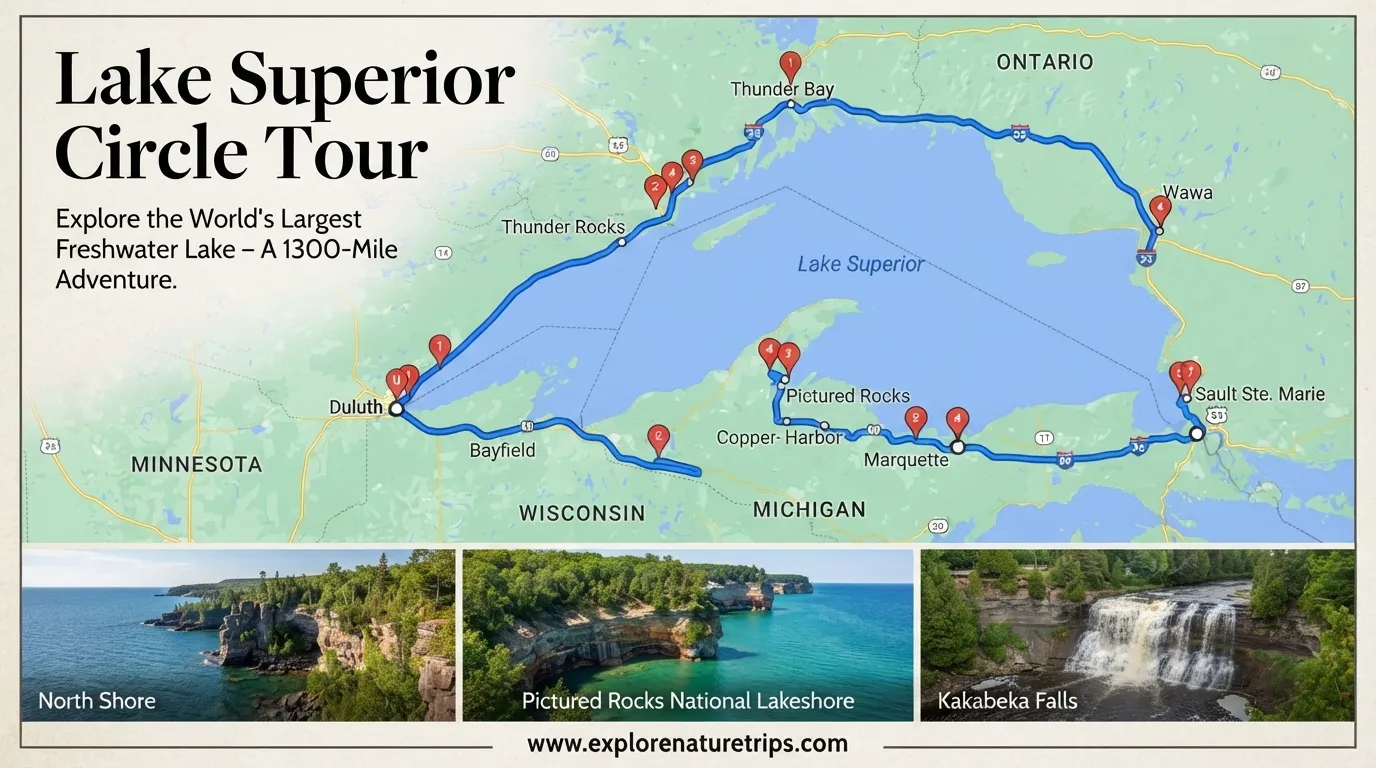
The Lake Superior Circle Tour is a spectacular international road trip that loops around Lake Superior through Michigan, Minnesota, Wisconsin, and Ontario. The complete route is commonly described as approximately 1,300 miles (2,092 km), although some itinerary-focused guides describe the journey as 1,000+ miles depending on the route and detours.
This is not a road trip that needs to be rushed. Depending on your travel style, you can attempt the loop in 4–5 days, follow a more comfortable 9-day itinerary, or spend 10–14 days exploring scenic roads, waterfalls, lighthouses, parks, beaches, towns, and wilderness areas.
The biggest advantage of taking more time is simple: you spend less of the trip behind the wheel and have more opportunities to stop, hike, explore, and enjoy Lake Superior.
How Long Does the Lake Superior Circle Tour Take?
There is no single correct answer because the Circle Tour can be approached at very different speeds.
4–5 Days: Fast Road Trip
A 4–5 day trip is possible for travelers who want to cover the route quickly. However, this approach leaves considerably less time for hiking, sightseeing, town visits, and spontaneous stops.
It is best suited to travelers who are primarily interested in completing the loop rather than experiencing every destination.
9 Days: More Experienced Itinerary
A 9-day itinerary provides a better balance between driving and sightseeing.
You can cover substantial portions of the route while still leaving time for important stops. However, careful planning is still useful because Lake Superior offers far more attractions than can comfortably fit into a short schedule.
10–14 Days: Recommended for Exploring
For travelers who want a more relaxed experience, 10–14 days is the stronger target.
A longer itinerary gives you more opportunities to:
- Explore waterfalls
- Visit historic lighthouses
- Hike in parks
- Enjoy scenic overlooks
- Visit small communities
- Spend time along the shoreline
- Stop at attractions without constantly watching the clock
- Deal with changing weather
- Include additional detours
A 12-day itinerary is particularly useful because it provides enough time to divide the major sections of the loop into manageable travel days.
Up to 2 Weeks: Slow-Paced Travel
An extended trip of up to 2 weeks works well for travelers who prefer a slower road-trip experience.
Instead of treating the Circle Tour as a race around the lake, you can make the journey about the destinations themselves.
Where Does the Lake Superior Circle Tour Start and End?
There are several practical ways to approach the loop.
One itinerary begins and ends in Duluth, Minnesota, creating a natural circular route through Minnesota, Ontario, Michigan, and Wisconsin.
Another major starting point is Sault Ste. Marie, Michigan, which provides direct access to the eastern Upper Peninsula and the Canadian side of the journey.
Because it is a circle, your starting point does not necessarily need to determine the overall experience.
Starting in Duluth
Duluth is a useful starting point for travelers following a western Lake Superior itinerary.
The first part of the journey can introduce you to:
- The Duluth waterfront
- Aerial Lift Bridge
- Lakewalk
- Minnesota’s North Shore
- Scenic shoreline landscapes
Starting in Sault Ste. Marie
Sault Ste. Marie, Michigan, is another prominent gateway. It is described as Michigan’s oldest city and a gateway to the Great Lakes.
Across the International Bridge is Sault Ste. Marie, Ontario, making this area particularly important for travelers crossing between the United States and Canada.
Which Direction Should You Drive?
The Circle Tour can be traveled clockwise or counterclockwise.
The official-style trip-planning system described in the competitor research allows travelers to select a starting point and choose either direction.
Your choice can depend on:
- Starting city
- Desired attractions
- Available time
- Camping reservations
- Weather
- Personal preference
The important thing is to build the route around the places you actually want to experience rather than simply following mileage.
A 12-Day Lake Superior Circle Tour Itinerary
A 12-day plan gives travelers enough structure without making every hour of the trip rigid.
Day 1 – Duluth, Minnesota
Begin in Duluth and explore the waterfront before starting the longer loop.
Important stops include:
- Duluth waterfront
- Aerial Lift Bridge
- Lakewalk
- Lake Superior shoreline
This is a good introductory day because you can experience the lake before beginning the longer scenic drive.
Day 2 – Split Rock Lighthouse to Thunder Bay
Continue along Minnesota’s North Shore toward the Canadian border.
A major stop is Split Rock Lighthouse, followed by the drive toward Thunder Bay.
The focus of this section is the combination of:
- Scenic shoreline
- Lighthouse views
- North Shore scenery
- International travel
Day 3 – Sleeping Giant Provincial Park
Spend the day around Sleeping Giant Provincial Park.
The area is especially associated with:
- Large cliffs
- Hiking
- Lake Superior views
- Wilderness scenery
Rather than treating the park as a quick roadside stop, give yourself time to experience its landscape.
Day 4 – Lake Superior Provincial Park
Continue through Lake Superior Provincial Park.
This section offers a different side of the journey, with:
- Rocky beaches
- Large waves
- Wilderness
- Scenic shoreline
The park section demonstrates why the Circle Tour is more than simply a highway loop.
Day 5 – Sault Ste. Marie and Eastern Upper Peninsula
Travel toward Sault Ste. Marie and begin transitioning back toward Michigan’s Upper Peninsula.
This is an important point in the route because the journey moves from Ontario toward the eastern U.P.
Day 6 – Pictured Rocks National Lakeshore
Continue toward Pictured Rocks National Lakeshore.
Major experiences include:
- Sandstone cliffs
- Waterfalls
- Overlooks
- Hiking
- Shoreline views
Pictured Rocks is one of the major scenic highlights to consider when building a Michigan section of the Circle Tour.
Days 7–12 – Continue the Loop
The remaining days can be organized around the destinations that matter most to you.
Potential areas and attractions identified in the competitor research include:
- Keweenaw Peninsula
- Apostle Islands
- Tahquamenon Falls State Park
- Boundary Waters Canoe Area Wilderness
- Frog Bay Tribal National Park
- Isle Royale National Park
- Grand Marais
- Marquette
- Thunder Bay
- Sault Ste. Marie
The key advantage of a 12-day or longer itinerary is that you do not have to squeeze every attraction into a single day.
The Biggest Attractions to Build Into Your Route
The Lake Superior Circle Tour contains a wide variety of natural and cultural stops.
Waterfalls
Waterfalls are one of the major attractions associated with the route. The competitor research identifies 90+ waterfalls across the Circle Tour experience.
Some trips can emphasize waterfalls more heavily in spring, when water levels and flow make them especially attractive.
Lighthouses
The route is also associated with 56 historic lighthouses.
If lighthouses are a priority, plan your stops rather than attempting to visit them randomly. A focused lighthouse itinerary can become a major theme of the road trip.
Parks and Wilderness
Nature-focused travelers can build the journey around parks and wilderness areas.
Notable destinations from the researched competitors include:
- Sleeping Giant Provincial Park
- Lake Superior Provincial Park
- Pictured Rocks National Lakeshore
- Tahquamenon Falls State Park
- Boundary Waters Canoe Area Wilderness
- Apostle Islands National Lakeshore
- Frog Bay Tribal National Park
- Isle Royale National Park
These locations make the Circle Tour especially attractive for travelers who want hiking and outdoor experiences rather than only scenic driving.
How Much Should You Drive Each Day?
One of the most useful planning recommendations is to limit normal driving to approximately 2–5 hours per day.
This makes a significant difference to the quality of the trip.
A day with 2 hours of driving can leave plenty of time for hiking and sightseeing. A day closer to 5 hours may be better used as a transportation-focused day between major destinations.
Why Avoid Overloading Your Schedule?
A road trip around Lake Superior includes:
- Border crossings
- Weather changes
- Scenic stops
- Hiking
- Parks
- Small communities
- Photography opportunities
- Food and lodging stops
Trying to schedule every hour can turn an enjoyable road trip into a race.
Leave room for stops.
Best Time to Take the Lake Superior Circle Tour
The researched guides identify May through October as an attractive overall travel period, while another itinerary recommends June through September.
Each season has a different advantage.
April
April can offer:
- Powerful waterfalls
- Fewer bugs
- Lower rates
However, some campgrounds and businesses may still be closed.
Late May and June
This period can mean:
- Fewer crowds
- Lower rates
- Active natural scenery
One major drawback is the presence of black flies, particularly around this period.
Mid-June
By mid-June, more festivals, tours, and attractions become active.
July
Late July brings seasonal highlights such as the beginning of blueberry and thimbleberry season.
August
August can be a strong period for swimming, particularly around the south shore.
September
September offers:
- Good weather
- Lower traffic
- Fewer bugs
It can be a particularly comfortable month for travelers who want a quieter experience.
Late September to Mid-October
This is the major fall foliage window identified in the competitor research.
The peak is described as occurring around late September through mid-October, while another guide narrows the strongest foliage period to late September–early October.
Fall weekends can still be busy, so lower traffic does not necessarily mean empty destinations.
Is Winter a Good Time for the Circle Tour?
A complete winter Circle Tour is generally not presented as the easiest option.
The researched travel guidance describes winter as generally unsuitable for a full Circle Tour unless travelers have the appropriate winter-driving skills and equipment.
Lake Superior weather can change quickly, so seasonal conditions should be taken seriously when planning a full loop.
What Should You Pack?
Because conditions can change quickly around Lake Superior, packing only for one type of weather is risky.
The researched packing recommendations include:
- Shorts
- T-shirts
- Long pants
- Fleece
- Raincoat
- Winter jacket
- Warm hat
- Gloves
- Socks
- Boots
- Sandals or water shoes
You should also consider carrying:
- Water
- Snacks
- Picnic supplies
- Flashlight or lantern
- Cell phone
- Compass
- Blankets
- Matches
- First-aid kit
The main lesson is to prepare for changing conditions rather than packing exclusively for the forecast at departure.
Camping Reservations: Plan Early
Camping is one area where advance planning matters significantly.
The competitor research provides these reservation windows:
| Camping Area | Recommended Reservation Window |
|---|---|
| Minnesota state parks | 120 days ahead |
| Ontario provincial parks | 5 months ahead |
| Michigan state parks | 6 months ahead |
| Wisconsin state parks | 11 months ahead |
This can make a major difference during busy periods.
Minnesota’s North Shore state-park campgrounds can become nearly full during summer. Fall weekends can also be crowded, while holiday weekends are particularly demanding.
Canadian summer holiday weekends can add additional camping pressure.
Book early when possible, especially if your itinerary depends heavily on camping.
Festivals and Seasonal Events
The researched planning guide identifies numerous events that can influence when travelers choose to visit.
| Event | Timing |
|---|---|
| Canada Day | July 1 |
| Red Cliff Powwow | Fourth of July |
| Blueberry Festival | Last Friday in July |
| Art on the Rocks | Last weekend of July |
| Fisherman’s Picnic | First weekend of August |
| Rendezvous and Powwow | Second weekend of August |
| Winnie the Pooh Festival | Mid-August |
| Live From the Rock | Mid-August |
| HarborFest | Late August |
| Lake Superior Dragon Boat Festival | Late August |
| Festival of Arts | First weekend after Labor Day |
| Blues Fest | Labor Day weekend |
| Copper Harbor Trails Festival | Labor Day weekend |
| Apple Festival | First weekend of October |
These dates can be useful when deciding whether to plan your trip around a specific event or avoid busy periods.
Border Crossing and International Travel
The Lake Superior Circle Tour crosses between the United States and Canada, so international travel preparation is essential.
A passport is required when crossing into Canada according to the researched itinerary information.
Travelers should also remember that crossing the border can affect the timing of an itinerary. Avoid planning an extremely tight schedule on a day that includes an international crossing.
Time Zones Matter
Time zones are another small detail that can become important on a long road trip.
The researched UPTravel guide specifically notes that:
- Western Upper Peninsula
- Wisconsin
- Minnesota
are in the Central Time Zone.
When building a detailed itinerary, keep time-zone changes in mind so reservations and planned arrival times do not become confusing.
Driving, GPS and Cell Service
The Circle Tour passes through a mixture of communities, wilderness areas, parks, and scenic roads.
For that reason, trip preparation should include:
- Cell phone
- GPS or navigation
- Offline route information where appropriate
- Compass
- Emergency supplies
- Water and snacks
Do not build your entire trip around the assumption that every part of the route will provide the same level of connectivity or roadside services.
Motorcycle, RV and Family Travel
The Circle Tour is not limited to one type of traveler.
The researched official-style resource provides planning filters for:
- Motorcycle Friendly
- RV Friendly
- Pet Friendly
- Roadside locations
- Accessibility-related options
The planning ecosystem also contains information relating to:
- Camping
- Wildlife
- Weather
- Cell coverage
- Border crossing
- RV travel
- Motorcycle travel
This makes it easier to adapt the same general route to different travel styles.
Can You Add the Keweenaw Peninsula?
Yes, the Keweenaw Peninsula is identified as an optional detour in the itinerary research.
A detour adds distance and time, so it is better suited to travelers following a 10–14 day or longer schedule rather than someone trying to finish the loop in 4–5 days.
The same principle applies to other optional destinations: the longer your trip, the more freedom you have to explore beyond the basic loop.
Isle Royale and the Circle Tour
Isle Royale National Park is another destination identified in the researched travel guide.
The planning information also describes a partial route involving:
Grand Portage → Rock Harbor → Copper Harbor
by ferry.
Because this is an additional travel component rather than simply another roadside stop, it requires more careful itinerary planning.
What Makes the Lake Superior Circle Tour Different?
The route combines several types of travel experiences into one loop.
Scenic Driving
The journey itself is part of the attraction. Instead of simply traveling between two cities, the route repeatedly places you alongside Lake Superior landscapes.
Hiking
There are opportunities to build hiking into multiple sections, including destinations such as Sleeping Giant Provincial Park and Pictured Rocks.
Waterfalls
With 90+ waterfalls identified in the researched guide, waterfall hunting can easily become a major theme of the trip.
Lighthouses
With 56 historic lighthouses, lighthouse enthusiasts have another strong reason to slow down.
Small Communities
The journey also connects travelers with communities such as:
- Duluth
- Grand Marais
- Marquette
- Sault Ste. Marie
- Thunder Bay
International Travel
Unlike a conventional U.S. road trip, the Circle Tour involves travel through Ontario, making border planning part of the experience.
Lake Superior Circle Tour Planning Checklist
Before leaving, use this quick checklist.
Route
- Decide whether to start in Duluth or Sault Ste. Marie
- Choose clockwise or counterclockwise
- Calculate whether your trip is 4–5, 9, 10–14 days, or longer
- Add extra time for detours
Documents
- Passport
- Required travel documents
- Reservation information
Navigation
- GPS
- Cell phone
- Route information
- Compass
Outdoor Gear
- Raincoat
- Warm layers
- Boots
- Water shoes or sandals
- First-aid kit
- Flashlight or lantern
Food and Emergency Supplies
- Water
- Snacks
- Picnic supplies
- Blankets
- Matches
Camping
Check reservation windows carefully:
120 days → Minnesota
5 months → Ontario
6 months → Michigan
11 months → Wisconsin
How to Plan a Better 10–14 Day Trip
A longer itinerary should not simply mean adding more driving.
Instead, use the extra days to improve the experience.
1. Keep Daily Driving Reasonable
Aim for approximately 2–5 hours of driving on normal travel days.
2. Group Nearby Attractions
Instead of crossing large distances repeatedly, group waterfalls, parks, lighthouses, and communities that are naturally along the same section of the route.
3. Reserve Popular Camping Spots
Summer and fall weekends can become busy. Make reservations according to the relevant state or provincial booking window.
4. Keep a Weather Buffer
Lake Superior weather can change rapidly. Avoid building an itinerary where one delayed activity causes the entire trip to collapse.
5. Leave Space for Unexpected Stops
Some of the best road-trip experiences happen when you have enough time to stop without worrying about reaching the next destination immediately.
Lake Superior Circle Tour Trip Planner
The researched official-style Circle Tour resource provides a detailed trip-planning system.
Travelers can:
- Create an account
- Use an online map
- Filter destinations
- Add locations to a trip
- Select a starting point
- Choose clockwise or counterclockwise travel
- Organize itinerary locations
- View regions
- Save a trip as PDF
- Print the itinerary
- Download GPX files
- Import directions into Google Maps
- Share the trip
The available filters include options such as Motorcycle Friendly, RV Friendly, and Pet Friendly.
There is also a free Lake Superior Circle Tour mobile app for iOS and Android, including iPhone and iPad.
Frequently Asked Questions
How many miles is the Lake Superior Circle Tour?
The commonly stated Circle Tour distance is approximately 1,300 miles (2,092 km). Some itinerary guides describe their route as 1,000+ miles, especially when discussing specific routes and detours.
How many days do you need for the Lake Superior Circle Tour?
You can technically complete it in 4–5 days, while 9 days is presented as a more experienced itinerary. For a more relaxed trip with sightseeing, 10–14 days is a better target.
How many hours should you drive each day?
A useful target is around 2–5 hours of driving per day. This leaves time for hiking, attractions, meals, photography, and exploring communities.
What are the best months for the Lake Superior Circle Tour?
The broader recommended season is May through October, while another itinerary identifies June through September as particularly suitable. Fall foliage is strongest around late September through mid-October.
Do I need a passport for the Circle Tour?
Yes. The researched itinerary information states that a passport is required when crossing into Canada.
Can I do the Circle Tour in 5 days?
Yes, a 4–5 day completion is possible, but it will be a fast-paced trip. If your goal is to hike, visit parks, explore towns, and see multiple attractions, a longer itinerary is preferable.
What is a good number of days for a first trip?
A 10–14 day itinerary gives you substantially more flexibility than a rushed 4–5 day journey.
When should I reserve campsites?
The researched reservation guidance gives different windows: 120 days ahead for Minnesota state parks, 5 months for Ontario provincial parks, 6 months for Michigan state parks, and 11 months for Wisconsin state parks.
Is the Circle Tour suitable for RVs and motorcycles?
Yes. The trip-planning resource includes RV Friendly and Motorcycle Friendly filters, allowing travelers to organize the route around their preferred travel style.
Can I travel the Circle Tour with a pet?
The researched trip-planning system includes a Pet Friendly filter, making it possible to identify suitable destinations when organizing a pet-friendly trip.
Is winter a good time to drive the full Circle Tour?
The researched travel guidance considers winter generally unsuitable for a complete Circle Tour unless travelers have appropriate winter-driving skills and equipment.
Can I add the Keweenaw Peninsula?
Yes. The Keweenaw Peninsula is identified as a detour option. It is more practical for travelers with 10–14 days or more, since additional detours increase both mileage and travel time.
Final Thoughts
The Lake Superior Circle Tour is best viewed as a complete road-trip experience rather than a race to cover 1,300 miles. A short 4–5 day journey can work for travelers focused on speed, while 9 days provides a more balanced option. For travelers who want time for waterfalls, lighthouses, hiking, parks, scenic communities, and shoreline stops, 10–14 days offers considerably more breathing room.
The most important part of planning is not simply counting miles. Build a realistic daily schedule, reserve camping early, prepare for changing weather, carry appropriate supplies, and allow enough time to enjoy the places between the major destinations.