
Russian Gulch State Park California: Trails, Waterfall, Bridge
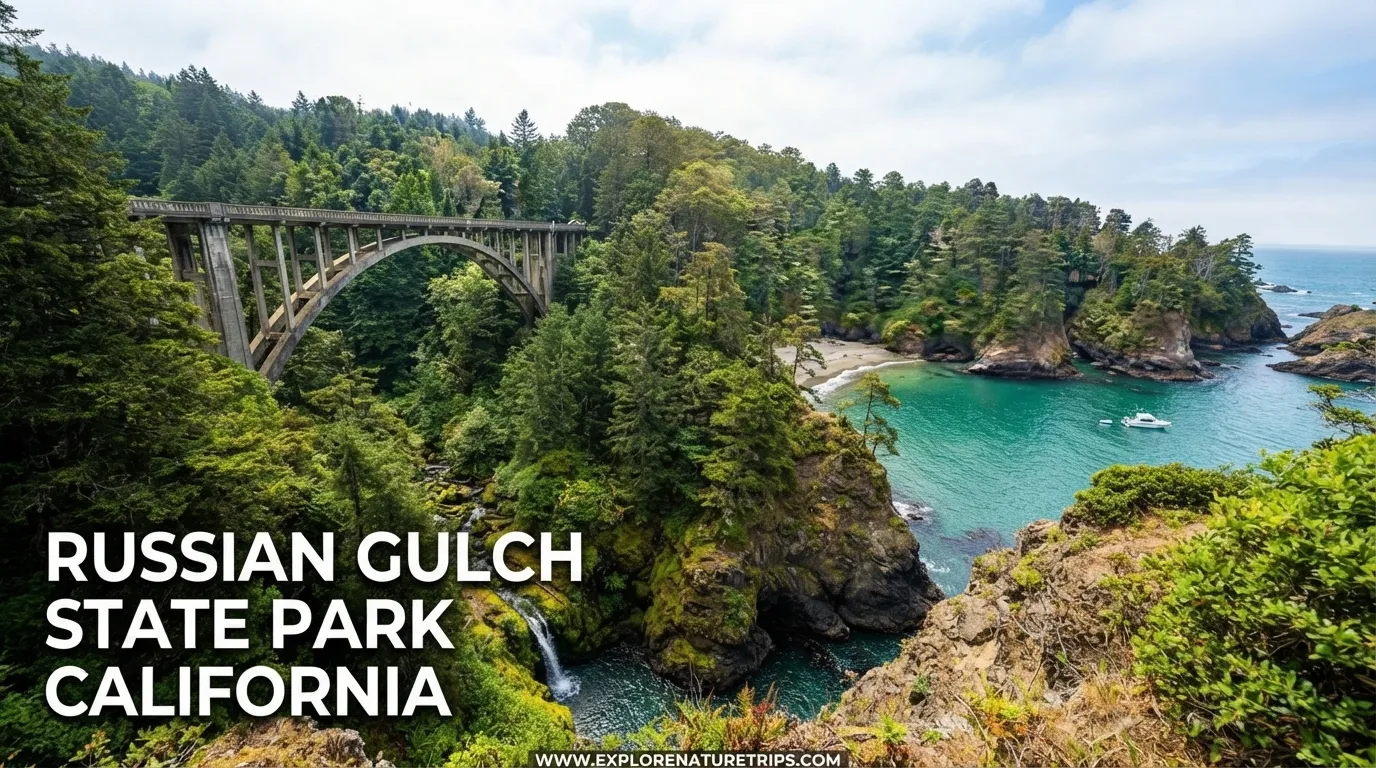
Russian Gulch State Park, California
Russian Gulch State Park California is a scenic destination on the Mendocino Coast where coastal bluffs, redwood forest, beaches, sea caves, creeks, and waterfalls come together in one park. Located about 2 miles north of Mendocino, the park covers approximately 1,000 acres and offers a variety of experiences for hikers, photographers, campers, beachcombers, bicyclists, and visitors looking for a peaceful coastal escape.
What makes Russian Gulch State Park especially interesting is the contrast between its rugged Pacific coastline and its sheltered inland forest. You can explore the headlands and sea caves, photograph the historic bridge, walk along the beach, or follow Fern Canyon Trail into the redwoods toward a 36-foot waterfall.
Whether you have only a few hours or plan to camp overnight, the park has several distinct areas worth exploring.
Explore 7 unforgettable adventures waiting for you at Russian Gulch State Park, California.
Why Visit Russian Gulch State Park?
Russian Gulch State Park stands out because its attractions are spread across both the coast and forest.
Along the western side, the headlands provide dramatic ocean scenery, rocky shoreline views, and access to viewpoints overlooking sea caves. Near the center of the park, the famous bridge crosses the sandy cove associated with Russian Gulch Creek.
Further inland, the landscape changes into a shaded forest environment where Fern Canyon Trail follows Russian Gulch Creek through redwoods, ferns, and other vegetation before reaching the waterfall.
This variety makes the park suitable for different types of visitors. Someone interested in photography may prefer the bridge and headlands, while hikers may want to explore Fern Canyon. Families can enjoy the beach and creek area, while campers can use the 30-site campground as a base for exploring the park.
1. Explore the Headlands Trail
The Headlands Trail is one of the best places to experience the coastal side of Russian Gulch State Park.
The trail is located on the western side of the park near the Pacific Coast. The Nature Seeker describes the hike as less than 1 mile, making it considerably shorter than the longer inland hiking options.
From the headlands, visitors can enjoy views of:
- The Pacific Ocean
- Rocky coastal formations
- Sea caves
- Waves crashing against the shoreline
- Coastal bluffs
- Seasonal wildflowers
The trail also provides opportunities to look toward the sea caves from above.
However, the coastline can be dangerous in places. Waves and changing ocean conditions mean visitors should remain in safe viewing areas rather than approaching unstable or exposed sections of the shoreline.
Why the Headlands Trail Is Worth It
The biggest advantage is the scenery without requiring a long hike. If you have limited time, a short coastal walk can provide some of the most memorable views in the park.
2. Discover the Sea Caves
The sea caves are another major attraction along the Russian Gulch coastline.
The Nature Seeker describes seeing 30+ sea caves in the area. Many can be viewed from the Headlands Trail, while caves closer to the bridge and bay may be easier to approach.
The appearance of the caves can change depending on the ocean and tide conditions. Some have water constantly moving through them, making them unsafe to enter.
The article also describes entering one cave on foot during low tide and notes that at least one cave can be explored by kayak.
Stay Cautious Around the Caves
Sea caves may look inviting, but they are not all safe to enter.
Before approaching one, consider:
- Tide conditions
- Wave activity
- Water movement
- Rock stability
- Your distance from the shoreline
- Whether you have a safe way back
A cave that appears calm from a distance can become dangerous when waves enter.
For most visitors, viewing the caves from a safe location is a better option than attempting to enter them.
3. See the Historic Russian Gulch Bridge
The Russian Gulch Bridge is one of the park’s most recognizable landmarks.
The bridge measures 527 feet long and rises approximately 100 feet above the area below. It is a concrete arch structure that crosses Russian Gulch Creek’s sandy cove.
The bridge was built in 1939 through the Works Progress Administration as part of the New Deal era associated with Franklin D. Roosevelt.
Its architecture has been compared with California’s well-known Bixby Bridge.
Why the Bridge Is a Photography Favorite
The bridge combines architecture with the surrounding coastal landscape. Depending on where you stand, you can photograph the concrete arch, forested surroundings, sandy cove, and ocean environment together.
The area beneath the bridge also provides access to the beach and nearby coastal activities.
4. Spend Time at Russian Gulch Beach
The beach and cove beneath the bridge provide a completely different experience from the exposed headlands.
Visitors can enjoy:
- Beach walking
- Photography
- Shell hunting
- Exploring the creek area
- Scuba diving
- Looking for marine life
The underwater environment described in the material includes sea stars, crabs, mussels, oysters, and red abalone.
The beach area can also serve as an access point for kayaking and sea-cave exploration when conditions are appropriate.
A Different View of the Park
While the headlands showcase the power of the Pacific, the cove beneath the bridge offers a more sheltered setting. This makes it a useful area to include when planning a balanced visit.
5. Hike Fern Canyon Trail
If you want to experience the forested side of Russian Gulch State Park, Fern Canyon Trail is one of the most important trails to consider.
The trail follows Russian Gulch Creek into a lush North Coast environment filled with:
- Redwood trees
- Ferns
- Horsetail
- Douglas firs
- Bigleaf maples
- Alders
- Riparian vegetation
Visit California describes the waterfall trail as following an old logging road and identifies the Fern Canyon route as paved.
The Nature Seeker describes a longer hike of 6+ miles, with approximately 6 miles round trip, reaching the waterfall deep within the park.
However, the accessibility-focused source describes an accessible Fern Canyon section of approximately 1 mile and reports turning around after 0.9 mile, while the trail appeared to continue.
These descriptions represent different portions or experiences of the trail rather than necessarily being contradictory. Visitors should therefore pay attention to the specific section and route they intend to follow.
What Makes Fern Canyon Special?
The forest environment creates a strong contrast with the coastal headlands. Instead of open ocean views, you get a shaded canyon landscape with vegetation surrounding Russian Gulch Creek.
During a wetter or early-season visit, water may flow down the canyon walls, adding to the atmosphere.
6. Visit the 36-Foot Waterfall
The inland waterfall is one of the park’s major natural attractions.
The waterfall is approximately 36 feet tall and is located in a fern-filled, verdant grotto within the forest.
The trailhead begins near the campground, making the waterfall relatively convenient to include in an inland exploration of the park.
The route passes through a forest environment containing second-growth redwoods, Douglas firs, bigleaf maples, alders, and ferns.
For visitors who enjoy forest scenery, the waterfall provides a rewarding destination after exploring the creek and canyon.
7. See Devil’s Punchbowl
Devil’s Punchbowl is one of the most unusual geological features at Russian Gulch State Park.
Visit California describes it as a collapsed sea arch located on the headlands.
Its approximate dimensions are:
- 100 feet wide
- 60 feet deep
The Nature Seeker places it less than 1 mile into the Headlands Trail and describes a drop of approximately 50 feet toward the beach.
Spring wildflowers can appear around the blufftops, while winter storms can create dramatic waves and saltwater spray through the Punchbowl.
Do Not Try to Climb Down
The feature may look tempting to explore from below, but the steep drop and coastal conditions make descending into it a poor choice.
The safer experience is to remain on established viewing areas and appreciate the formation from above.
Kayaking Around Russian Gulch
Kayaking is another activity associated with the calmer bay area near the bridge.
The coastal side of the park can have rougher conditions, while the bay near the bridge provides a more sheltered environment for kayaking.
One attraction of kayaking is the opportunity to see parts of the coastline and sea caves from the water.
However, conditions can change quickly along the coast. Visitors should avoid treating the sea caves or ocean as automatically safe simply because the water looks calm.
Safety should come before exploration.
Camping at Russian Gulch State Park
Camping can make it easier to experience both the coastal and inland portions of the park.
The campground is described as having 30 sites and is located near the waterfall trailhead.
This location can be useful for visitors who want to explore Fern Canyon without having to make the trip solely as a short coastal stop.
The park also includes picnic areas, making it possible to combine hiking or sightseeing with a meal outdoors.
What to Expect From a Camping Visit
A camping-focused visit can give you more time to experience:
- Fern Canyon
- The waterfall
- Coastal headlands
- The bridge
- Beach areas
- Picnic areas
- Sunset views
Accessibility at Fern Canyon
Russian Gulch State Park also has useful accessibility information for visitors with mobility needs.
The accessibility-focused review examined the Fern Canyon Trail using a motorized wheelchair.
The reviewed section is described with the following characteristics:
| Accessibility Feature | Details |
|---|---|
| Trail section | Fern Canyon |
| Accessible section | About 1 mile |
| Trail length described | 1–2 miles |
| Typical width | 4 feet or more |
| Elevation change | 46 feet |
| Grade | Level |
| Terrain | Firm |
| Accessible parking | 1 space |
| Accessible parking type | Van accessible |
| Maximum slope mentioned | 2% |
| Accessible picnic tables | 1 |
| Picnic-table knee clearance | 27+ inches |
| Restroom at trailhead | No |
The review notes that the trail follows Russian Gulch Creek through dense redwood forest. It also identifies 3 rock swales crossing the trail.
In some areas, gravel becomes thicker, although the reviewer found it manageable in a motorized wheelchair.
Why This Information Matters
Accessibility information can be difficult to find in general travel articles. Details such as trail width, elevation change, surface conditions, parking, and picnic-table clearance can help visitors decide whether a particular section fits their needs.
Because trail conditions can change, visitors should still verify current conditions before traveling.
Wildlife and Nature Along the Park
Russian Gulch State Park provides opportunities to observe both terrestrial and marine environments.
- Salmon
- Steelhead trout
- Rainbow trout
- Sea stars
- Crabs
- Mussels
- Oysters
- Red abalone
During the rainy season, rainbow trout and steelhead trout may be seen in the creek environment.
The coastal waters also support marine life that can be observed around the beach and cove.
Whale Watching From the Headlands
The headlands are highlighted as a whale-watching location during December through April.
This seasonal opportunity gives visitors another reason to explore the coastal portion of the park during the winter and early spring period.
Even outside whale-watching season, the headlands can be worthwhile for sunset watching, which is described as possible throughout the year.
Picnic Areas and Outdoor Relaxation
Russian Gulch State Park isn’t only about hiking.
Several picnic areas provide opportunities to stop and enjoy the surroundings after exploring the trails.
Picnicking can be combined with:
- A short coastal hike
- Beach exploration
- Bridge photography
- Family time
- Creek-side scenery
- Camping
The accessibility review identifies one picnic table with end access near the Fern Canyon trailhead. The route and surface to the table are described as firm and stable.
Best Things to Do at Russian Gulch State Park
If you want a quick checklist, these are the major experiences covered by the available park information:
- Hike the Headlands Trail
- View the 30+ sea caves
- Photograph Russian Gulch Bridge
- Walk along the beach
- Explore Fern Canyon
- See the 36-foot waterfall
- Visit Devil’s Punchbowl
- Go kayaking in suitable conditions
- Enjoy a picnic
- Camp at one of the 30 campground sites
- Look for seasonal wildlife
- Try whale watching from December through April
- Watch the sunset from the coastal headlands
How to Plan Your Visit
Russian Gulch State Park is easier to enjoy when you divide the park into two main experiences: coast and forest.
For Coastal Scenery
Prioritize:
- Headlands Trail
- Sea caves
- Devil’s Punchbowl
- Russian Gulch Bridge
- Beach
- Sunset views
For Forest Scenery
Prioritize:
- Fern Canyon Trail
- Russian Gulch Creek
- Redwood forest
- Ferns and horsetail
- Waterfall
For a Longer Visit
If you have more time, combine the two areas with:
- Hiking
- Photography
- Picnicking
- Camping
- Beach exploration
- Wildlife viewing
This approach lets you experience the major differences between the exposed coastal landscape and the sheltered redwood canyon.
Russian Gulch State Park vs. Different Visitor Interests
| Visitor Interest | Best Area to Explore |
|---|---|
| Ocean views | Headlands Trail |
| Sea caves | Headlands and coastal area |
| Photography | Bridge, headlands, beach |
| Waterfall | Fern Canyon |
| Redwood forest | Fern Canyon |
| Geology | Devil’s Punchbowl |
| Beach experience | Cove beneath the bridge |
| Kayaking | Bay near the bridge |
| Camping | 30-site campground |
| Accessibility information | Accessible Fern Canyon section |
| Whale watching | Headlands, December–April |
| Sunset | Coastal headlands |
Frequently Asked Questions
Where is Russian Gulch State Park California?
Russian Gulch State Park is located approximately 2 miles north of Mendocino along California’s North Coast.
How large is Russian Gulch State Park?
The park covers approximately 1,000 acres and has nearly 1.5 miles of ocean frontage.
How long is the Headlands Trail?
The Nature Seeker describes the Headlands Trail hike as less than 1 mile, making it one of the shorter coastal experiences in the park.
How many sea caves are at Russian Gulch?
The Nature Seeker reports seeing 30+ sea caves in the area. Many can be viewed from the Headlands Trail.
How tall is the Russian Gulch waterfall?
The waterfall is approximately 36 feet tall and is located in a fern-filled forest grotto.
How long is Russian Gulch Bridge?
The historic bridge is approximately 527 feet long and 100 feet high.
When was Russian Gulch Bridge built?
The bridge was built in 1939 through the Works Progress Administration.
How big is Devil’s Punchbowl?
Devil’s Punchbowl is described as approximately 100 feet wide and 60 feet deep.
Is there camping at Russian Gulch State Park?
Yes. The campground is described as having 30 sites.
Can you kayak at Russian Gulch State Park?
Kayaking is highlighted around the calmer bay near the bridge. Sea-cave exploration by kayak is also mentioned, but coastal conditions can change, so visitors should use appropriate caution.
Is Russian Gulch State Park accessible?
An accessibility review identifies an approximately 1-mile accessible section of Fern Canyon Trail, with a trail width of 4 feet or more, a 46-foot elevation change, and firm terrain. It also identifies 1 accessible parking space near the trailhead.
When is whale watching best at Russian Gulch?
The headlands are described as a good whale-watching location from December through April.
What are the main attractions at Russian Gulch State Park?
The major attractions include Headlands Trail, sea caves, Russian Gulch Bridge, beach, Fern Canyon Trail, the 36-foot waterfall, and Devil’s Punchbowl.
Final Thoughts
Russian Gulch State Park California offers an unusually varied coastal experience. Within the same park, visitors can move from dramatic ocean cliffs and 30+ sea caves to a shaded redwood canyon and a 36-foot waterfall.
The 527-foot Russian Gulch Bridge, 100-foot-wide Devil’s Punchbowl, beach cove, camping area, and accessible Fern Canyon section add even more variety. Whether your priority is hiking, photography, wildlife, kayaking, camping, or simply enjoying the coastline, planning around the park’s different landscapes can help you make better use of your visit.
The best experience is not necessarily trying to see everything. Choose the areas that match your interests, allow enough time for the conditions, and enjoy the contrast between the Pacific Coast and Russian Gulch’s forested interior.

Hi, I’m Marcus! I love exploring the outdoors and discovering incredible places. Through ExploreNatureTrips blog, I share my travel experiences, useful tips, and recommendations for the best sights, trails, and destinations to visit.
2 Comments