How to Hike Down Into Devils Punchbowl in Oregon
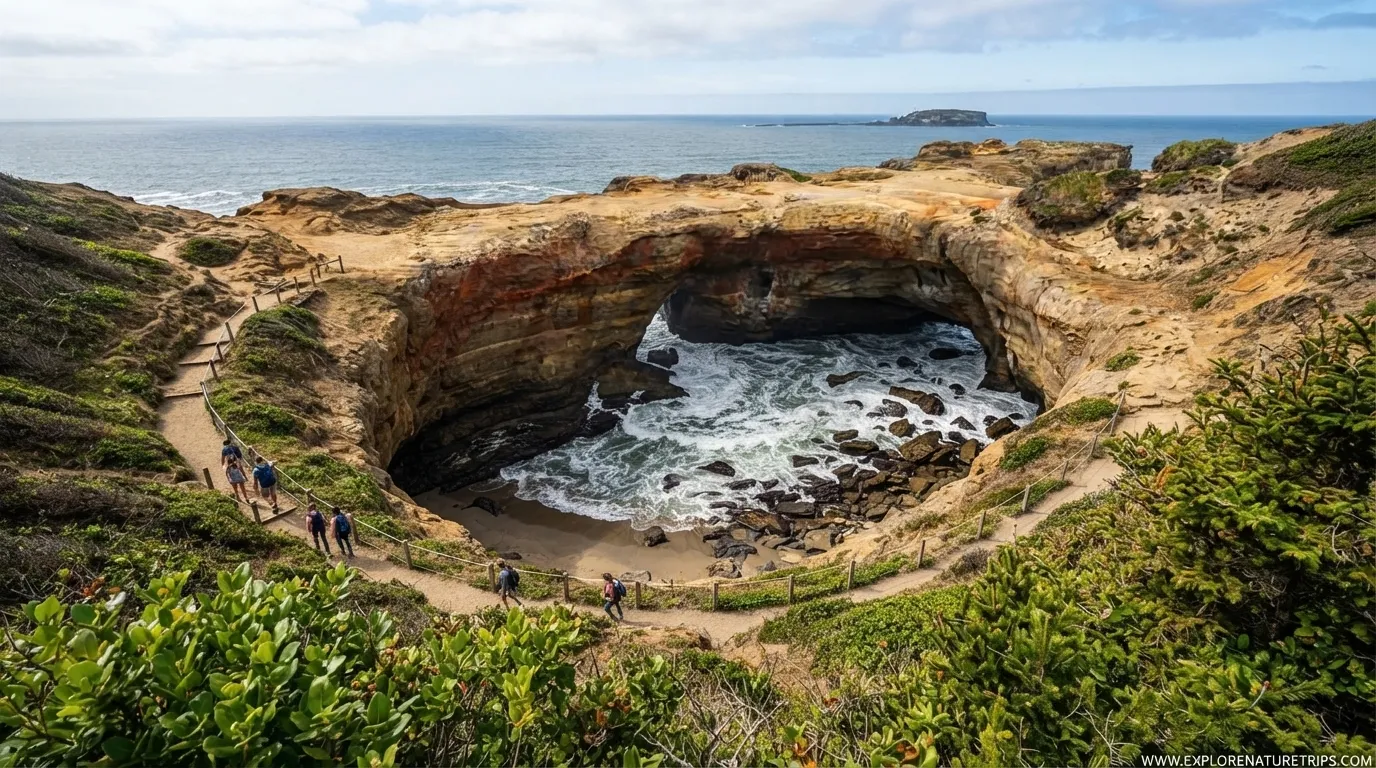
Devils Punchbowl on the Oregon Coast is easy to admire from above, but reaching the inside is a completely different experience. The route is short, yet tide timing matters more than distance. At low tide, you can walk down to the beach, follow the shoreline, and enter the dramatic sandstone formation through its sea arches.
The hike itself is not especially long. Depending on the route and what sections you explore, trail descriptions put the overall distance between about 0.8 and 1.8 miles, while the beach-access portion is only about 0.1 mile. The bigger challenge is knowing when to go and understanding the slippery, changing coastal terrain.
Where Is Devils Punchbowl?
Devils Punchbowl is located near Otter Rock on the Oregon Coast. The formation sits within the Devils Punchbowl State Natural Area and can be viewed from the top without making the beach descent.
From above, the Punchbowl looks like a giant hollow carved into the rocky coastline. The formation developed through sea-cave erosion and collapse, leaving an open-topped sandstone structure that continues to be shaped by ocean waves.
You can enjoy the viewpoint at any tide, but getting inside is a different matter.
When Should You Hike Down Into Devils Punchbowl?
The most important part of this hike is the tide.
The interior should only be approached at low tide. The repeatedly emphasize that the Punchbowl becomes unsafe as water returns through its openings.
A practical plan is to arrive approximately 30–60 minutes before the day’s lowest tide. One detailed account describes a tide of around -0.5 and recommends conditions around 0 or below.
| Tide Condition | Recommended Approach |
|---|---|
| Around 0 or below | Best opportunity |
| Very low tide | Best margin for exploring |
| Normal low tide | Possible, but less margin |
| Rising tide | Avoid entering |
| Mid/high tide | Do not enter |
| Storm or large waves | Stay outside |
Do not treat the low-tide time as the moment you should enter and then assume you can stay indefinitely. The tide will begin returning.
The safest strategy is to reach the beach before low tide, enter only when the conditions are clearly suitable, spend limited time inside, and leave while you still have a comfortable exit window.
How to Reach the Beach From the Parking Area
The route described by Pines & Vines provides a straightforward way to reach the beach.
Step 1: Start near the 1st Street parking area.
From the parking lot at the end of 1st Street, walk toward C Avenue.
Step 2: Turn onto C Avenue.
Follow the walking route along C Avenue.
Step 3: Continue past 3rd Street.
After passing 3rd Street, look for the beach-access trail.
Step 4: Take the beach-access trail.
The trail descends approximately 0.1 mile toward Otter Crest Beach.
Step 5: Watch for the eroded section.
One reports an eroded section approximately 4 feet high near the lower portion of the trail. A dirt slope beside the damaged section can provide access, but it is steep and requires care.
Do not rush this section simply because the distance is short.
What to Do Once You Reach Otter Crest Beach
Once you reach the beach, the route becomes much more dependent on the shoreline and tide conditions.
Turn left/south and continue along the beach toward Devils Punchbowl.
The walk along the beach is relatively short. One describes the Punchbowl as roughly 10–15 minutes away after reaching the beach, while another describes the beach approach as a short walk of approximately a quarter mile.
Keep the cliffs on your side and avoid wandering unnecessarily toward the ocean.
There may be sand, wet rocks, seaweed, tide pools and uneven surfaces along the way.
How to Find the Entrance
As you approach the cliffs, the large sandstone formation becomes easier to recognize.
The Punchbowl has large arched openings facing the beach and ocean. At suitable low tide, the opening becomes a natural gateway into the formation.
According to Pines & Vines, there are 2 arches associated with the beach-facing structure and a 3rd opening toward the ocean.
The interior is dramatically different from the view above. Instead of looking down into a swirling pool of seawater, you can see the exposed rocky floor, sandstone walls and openings where the ocean normally enters.
What Is It Like Inside Devils Punchbowl?
Inside, the terrain is not a smooth walking surface.
Expect:
- Slippery rocks
- Wet sandstone
- Seaweed-covered surfaces
- Loose and broken rocks
- Tide pools
- Large boulders
- Uneven footing
- Ocean openings
The ceiling is open because the original sea-cave roof collapsed. The sandstone walls show the continuing effects of coastal erosion.
Some rocks inside have fallen from the surrounding structure, so avoid climbing unnecessarily.
How Long Should You Stay Inside?
Do not plan your visit around spending as much time inside as possible.
A conservative approach is better: enter during the low-tide window, take a quick look around, take your photographs, and return to the beach while there is still plenty of water-level margin.
Pines & Vines emphasizes arriving 30–60 minutes before low tide, while the more detailed descriptions recommend keeping enough time to leave before the tide begins creating a problem.
The goal is not to maximize your time inside.
The goal is to leave safely before conditions change.
Why the Rocks Can Be More Difficult Than the Hike
The trail itself is generally rated easy, but that does not mean every part is easy.
The difficult sections are created by:
- The eroded beach-access trail.
- Steep sections near the beach.
- Wet sand.
- Algae and seaweed.
- Uneven sandstone.
- Tide pools.
- Large rocks.
- Changing ocean conditions.
This is why ordinary walking ability does not automatically make the Punchbowl safe at every tide.
A short hike can still have serious coastal hazards.
What Shoes Should You Wear?
Wear footwear with good traction.
The specifically highlight slippery rocks as one of the major problems around the Punchbowl. Walking directly over wet sandstone in smooth-soled footwear can make the short distance much harder.
Good footwear should help with:
- Wet rocks
- Sand
- Uneven ground
- Seaweed
- Short rocky sections
Avoid treating the beach portion like a normal paved trail.
Parking and Fees
There are 2 public parking areas associated with the Devils Punchbowl area.
The parking locations make it possible to access both the viewpoint and the beach route, although the exact starting point affects how much road walking you do.
The Oregon Hikers information lists a day-use fee of:
- $10 for residents
- $12 for non-residents
- Annual State Parks pass accepted
Pines & Vines also reports a $10/day parking cost and a $60/year pass option.
Because parking and park conditions can change, check current signage when you arrive.
What Else Can You See Along the Route?
The Devils Punchbowl area offers more than the main formation.
The Oregon Hikers route mentions several additional coastal features, including:
- Tide pools
- Small sea caves
- A small waterfall
- Wave-cut platforms
- Seals
- Gull Rock
- Otter Crest
- Cape Foulweather
- Beverly Beach
- Moolack Beach
- Yaquina Head Light
- Ground squirrels
There are also 2 low-tide-access beaches beyond the main Punchbowl route, with a total of 3 waterfalls cascading toward them.
These features can make the area worthwhile even if conditions are not appropriate for entering the Punchbowl.
Wildlife and Tide Pools
Low tide exposes parts of the coastline that are normally underwater.
The Oregon Hikers material specifically identifies sunflower sea stars, starfish, seals and feather boa kelp among the area’s natural features.
If you explore tide pools, look rather than handle wildlife. The purpose of the low-tide visit should be to observe the coastal environment without disturbing it.
Can You Take Children?
The overall trail is described as family friendly by Oregon Hikers, but the actual Punchbowl entrance requires more judgment.
Pines & Vines recommends avoiding the Punchbowl with children younger than 7.
That does not mean older children can safely enter under any conditions. The decisive factors remain:
- Tide
- Waves
- Footing
- Weather
- Child’s ability to follow instructions
For families, viewing the Punchbowl from above is a much easier alternative when the beach conditions are questionable.
Can You Bring a Dog?
Dogs are allowed in the area on a leash according to the trail information.
However, Pines & Vines specifically recommends not taking dogs into the Punchbowl because of the slippery and uneven rocks.
A dog may have difficulty navigating wet sandstone and could also become exposed to incoming waves.
Devils Punchbowl Route Summary
Here is the complete route in a simple format:
| Stage | Route | Approximate Detail |
|---|---|---|
| 1 | Start near 1st Street | Parking area |
| 2 | Walk toward C Avenue | Short street section |
| 3 | Continue past 3rd Street | Find beach access |
| 4 | Descend to beach | 0.1 mile |
| 5 | Deal with eroded section | About 4 ft |
| 6 | Reach Otter Crest Beach | Beach level |
| 7 | Turn left/south | Follow shoreline |
| 8 | Reach Punchbowl | Roughly 10–15 min from beach access |
| 9 | Enter through arch | Low tide only |
| 10 | Explore briefly | Watch water and footing |
| 11 | Return through arch | Before tide rises |
| 12 | Walk back to access trail | Retrace route |
What Makes This Hike Different?
The interesting part of Devils Punchbowl is that the difficulty is not primarily physical.
The trail is short, and Oregon Hikers rates the hike Easy, with approximately 100 feet of elevation gain.
The real skill is timing the coastline.
You need to understand that the same location can change from an accessible rocky floor to a water-filled ocean formation as the tide changes.
That makes the tide chart just as important as your hiking shoes.
Devils Punchbowl Safety Checklist
Before leaving the parking area, make sure you can answer yes to these questions:
- Have you checked the tide?
- Is the tide sufficiently low?
- Are the waves relatively calm?
- Is the beach-access route open?
- Do you have enough time to return before the tide rises?
- Are your shoes suitable for wet rocks?
- Are you prepared for slippery terrain?
- Are you avoiding storm conditions?
- Do you have a clear exit route?
- Are you willing to turn around if conditions change?
If the answer to any important safety question is no, enjoy the viewpoint instead.
What Not to Do
Avoid these common mistakes:
- Do not enter at high tide.
- Do not wait until the tide is already rising.
- Do not enter during dangerous surf conditions.
- Do not assume a short distance means low risk.
- Do not run across slippery rocks.
- Do not climb unstable formations.
- Do not take unnecessary chances for photographs.
- Do not ignore changing waves.
The Oregon Hikers guide is particularly clear that entering the interior at high water can be fatal.
Is Devils Punchbowl Worth Hiking Into?
Yes, when conditions are right.
The attraction is not the length of the hike. It is the unusual experience of walking into a formation that is normally occupied by the Pacific Ocean.
The combination of a 0.1-mile beach-access trail, short shoreline walk, low-tide entrance and dramatic sandstone interior makes the trip memorable without requiring a long hike.
But the experience is highly dependent on conditions.
If the tide, waves or footing do not look right, the safer choice is to enjoy Devils Punchbowl from above.
Final Thought
Hiking down into Devils Punchbowl is a short Oregon Coast adventure, but tide timing is more important than mileage.
The route can involve only about 0.1 mile of beach-access trail and roughly 100 feet of elevation gain, yet wet sandstone, slippery rocks and returning ocean water can quickly change the experience.
For the best chance of a safe visit, plan around low tide, arrive roughly 30–60 minutes beforehand, use suitable footwear, and leave the interior well before the water begins returning.
When conditions are not right, you can still enjoy the spectacular formation from above. That flexibility is part of what makes Devils Punchbowl worth visiting: you do not need to enter the formation to have a memorable Oregon Coast experience.
Frequently Asked Questions
How long is the Devils Punchbowl hike?
The trail descriptions report approximately 0.8 to 1.8 miles, depending on the route and areas included. The beach-access section itself is about 0.1 mile.
How do you get inside Devils Punchbowl?
Reach Otter Crest Beach, turn left/south, and follow the shoreline toward the sandstone formation. At sufficiently low tide, you can enter through the large sea arch.
What tide is best for Devils Punchbowl?
A tide around 0 or below is the preferred condition described by the detailed material. One visit was made at approximately -0.5.
How early should you arrive before low tide?
Pines & Vines recommends arriving approximately 30–60 minutes before low tide, giving you time to reach the formation before the tide begins changing.
Is Devils Punchbowl difficult?
The overall hike is generally rated Easy, with about 100 feet of elevation gain. The difficult part is the slippery and uneven coastal terrain rather than the distance.
How far is the beach access trail?
The beach-access trail is approximately 0.1 mile long.
Is there an entrance fee?
Oregon Hikers lists a $10 resident and $12 non-resident day-use fee, with an annual State Parks pass also accepted. Pines & Vines reports $10/day and a $60/year pass option.
Can you enter Devils Punchbowl at high tide?
No. The strongly warn against entering the Punchbowl at high tide. The interior can fill with water, and the returning ocean can cut off the exit.
Are dogs allowed?
Dogs are allowed on a leash, but entering the Punchbowl with a dog is discouraged because the interior contains slippery and uneven rocks.
Can children hike to Devils Punchbowl?
The trail is described as family friendly, but the actual interior requires careful judgment. Pines & Vines recommends avoiding the Punchbowl with children younger than 7.
What should you wear?
Wear shoes with good traction because the route can include wet sandstone, seaweed, rocks and uneven surfaces.
Is the Devils Punchbowl accessible year-round?
Oregon Hikers lists the hike as year-round, but entering the Punchbowl itself depends on tide, surf and beach conditions. A winter storm or high tide can make entry unsafe.
What if the tide is too high?
Stay at the upper viewpoint. The Punchbowl is still impressive when waves enter and churn inside the formation, and you avoid the hazards associated with the beach route.

Hi, I’m Marcus! I love exploring the outdoors and discovering incredible places. Through ExploreNatureTrips blog, I share my travel experiences, useful tips, and recommendations for the best sights, trails, and destinations to visit.