Icefields Parkway Driving Guide: What to Know Before You Go
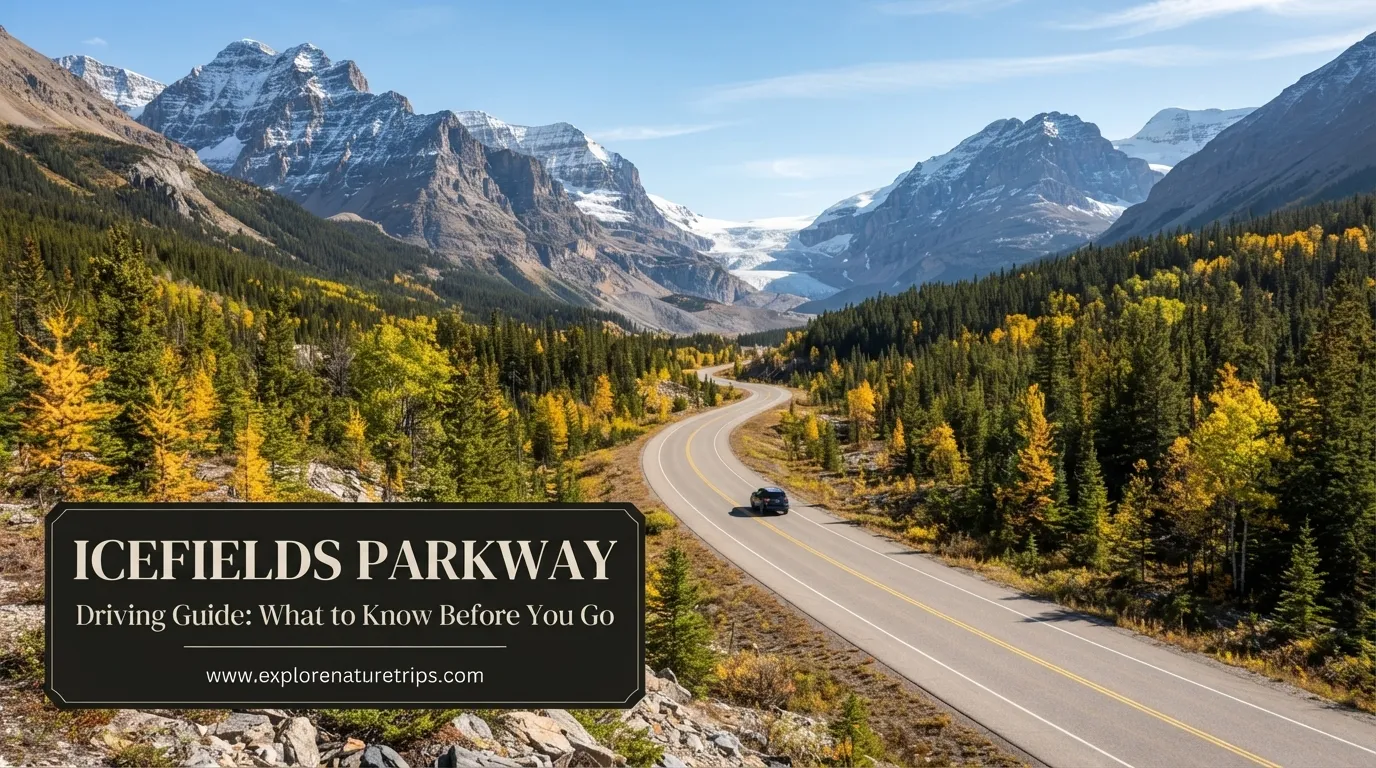
The Icefields Parkway is one of the most memorable mountain drives in the Canadian Rockies, connecting Lake Louise and Jasper through a landscape of glaciers, turquoise lakes, waterfalls, wildlife, and towering peaks.
The route covers about 144 miles (232 km). Technically, you can drive it in around 3 hours without stopping, but that is not a realistic sightseeing plan. The most useful way to think about this road is as a full-day experience rather than a simple transfer between two destinations.
For a comfortable trip, allow around 8–12 hours if you want regular viewpoints and major attractions. If you prefer hiking, photography, or a slower pace, dividing the journey across 2 days gives you much more flexibility.
How Long Does It Take to Drive the Icefields Parkway?
The biggest planning mistake is treating the 3-hour driving estimate as the time needed for the entire experience.
That figure represents a relatively direct drive with little or no sightseeing. In reality, the Parkway is filled with places where you will naturally want to stop.
A better schedule is:
- 3 hours: direct driving estimate.
- 6–8 hours: faster sightseeing day.
- 8–12 hours: more comfortable sightseeing schedule.
- 2 days: better for travelers who want hikes, photographs, and longer stops.
If you are traveling for the first time, a full day is the safest planning choice. Starting early gives you more daylight and reduces the pressure to skip attractions later in the route.
Should You Spend One or Two Days?
A 1-day journey can work if you select your stops carefully.
A 2-day trip is preferable if you want to:
- Spend more time at the Columbia Icefield.
- Take hikes.
- Photograph lakes and mountains.
- Wait for better weather.
- Enjoy wildlife sightings safely.
- Avoid rushing from one viewpoint to another.
The Parkway rewards travelers who leave room for unexpected stops.
When Is the Best Time to Drive the Icefields Parkway?
The five guides consistently emphasize June through September as the strongest period for a first visit.
However, each part of this period offers a slightly different experience.
| Period | What to expect |
| June | Long daylight, waterfalls, snow-covered mountains and fewer crowds than peak summer |
| July | Warm weather, accessible attractions and heavy visitor traffic |
| August | Warmest period but generally one of the busiest |
| September | Cooler weather, fewer crowds and early fall scenery |
| October | Quieter but increasingly unpredictable weather |
| November–April | Winter conditions, snow, ice, shorter daylight and reduced services |
| May–early June | Transitional conditions with possible snow and ice |
July and August
These are attractive months because of warmer conditions and easier access to many attractions. The trade-off is crowding.
Popular parking areas can become busy, particularly around famous lakes and major attractions.
If you travel during these months, an early start is especially useful.
September
September stands out as a strong compromise between scenery and crowds.
You can encounter:
- Cooler temperatures.
- Fewer visitors.
- Early fall colors.
- Excellent photography conditions.
- Changing mountain weather.
Winter Driving
Winter should not be approached like a normal summer road trip.
The guides emphasize:
- Snow and ice.
- Shorter daylight.
- Reduced services.
- Changing road conditions.
- Additional vehicle preparation.
- Possible closures or difficult travel conditions.
One guide notes that winter snow-clearing operations occur between approximately 7 AM and 3:30 PM.
Winter travelers should check conditions before leaving and carry appropriate cold-weather supplies.
Where Does the Icefields Parkway Start and End?
The scenic Parkway connects Lake Louise with Jasper along Highway 93.
Travelers coming from Banff should remember that the main Parkway journey begins around the Lake Louise area rather than treating Banff itself as the southern endpoint.
The route passes through parts of:
- Banff National Park
- Jasper National Park
- The Canadian Rockies
- The Columbia Icefield region
Its approximately 232 km length is packed with scenic stops, which is why the route takes considerably longer to experience than its driving time suggests.
What Should You See Along the Parkway?
You do not need to stop everywhere. A better strategy is to choose several major attractions and leave some flexibility for scenic pullouts.
Lake Louise
Lake Louise is an important starting-area destination and one of the most recognizable locations associated with the Canadian Rockies.
Depending on your itinerary, you can combine the lake with:
- Lakeshore scenery.
- Hiking.
- Canoeing.
- Access to other nearby attractions.
The area can become extremely busy, so arriving early is helpful.
Bow Lake
Bow Lake provides a classic mountain-and-water landscape and is one of the natural highlights along the route.
It works particularly well as a photography stop because you do not need to spend an entire day there to appreciate the scenery.
Peyto Lake
Peyto Lake is one of the recurring highlights in the guides.
Its distinctive turquoise appearance and surrounding mountain scenery make it a particularly worthwhile stop for first-time visitors.
Plan additional time for parking and walking rather than assuming the viewpoint will take only a few minutes.
Mistaya Canyon
Mistaya Canyon offers a completely different landscape from the large alpine lakes.
Instead of a broad mountain panorama, the attraction focuses on the powerful movement of water through the canyon.
It is a useful stop when building variety into a one-day itinerary.
Columbia Icefield
The Columbia Icefield is one of the major reasons travelers choose the Parkway.
This area brings together:
- Glaciers.
- High mountain scenery.
- The Athabasca Glacier.
- The Columbia Icefield Skywalk.
- Hiking opportunities.
- Visitor facilities.
If you plan to participate in a glacier-related experience, allow substantially more time than you would for a simple roadside viewpoint.
Athabasca Glacier
The Athabasca Glacier is among the route’s best-known attractions.
One describes the glacier as approximately 10,000 years old.
The guides emphasize that visitors should follow designated access rules rather than treating a glacier as an ordinary hiking surface.
Guided commercial experiences are available, while the glacier can also be viewed from approved areas.
Do not cross barriers or attempt to explore glacier terrain independently.
Hidden crevasses and rapidly changing conditions make this an area where safety matters more than getting a closer photograph.
Columbia Icefield Skywalk
The Columbia Icefield Skywalk provides another way to experience the landscape.
The material notes that visitors use transportation from the glacier-area facilities and need a ticket for the experience.
Because this can take additional time, include it in your schedule before deciding how many other stops you can realistically fit into the same day.
Athabasca Falls
Athabasca Falls is another major attraction toward the Jasper side.
The waterfall drops approximately 25 meters, creating a powerful contrast with the quieter lakes and glacier viewpoints earlier in the journey.
Allow time to park, walk to viewing areas, and enjoy the surrounding landscape.
Sunwapta Falls
Sunwapta Falls adds another waterfall stop to the route and can be particularly useful for travelers who enjoy combining mountain scenery with short walks.
Weeping Wall
The Weeping Wall is another recognizable roadside feature and demonstrates why the Parkway is more than a simple route between two towns.
Not every stop needs to become a long hike. Some are valuable precisely because you can pause, look around, and continue.
What Should You Pack?
Because services are limited, preparation is one of the most important parts of the trip.
Food and Water
Carry enough:
- Water
- Snacks
- Lunch
- Emergency food
- Extra drinks
Do not plan your entire day around finding a restaurant exactly when you become hungry.
Fuel
Start with a full tank.
The guides repeatedly identify Saskatchewan River Crossing as the key fuel and service point along the route.
Fuel availability can be seasonal, and the location is not something you should treat as a guaranteed backup in every season.
A simple rule is:
Fuel before entering the remote section of the route.
Offline Navigation
Cell service is very limited along the Parkway.
Before leaving, download:
- Offline maps.
- Accommodation details.
- Important route information.
- Trail information.
- Reservation details.
Do not depend on being able to search for information once you are deep into the route.
What Is the Weather Like?
Mountain weather can change much faster than expected.
One describes experiencing several different weather conditions within approximately 8 hours, including rain, snow, storm conditions, and sunshine at different sections of the journey.
That is why checking the forecast once is not enough.
Pack layers so you can adjust throughout the day.
Useful clothing includes:
- Warm outer layer.
- Waterproof jacket.
- Comfortable walking shoes.
- Extra socks.
- Hat or gloves depending on season.
- Sun protection.
Even during warmer months, glacier and high-elevation areas can feel considerably colder.
What Wildlife Might You See?
Wildlife is one of the memorable parts of an Icefields Parkway trip, but sightings should never be treated as guaranteed.
The guides mention:
- Grizzly bears
- Black bears
- Elk
- Bighorn sheep
- Mountain goats
- Moose
- Wolves
If you see wildlife, keep a safe distance.
Wildlife Safety Rules
- Never feed an animal.
- Do not approach wildlife for photographs.
- Stay inside your vehicle when appropriate.
- Use your camera’s zoom rather than walking closer.
- Keep food properly stored.
- Follow local wildlife warnings.
- Never stop your vehicle in an unsafe location simply because an animal is nearby.
A wildlife sighting is a bonus—not a reason to create a dangerous traffic situation.
How Much Daylight Should You Expect?
Daylight can dramatically change how much of the route you can comfortably experience.
The material notes that around June, travelers can have approximately 16 hours of daylight, while December can provide only around 8 hours.
That difference matters.
A summer itinerary can comfortably include several scenic stops. A winter itinerary requires much more careful timing.
For a first visit, use daylight to your advantage by starting early.
What About Cell Service?
Do not assume you will have reliable phone service.
The guides repeatedly warn about limited or absent cell coverage.
Before leaving:
- Download your route.
- Save accommodation information.
- Screenshot important reservations.
- Download trail information.
- Tell someone your approximate itinerary if appropriate.
- Keep your vehicle prepared for changing conditions.
This small amount of preparation can prevent a major inconvenience later.
Where Can You Stay?
Accommodation planning depends on whether you drive the route in one day or divide it into multiple sections.
Useful bases mentioned across the guides include:
| Area | Best use |
| Lake Louise | Starting the route early |
| Canmore | Base before the Parkway |
| Banff | Combining the Parkway with Banff sightseeing |
| Jasper | Northern endpoint and overnight stay |
| Saskatchewan River Crossing | Central route stop |
| Parkway-area lodges/hostels | Staying closer to the route |
One itinerary included 3 nights in Canmore and 2 nights in Jasper, demonstrating how travelers can build the Parkway into a larger Canadian Rockies trip rather than completing everything in a single rushed day.
How to Plan a One-Day Drive
If you only have one day, prioritize.
A practical sequence is:
Early Morning
Start around Lake Louise and head north.
Consider:
- Lake Louise area
- Bow Lake
- Peyto Lake
Starting early gives you more time for later attractions.
Late Morning
Continue toward:
- Mistaya Canyon
- Scenic river viewpoints
- Saskatchewan River Crossing
Use this part of the route for shorter stops rather than spending too long at every location.
Midday
Take your main food break and make sure you have enough fuel and water.
Do not wait until the final part of the route to solve basic supply needs.
Afternoon
Focus on the Columbia Icefield area.
Potential highlights include:
- Athabasca Glacier
- Columbia Icefield Skywalk
- Glacier viewpoints
- Parker Ridge area, depending on conditions and available time
Late Afternoon
Continue toward:
- Sunwapta Falls
- Athabasca Falls
- Jasper
This is a full day, not a relaxed half-day excursion.
A Better Two-Day Approach
If you can spare 2 days, the experience becomes less rushed.
Day 1
Concentrate on the southern section:
- Lake Louise
- Bow Lake
- Peyto Lake
- Mistaya Canyon
- Saskatchewan River Crossing
- Nearby scenic viewpoints
Stay overnight rather than forcing yourself to continue late.
Day 2
Focus on the northern and glacier section:
- Columbia Icefield
- Athabasca Glacier
- Parker Ridge, if appropriate
- Sunwapta Falls
- Athabasca Falls
- Jasper
This approach provides more room for photography, weather changes, and longer stops.
Hiking Along the Parkway
The Parkway is not only a driving route.
The guides mention several hiking opportunities, including:
| Hike | Approximate distance |
| Helen Lake & Cirque Peak | 17.2 km |
| Bow Glacier Falls | 8.7 km |
| Lake Agnes Tea House | 4-mile round trip |
These distances make one point clear: you should not combine several major hikes with every major roadside attraction during a single day unless you have planned substantially more time.
Check conditions before starting any hike, especially during shoulder seasons.
Road Conditions and Driving Safety
The Icefields Parkway is a mountain road, so driving conditions can change quickly.
Watch for:
- Snow.
- Ice.
- Rain.
- Wildlife.
- Cyclists.
- RVs.
- Slow-moving traffic.
- Sudden weather changes.
- Busy parking areas.
Do not stop wherever you happen to see a beautiful view.
Use designated pullouts and parking areas whenever possible.
Before You Leave
Use this checklist:
- Fuel tank full
- Water packed
- Food packed
- Offline maps downloaded
- Weather checked
- Road conditions checked
- Vehicle prepared
- Warm layers packed
- Accommodation confirmed
- Camera/phone charged
- Emergency supplies available
This preparation is especially important because cell service is limited.
Is the Icefields Parkway Worth Driving?
Yes—but only if you plan it as a scenic journey rather than a shortcut.
The route’s value comes from the combination of experiences:
- 232 km of mountain scenery.
- Glaciers.
- Turquoise lakes.
- Waterfalls.
- Wildlife.
- Hiking.
- Photography.
- High-elevation landscapes.
- Unexpected roadside viewpoints.
The most memorable part may not even be your planned attraction. Several guides emphasize that smaller, less-famous pullouts can provide some of the quietest and most rewarding moments.
That is why a flexible itinerary works better than trying to check off every attraction.
Common Planning Mistakes to Avoid
Treating 3 Hours as the Total Trip Time
The 3-hour figure is a driving estimate, not a sightseeing schedule.
Starting Too Late
A late start can leave you rushing through the most important attractions.
Ignoring Fuel
Do not enter a remote mountain route assuming you will find fuel whenever you need it.
Depending on Cell Service
Download what you need before departure.
Overloading the Itinerary
Trying to combine every lake, waterfall, glacier, and hike into one day can make the experience stressful.
Underestimating Weather
A sunny morning does not guarantee sunny conditions several hours later.
Approaching Wildlife
Never sacrifice safety for a photograph.
Ignoring Seasonal Changes
A route that feels easy in July can require much more preparation during winter or shoulder seasons.
Frequently Asked Questions
How long is the Icefields Parkway?
The route is approximately 144 miles (232 km) between Lake Louise and Jasper.
How long does it take to drive the Icefields Parkway?
A direct drive can take around 3 hours, but travelers should plan approximately 8–12 hours for a proper sightseeing day.
Is one day enough for the Icefields Parkway?
Yes. One full day can work if you prioritize major attractions. Two days is better for a slower trip with hikes and longer stops.
What is the best month to drive the Icefields Parkway?
The main recommended period is June through September. July and August are warmer but busier, while September can offer fewer crowds and early fall scenery.
Is September a good time to visit?
Yes. September can provide a useful balance of scenery, cooler temperatures and fewer visitors than peak summer.
Is the Icefields Parkway open in winter?
The guides describe the route as a year-round road, but winter brings snow, ice, shorter daylight, reduced services and more challenging driving conditions.
How much daylight is available in summer?
Around June, the material notes approximately 16 hours of daylight, making long sightseeing days more practical.
Is there cell service on the Icefields Parkway?
Cell service is very limited, so download maps and important information before beginning the drive.
Where should I get fuel?
Saskatchewan River Crossing is the key fuel and service location identified by the guides. It is safer to begin the remote section with a full tank rather than relying entirely on this stop.
What wildlife can I see?
Possible sightings include grizzly bears, black bears, elk, bighorn sheep, mountain goats, moose and wolves. Sightings are never guaranteed, and wildlife should always be observed from a safe distance.
Can I walk onto Athabasca Glacier by myself?
No. The material emphasizes using approved areas and authorized experiences rather than independently walking onto dangerous glacier terrain.
How many days should I spend on the Icefields Parkway?
A 1-day drive is possible, while 2 days provides a more relaxed experience. Travelers who want substantial hiking and photography may benefit from allowing even more time in the surrounding Canadian Rockies.
Final Planning Takeaway
Most importantly, prepare before you leave. Fuel up, download your maps, check weather and road conditions, carry food and water, dress in layers, and leave room for unexpected stops.
The Parkway is best experienced when you are not racing to reach the other end. Give the road a full day—or better yet, 2 days—and let the mountains, glaciers, lakes, a nd changing weather shape the journey.

Hi, I’m Marcus! I love exploring the outdoors and discovering incredible places. Through ExploreNatureTrips blog, I share my travel experiences, useful tips, and recommendations for the best sights, trails, and destinations to visit.