Alaska Road Trip Ideas: 10 Routes, Itineraries & Tips
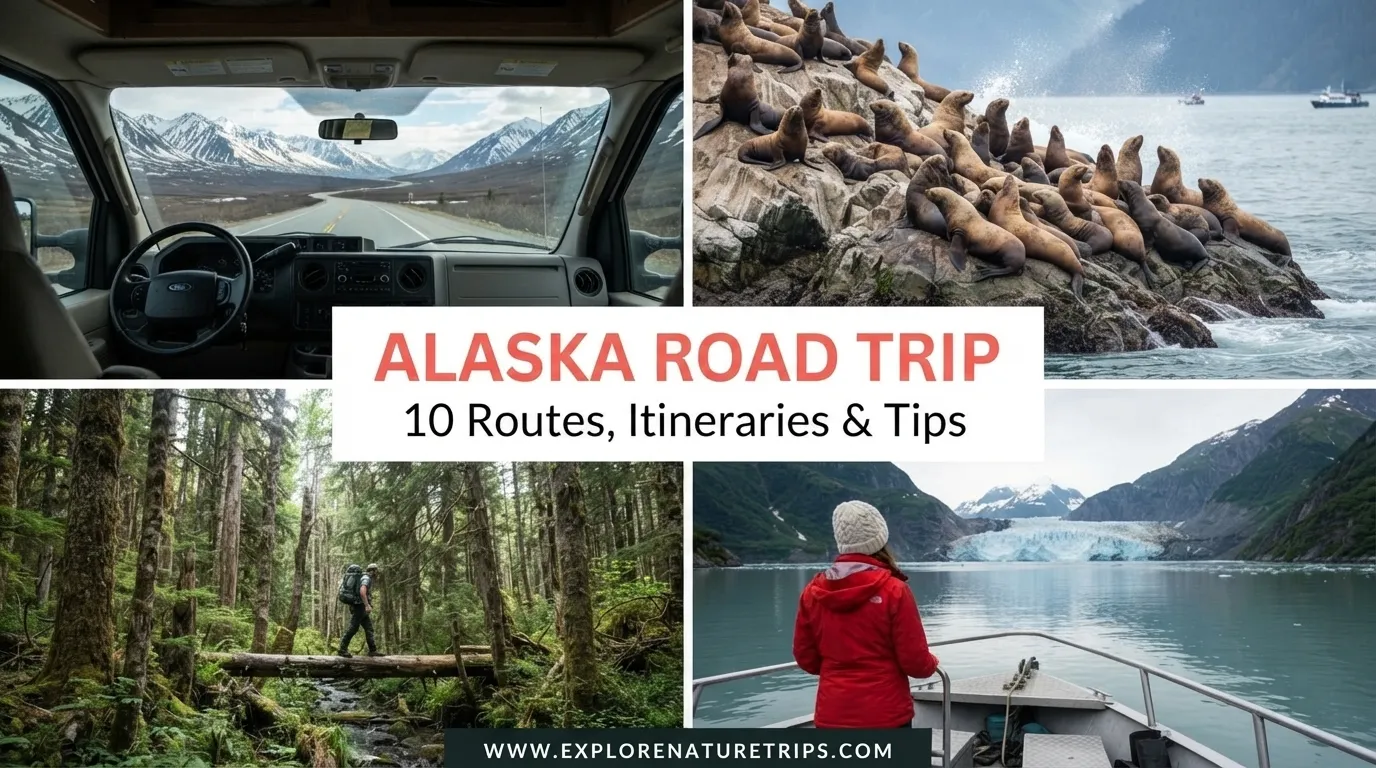
Planning an Alaska road trip can feel overwhelming because the state combines huge distances, remote highways, changing weather, wildlife, glaciers, mountains, and small communities. The good news is that you do not need to see everything on one trip.
The travel guides reviewed for this article point to a practical range of 3 to 14 days, depending on how much of Alaska you want to experience. A shorter trip can concentrate on Anchorage and the Kenai Peninsula, while a 10-day journey gives you enough time to combine major stops such as Seward, Homer, Talkeetna, and Denali. A 14-day trip can add Fairbanks and provide more breathing room.
There are also routes for travelers who want something more adventurous. The 135-mile Denali Highway, the 60-mile McCarthy Road, the 125-mile Seward Highway, and the 142-mile Sterling Highway offer very different experiences, from accessible scenic drives to rougher remote-road adventures.
A 10-day itinerary is particularly useful because it allows travelers to experience both the Kenai Peninsula and Denali without trying to change hotels every night. One specifically recommends 10 days for the Anchorage–Denali–Kenai loop, while another presents 10 days as its best overall first-time route.
1. Seward Highway: Anchorage to Seward
The Seward Highway is one of the strongest choices for a first Alaska road trip. The route covers approximately 125 miles (201 km) between Anchorage and Seward and combines mountains, coastline, wildlife, waterfalls, glaciers, and viewpoints.
The drive follows Turnagain Arm and passes areas including Girdwood, Alyeska Ski Resort, Chugach National Forest, Portage Valley, and Turnagain Pass before reaching Seward.
Potential stops include:
- Turnagain Arm
- Girdwood
- Winner Creek Trail
- Portage Valley
- Alaska Wildlife Conservation Center
- Portage Glacier
- Turnagain Pass
- Seward
- Exit Glacier
- Lowell Point
A five-day Kenai Peninsula sample begins with Anchorage to Girdwood, continues to Seward, adds a Kenai Fjords experience, then moves toward Homer before returning to Anchorage.
Best travel window: late May to early September.
2. Sterling Highway: Anchorage to Homer
For travelers who want to reach the southern Kenai Peninsula, the Sterling Highway provides a different route toward Homer.
The road covers approximately 142 miles (228 km) from its connection with the Seward Highway toward the Homer Spit. Along the way, travelers encounter Kenai Lake, Cooper Landing, wildlife areas, fishing opportunities, mountain scenery, and views toward Kachemak Bay.
Homer can be used as a base for exploring the surrounding coastal landscape. One suggested experience is taking a water taxi toward Kachemak Bay State Park and spending a night near Grewingk Glacier Lake.
This route works especially well when your itinerary includes both Seward and Homer.
3. Denali Highway: Cantwell to Paxson
The Denali Highway is very different from the main roads around Anchorage and Seward.
It stretches approximately 135 miles (217 km) and is mostly gravel. The route connects the Cantwell and Paxson areas and provides remote views of tundra, alpine landscapes, and wildlife.
A sample three-day approach is:
- Day 1: Paxson → Tangle Lakes
- Day 2: Continue toward Maclaren Summit and explore trails
- Day 3: Camp near the Susitna River and finish toward Cantwell or continue toward Denali
The recommended travel period is approximately mid-June to mid-September, with road conditions worth checking before departure.
This is a better choice for travelers looking for remote scenery rather than a straightforward highway experience.
4. Dalton Highway and the Arctic Circle
For a more extreme road adventure, the Dalton Highway heads toward the Arctic Circle and beyond.
The route provides access to boreal forest, tundra, the Trans-Alaska Pipeline, and remote landscapes. The guide recommends June through August and notes that 4WD is highly recommended.
A three-day concept includes:
- Day 1: Fairbanks → Coldfoot
- Day 2: Continue to the Arctic Circle and return
- Day 3: Option to continue toward Prudhoe Bay or explore the Gates of the Arctic area by air
This route requires more preparation than the Anchorage–Seward corridor, so it should not be treated like an ordinary city-to-city drive.
5. McCarthy Road and Wrangell-St. Elias
The McCarthy Road offers another remote Alaska experience.
The route runs approximately 60 miles (97 km) between Chitina and McCarthy and is associated with Wrangell-St. Elias National Park and Preserve. The road is gravel and can involve rough conditions, so travelers should prepare for a slower journey.
The suggested season is approximately mid-May through mid-October, although road conditions can affect access.
Important planning considerations include:
- Check current road conditions.
- Carry suitable supplies.
- Expect gravel.
- Allow extra driving time.
- Be prepared for limited services.
- Consider the possibility of tire or vehicle problems.
6. Haines Highway and the Chilkat Area
The Haines Highway offers a route through alpine scenery toward the Yukon border.
The Nature Seeker’s suggested three-day structure includes:
- Day 1: Haines and the Alaska Chilkat Bald Eagle Preserve
- Day 2: Drive toward the Yukon border and stop at Million Dollar Falls
- Day 3: Return while allowing time for photography and short hikes
The suggested general season is May through October, while the source identifies October–November as a particularly interesting period for bald-eagle viewing.
This route is especially appealing if wildlife and quieter landscapes matter more to you than completing a classic Anchorage loop.
7. Glenn Highway
The Glenn Highway connects Anchorage with Glennallen and provides access to mountain and glacier scenery.
The route can be combined with:
- Chugach Mountains
- Matanuska Glacier
- Lions Head Trail
- Wrangell-St. Elias National Park
A sample itinerary from the material uses 3 days, making this a useful addition for travelers who do not have enough time for a much longer Alaska circuit.
The suggested travel period is May through September.
8. Alaska Marine Highway and Sitka
Not every Alaska road trip has to involve driving the entire way.
The Alaska Marine Highway can be combined with a Southeast Alaska adventure around Sitka. The suggested itinerary is approximately 3 days, with a Juneau-to-Sitka ferry journey and local exploration.
Possible places and experiences include:
- Sitka National Historical Park
- Fortress of the Bear
- Goddard Hot Springs
- Mosquito Cove Trail
The source suggests May through September for this style of trip.
9. Kenai Peninsula Loop
If you have approximately 5 days, a Kenai Peninsula loop can provide a strong mixture of mountains, glaciers, coastal scenery, and wildlife.
A practical structure based on the itineraries is:
| Day | Route | Main focus |
| 1 | Anchorage → Girdwood | Turnagain Arm + hiking |
| 2 | Girdwood → Seward | Exit Glacier + Lowell Point |
| 3 | Seward | Kenai Fjords / Resurrection Bay |
| 4 | Seward → Homer | Ninilchik + Anchor Point |
| 5 | Homer → Anchorage | Homer Spit + return |
This approach avoids attempting to cover the entire state and instead concentrates your time in one region.
10. A 10-Day Alaska Road Trip
For a first visit, a 10-day itinerary provides one of the best balances between sightseeing and driving.
The combined material supports a route built around Anchorage, Seward, Homer, Talkeetna, and Denali.
Days 1–2: Anchorage
Use the first two days to settle in and explore Anchorage rather than immediately beginning a long drive.
Potential stops include:
- Anchorage Museum
- Anchorage Trolley Tours
- Local viewpoints
- Downtown Anchorage
Days 3–4: Seward
Drive toward Seward via Turnagain Arm.
Allow time for:
- Alaska Wildlife Conservation Center
- Seward
- Exit Glacier
- Glacier or boat excursions
- Kenai Fjords National Park
Keeping two days for Seward gives you more flexibility if weather affects a boat trip.
Days 5–6: Homer
Continue toward Homer through the Kenai Peninsula.
Use the additional day for:
- Homer Spit
- Kachemak Bay
- Wildlife experiences
- Coastal scenery
- Local exploration
Day 7: Talkeetna
Head north toward Talkeetna.
The town works well as a transition between the Kenai Peninsula and Denali portion of the trip.
Days 8–9: Denali National Park
Reserve two days for the Denali area.
The itinerary sources emphasize Denali as a major part of a first-time Alaska road trip rather than something to skip.
Day 10: Return to Anchorage
Finish the loop by returning to Anchorage.
This schedule is intentionally not packed with a new destination every few hours. That makes it easier to accommodate weather, wildlife sightings, road stops, and unexpected delays.
A 14-Day Alaska Road Trip
If you have 14 days, the additional time can be used to slow down rather than simply adding more driving.
One ‘s 14-day structure allocates:
| Destination | Suggested time |
| Anchorage | 2 days |
| Seward | 2 days |
| Homer | 2 days |
| Talkeetna | 1 day |
| Denali | 3 days |
| Fairbanks | 2 days |
| Anchorage | 2 days |
| Total | 14 days |
This version gives travelers substantially more time around Denali and adds Fairbanks without removing the Kenai Peninsula.
Short Alaska Road Trips: 3 to 7 Days
Not everyone has two weeks available.
The itineraries demonstrate that Alaska can be approached in shorter formats.
3 days:
Anchorage → Seward → Anchorage
4 days:
Anchorage → Seward → additional Seward day → Anchorage
5 days:
Anchorage → Homer → Homer → Soldotna → Anchorage
7 days:
Anchorage → Seward → Kenai Fjords → Homer → Homer → return toward Anchorage → departure
For the complete Anchorage–Denali–Kenai loop, one source recommends at least 10 full days so travelers do not have to rush major experiences such as the Kenai Fjords cruise and Denali shuttle.
When Is the Best Time for an Alaska Road Trip?
The sources repeatedly concentrate road-trip planning around the warmer travel season.
| Period | What the sources emphasize |
| May | Shoulder-season option |
| Mid-June–early September | Main/peak travel window |
| Late August–early September | Strong option for fewer crowds and fall color |
| Mid-September | Still useful for some routes, depending on conditions |
| Late September | Shoulder season; services may be limited |
| October–November | Highlighted for bald-eagle viewing around the Haines area |
Follow Me Away identifies late August and early September as its preferred period because summer crowds begin to decrease, lodging prices can fall slightly, fall color develops, and wildlife viewing remains possible. It also warns that some services shut down shortly after Labor Day.
The Nature Seeker gives route-specific windows such as late May–early September for the Seward Highway, mid-June–mid-September for the Denali Highway, and June–August for the Dalton Highway.
How to Choose the Right Route
Your available time should determine your route.
Choose the Seward Highway if you want an accessible first road trip with mountains, glaciers, wildlife, and coastal scenery.
Choose the Sterling Highway if Homer and the southern Kenai Peninsula are priorities.
Choose the Denali Highway if you want remote gravel-road scenery and fewer crowds.
Choose the Dalton Highway if reaching the Arctic Circle is a major goal and you are comfortable with a more demanding drive.
Choose McCarthy Road if you want a remote Wrangell-St. Elias experience.
Choose Haines Highway if wildlife, alpine scenery, and the Yukon direction interest you.
Choose the 10-day Anchorage–Seward–Homer–Talkeetna–Denali route if this is your first major Alaska road trip and you want a balanced itinerary.
Alaska Road Trip Driving Distances
| Route | Approximate distance |
| Seward Highway | 125 miles / 201 km |
| Sterling Highway | 142 miles / 228 km |
| Denali Highway | 135 miles / 217 km |
| McCarthy Road | 60 miles / 97 km |
| Alaska road trip covered by HoneyTrek | 2,545 miles |
The numbers above show why Alaska requires a different approach to road-trip planning. Even individual highways can cover well over 100 miles, while a broader Alaska adventure can involve thousands of miles. HoneyTrek’s own journey covered 2,545 miles over 4 weeks, although the authors note that most vacationers have closer to 10–14 days.
What Makes an Alaska Road Trip Different?
One of the biggest mistakes is treating Alaska like a compact road-trip destination.
A route may look simple on a map, but the experience can include:
- Wildlife stops
- Scenic viewpoints
- Glacier excursions
- Hiking
- Weather changes
- Gravel sections
- Remote fuel opportunities
- Road construction
- Limited connectivity
HoneyTrek’s experience illustrates the demanding side of an Alaska journey particularly well. Their 1985 four-cylinder camper received new tires, a brake job, and a full tune-up before they headed toward the Alaska Highway. They traveled through British Columbia and the Yukon before continuing into Alaska.
Plan for More Stops Than Your Map Suggests
A useful rule from the experiences is to leave room for spontaneous stops.
For example, the Seward Highway can involve wildlife viewing around Turnagain Arm, viewpoints in the Chugach Mountains, Portage Valley, glacier scenery, and stops around Seward.
That means the fastest possible driving time should not automatically become your planned schedule.
Build your days around experiences, not just arrival times.
Hotels or RV for an Alaska Road Trip?
Both options appear in the material.
Hotels can make sense when you want:
- Easier logistics
- A conventional itinerary
- Less vehicle responsibility
- More predictable overnight arrangements
RV travel can work well when you want:
- More flexibility
- Camping opportunities
- A slower travel style
- More independence
HoneyTrek’s experience demonstrates the adventure side of RV travel, but it also shows why vehicle preparation matters. Their camper needed mechanical preparation before tackling Alaska’s long and rougher routes.
What to Pack
The material emphasizes practical preparation rather than packing for comfort alone.
Consider carrying:
- Waterproof layers
- Insulated clothing
- Hiking boots
- Bear spray
- Bug spray
- Offline maps
- A printed road guide
- Portable battery pack
- Reusable water bottle
- Binoculars
- Headlamp or flashlight
- Emergency roadside equipment
The Milepost is specifically recommended by Live, Travel, Teach. The author highlights the 2026 edition at $45 and notes that it covers stops along Alaska’s highways. A paper copy can also be useful because some Alaska highways have internet dead zones.
Do Not Depend Entirely on Cell Service
Remote Alaska routes can have limited connectivity.
That makes offline navigation and a physical road guide particularly useful.
Before leaving a connected area:
- Download your route.
- Save important locations.
- Know where your next fuel opportunity is.
- Keep emergency contacts accessible offline.
- Carry a paper map or guide.
- Check road conditions before remote sections.
This becomes especially important on routes such as the Denali Highway, Dalton Highway, and McCarthy Road.
Build Buffer Time Into Your Itinerary
One of the clearest planning lessons from the itineraries is that you should not fill every day to maximum capacity.
Worth The Trip specifically identifies not allowing buffer days and trying to see too much as common Alaska road-trip mistakes. It also warns against staying only one night everywhere.
A better approach is to leave some flexibility around important activities.
For example, if a Kenai Fjords cruise is a major priority, avoid designing the rest of the itinerary so tightly that one weather delay ruins the entire schedule.
Alaska Road Trip Mistakes to Avoid
Trying to See the Entire State
Alaska is too large for a rushed itinerary. Pick a region and build depth into your route.
Changing Hotels Every Night
Moving constantly creates more packing and driving. Staying 2 nights in selected locations can make the trip more enjoyable.
Skipping Denali on a Longer Trip
For a first-time itinerary lasting around 10–14 days, the guides consistently give Denali an important place in the route.
Ignoring Road Conditions
Remote gravel routes can be very different from major highways. Check conditions before committing to them.
Forgetting Fuel Planning
Remote routes require more attention to fuel because services are less frequent.
Treating Every Road as a Normal Highway
The Denali Highway and McCarthy Road, for example, have gravel sections and require a different mindset from the main Anchorage–Seward corridor.
Frequently Asked Questions
How many days do you need for an Alaska road trip?
A short trip can work in 3–5 days, but 10 days is a stronger target for a first-time Anchorage–Denali–Kenai journey. A 14-day itinerary allows additional time around major destinations.
Is 7 days enough for Alaska?
Yes, if you focus on a limited area. A seven-day itinerary can combine Anchorage, Seward, Homer, and the return toward Anchorage. For the full Anchorage–Denali–Kenai loop, 10 days is a more practical minimum.
What is the best month for an Alaska road trip?
The sources emphasize the period from mid-June through early September. Late August and early September are highlighted as particularly attractive because of fewer crowds, changing vegetation, and continued wildlife opportunities.
How long is the Seward Highway?
The Anchorage-to-Seward drive is approximately 125 miles (201 km).
How long is the Denali Highway?
The Denali Highway is approximately 135 miles (217 km) and is primarily a gravel route.
How long is the Sterling Highway to Homer?
The Sterling Highway route described by Live, Travel, Teach covers approximately 142 miles (228 km) toward Homer.
Is the McCarthy Road paved?
The guide describes the 60-mile (97 km) McCarthy Road as a gravel road, so travelers should prepare for slower and rougher driving conditions.
Should I choose an RV or hotel?
Both can work. Hotels provide simpler logistics, while an RV offers flexibility and a more independent travel experience. If choosing an RV for remote Alaska routes, vehicle preparation is especially important.
Do I need a physical road guide?
It can be useful. Live, Travel, Teach recommends The Milepost and specifically highlights the 2026 edition, priced at $45, because it includes information for Alaska’s highways and can remain useful when internet service is unavailable.
Final Alaska Road Trip Planning Takeaway
The best Alaska road trip is not necessarily the one that covers the most miles. It is the one that gives you enough time to enjoy the places between those miles.
For a first visit, 10 days provides a strong middle ground: Anchorage, Seward, Homer, Talkeetna, and Denali can create a varied route without turning every day into a race. If you have only 3–7 days, concentrate on the Kenai Peninsula instead. With 14 days, slow the journey down and add Fairbanks or additional nights at your favorite stops.
For travelers seeking something more adventurous, the 135-mile Denali Highway, 60-mile McCarthy Road, 125-mile Seward Highway, 142-mile Sterling Highway, and Dalton Highway offer very different versions of Alaska.
The most important preparation is simple: choose your route first, check seasonal access, allow buffer time, prepare for limited connectivity, keep an eye on road conditions, and leave enough space in your schedule to stop when Alaska gives you a reason to.

Hi, I’m Marcus! I love exploring the outdoors and discovering incredible places. Through ExploreNatureTrips blog, I share my travel experiences, useful tips, and recommendations for the best sights, trails, and destinations to visit.