
Colorado Road Trip Ideas: Scenic Routes, Itinerary & Tips
Colorado brings together mountain passes, national parks, historic towns, red-rock formations, alpine lakes, desert landscapes, and scenic highways in one state. That variety makes it possible to build a short weekend route or a much longer loop without relying on just one type of scenery.
The five travel guides reviewed for this route cover everything from 4-day scenic drives to a roughly 1,000-mile loop requiring around 18–20 hours of driving. Another traveler spent 10 days exploring the state, while one couple drove more than 1,200 miles and remained in Colorado for almost 2 months.
For first-time visitors, the biggest decision is not simply where to go. It is deciding how much time you have, how much driving you enjoy, and whether your priority is mountains, national parks, historic towns, or a mixture of all three.
A 1,000-Mile Colorado Road Trip Loop
For travelers who want to see a broad selection of Colorado rather than concentrating on one region, a loop beginning and ending in Denver is one of the most practical approaches.
One itinerary covers approximately 1,000 miles and estimates 18–20 hours of total driving. With its suggested stops, the trip takes around 3 weeks, although the route can be shortened to approximately 1 week or extended to 1 month.
A useful sequence is:
Denver → Colorado Springs → Great Sand Dunes → Mesa Verde → Black Canyon → Grand Junction → Glenwood Springs → Breckenridge → Estes Park → Boulder → Denver
This arrangement creates a varied journey rather than repeatedly driving through the same type of landscape.
Denver: Start and Finish the Journey

Denver works naturally as the starting point because it provides access to the road network and Denver International Airport.
The itinerary recommends spending 3 days in Denver when time allows. Attractions mentioned include Union Station, Larimer Square, the Denver Art Museum, the Denver Museum of Nature & Science, restaurants, and the city’s surrounding outdoor areas.
If you’re working with a tight schedule, Denver can also function primarily as your arrival and departure point.
Planning tip: Pick up your rental vehicle after exploring downtown if you do not need a car immediately. This can make the beginning of the trip easier.
Colorado Springs, Pikes Peak & Garden of the Gods
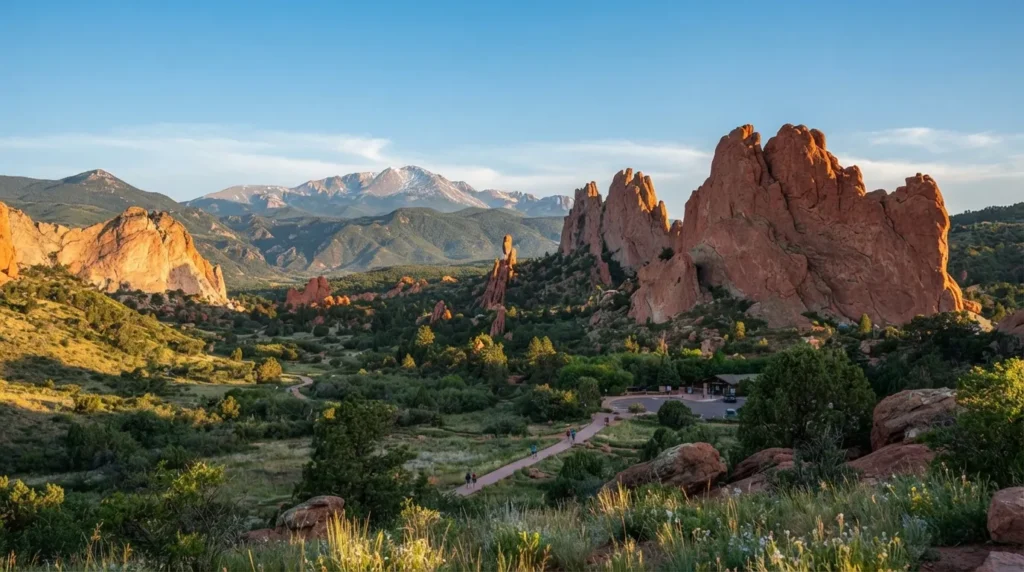
From Denver, Colorado Springs is approximately 73 miles away, with a stated driving time of about 1 hour. The itinerary recommends around 2 days here.
The major attractions include:
- Garden of the Gods
- Pikes Peak
- Manitou Springs
- Pikes Peak Highway
- North Cheyenne Cañon Park
- Broadmoor Seven Falls
Pikes Peak reaches 14,115 feet, according to Travel + Leisure, while the scenic route guide also emphasizes the mountain as one of Colorado Springs’ defining attractions.
Garden of the Gods is especially useful for travelers who want impressive scenery without committing an entire day to a difficult mountain hike.
Great Sand Dunes National Park
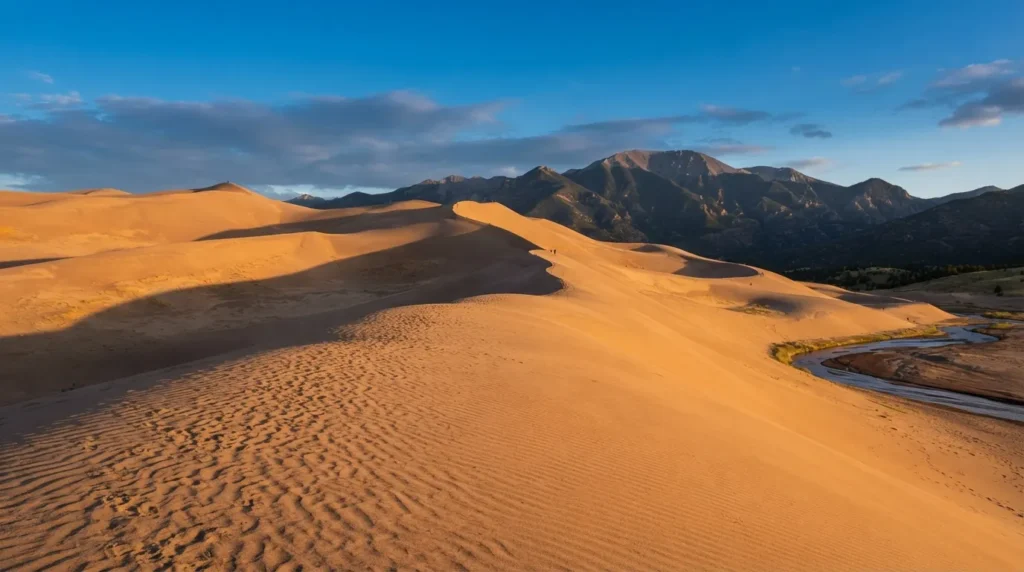
Great Sand Dunes creates one of the biggest visual changes on a Colorado road trip. Instead of alpine scenery, you get enormous sand formations backed by mountains.
The dunes reach approximately 750 feet, making this one of the most distinctive stops on the route.
The suggested itinerary gives this area approximately 2 days. Another route guide creates a 4-day southern Colorado experience around the dunes, Alamosa, Zapata Falls, hot springs, wildlife areas, and Fort Garland.
Popular activities mentioned include:
- Hiking the dunes
- Sandboarding or sand sledding
- Visiting Zapata Falls
- Stargazing
- Camping
- Exploring nearby southern Colorado communities
Mesa Verde National Park
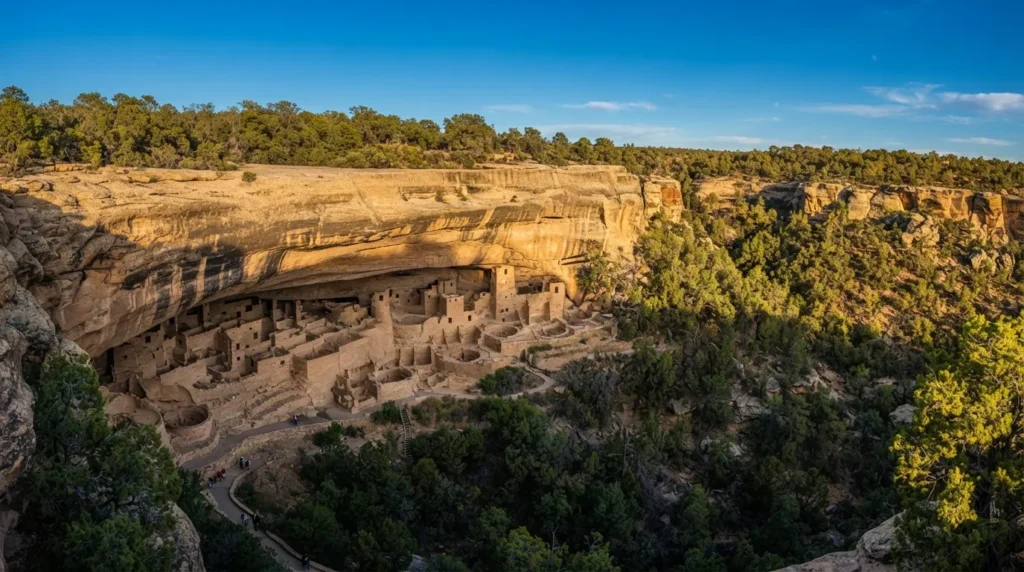
Mesa Verde adds a completely different type of experience to the road trip.
The park contains hundreds of archaeological sites, including the famous Cliff Palace, where ancient Pueblo people constructed homes within the cliffs.
The longer road-trip itinerary places Mesa Verde approximately 199 miles from Great Sand Dunes, with a drive of around 3 hours 45 minutes, and recommends 2 days.
This is an important planning point: Mesa Verde sits farther southwest, so travelers with only a few days may need to choose between visiting it and keeping the route compact.
Durango, Silverton & Ouray
The southwestern mountain section combines historic towns with dramatic mountain roads.
The San Juan Skyway route connects:
- Durango
- Silverton
- Ouray
- Telluride
The Million Dollar Highway is one of the major scenic sections, with steep mountain scenery, curves, historic mining communities, waterfalls, and hot springs. A sample route allocates 4 days to the San Juan Skyway.
Travel Nation’s experience also highlights the drive from Durango toward Grand Junction, particularly during September, when the surrounding aspen forests can display golden autumn color.
Black Canyon of the Gunnison & Grand Junction
Black Canyon of the Gunnison provides a dramatic contrast to the open dunes and alpine landscapes.
A structured itinerary places Black Canyon approximately 153 miles from Mesa Verde, requiring around 3 hours of driving, with 1 day suggested for the main visit. Travelers who want more hiking can add additional time.
From there, Grand Junction is approximately 71 miles away, with a driving time of about 1 hour 20 minutes. The itinerary recommends 2 days in the area.
The broader Western Slope route also includes:
- Colorado National Monument
- Montrose
- Palisade
- Fruit orchards
- Vineyards
- Small towns
Travel Nation spent several days around Palisade and used a bicycle for exploring the vineyards rather than driving after wine tasting.
Glenwood Springs, Aspen & the High Mountains
Heading east brings the route back toward Colorado’s famous mountain communities.
Glenwood Springs is highlighted for its natural hot springs and its location near the Colorado and Roaring Fork rivers. From there, travelers can continue toward Aspen and the higher mountain passes.
The Aspen route can be combined with:
- Maroon Bells
- Crater Lake Trail
- Independence Pass
- Continental Divide
- Twin Lakes
Independence Pass rises above 12,000 feet, and the suggested travel period is late June through early October when the pass is open.
Because elevation increases quickly in this region, this portion deserves slower driving and sensible weather planning.
Breckenridge & Historic Mountain Towns
Breckenridge provides a different experience from the larger cities and national parks.
The structured itinerary places Breckenridge about 95 miles from Hanging Lake, with an estimated driving time of 1 hour 40 minutes, and recommends 2 days.
The town combines:
- Historic mining-era architecture
- Mountain scenery
- Hiking
- Mountain biking
- Skiing
- Snowboarding
For travelers visiting outside winter, the historic downtown and surrounding mountain activities still make it a useful stop.
Rocky Mountain National Park & Trail Ridge Road
Rocky Mountain National Park is one of the strongest anchors for a Colorado road trip.
The structured route places Estes Park and Rocky Mountain National Park approximately 130 miles from Breckenridge, requiring about 2 hours 40 minutes, with 3 days recommended.
Other guides suggest that travelers could spend several days or even substantially longer exploring the park.
Trail Ridge Road is the major scenic drive through this section. The road climbs above 12,000 feet and connects the Estes Park side with Grand Lake. The recommended opening period in the route guides ranges from late May to mid-October, depending on conditions.
Wildlife mentioned across the guides includes:
- Elk
- Moose
- Marmots
- Bighorn sheep
- Mountain goats
Boulder on the Way Back to Denver
Boulder makes a convenient final stop before returning to Denver.
The structured itinerary places Boulder approximately 40 miles from Rocky Mountain National Park, requiring about 1 hour, and recommends 2 days. From Boulder back to Denver, the stated distance is approximately 27 miles, with a driving time of around 30 minutes.
The Peak to Peak route also connects Boulder with Nederland, Estes Park, and Allenspark, with September highlighted as an attractive period for fall foliage.
Colorado Road Trip Timing by Season
The guides consistently emphasize the warmer months, but the ideal window depends on the route.
| Period | Best suited for |
|---|---|
| April–May | Great Sand Dunes and lower-elevation areas |
| Late May–June | Many scenic roads as seasonal access improves |
| Late June–August | High mountain routes and summer activities |
| September | Fall colors, mountain scenery, comfortable road-trip conditions |
| Early October | Autumn scenery and selected scenic routes |
| Mid-October onward | Increasing weather and mountain-road limitations |
Travel Nation identifies May through mid-October as the best overall period and traveled during the second half of September, while individual routes have narrower seasonal windows.
How Many Days Do You Need?
There is no single correct answer.
For a 4-day trip, choose one concentrated route rather than attempting the entire state.
For around 7 days, combine several nearby destinations and reduce longer detours.
For approximately 2–3 weeks, the 1,000-mile loop provides enough time to experience multiple national parks, mountain towns, scenic roads, and cities without turning every day into a driving marathon.
One traveler’s personal journey lasted 10 days, while another couple drove more than 1,200 miles and spent approximately 2 months exploring Colorado.
Distance and Driving-Time Reference
| Segment | Approx. distance | Approx. drive | Suggested stay |
|---|---|---|---|
| Denver → Colorado Springs | 73 mi | 1 hr | 2 days |
| Colorado Springs → Great Sand Dunes | 154 mi | 2 hr 45 min | 2 days |
| Great Sand Dunes → Mesa Verde | 199 mi | 3 hr 45 min | 2 days |
| Mesa Verde → Black Canyon | 153 mi | 3 hr | 1 day |
| Black Canyon → Grand Junction | 71 mi | 1 hr 20 min | 2 days |
| Breckenridge → Estes Park | 130 mi | 2 hr 40 min | 3 days |
| Rocky Mountain NP → Boulder | 40 mi | 1 hr | 2 days |
| Boulder → Denver | 27 mi | 30 min | Departure |
These figures come from the structured itinerary and are useful for understanding how much driving each section adds to the overall trip. Actual journey times can change with traffic, weather, road conditions, stops, and seasonal closures.
High-Elevation Stops to Plan Carefully
Colorado’s scenery becomes more impressive as roads climb, but elevation should be treated as a genuine planning factor.
| Location/route | Elevation detail |
|---|---|
| Trail Ridge Road | 12,000+ ft |
| Independence Pass | 12,000+ ft |
| Mount Evans Scenic Byway | 14,130 ft |
| Pikes Peak | 14,115 ft |
| Denver | About 1 mile above sea level |
Take your time when moving from lower elevations to high mountain roads. Build breaks into the schedule instead of treating every scenic stop as something to rush through.
A Simple Planning Strategy
If this is your first Colorado road trip, use this approach:
1. Choose your trip length.
Four days, one week, two weeks, and three weeks require very different routes.
2. Select one priority.
Choose mountains, national parks, scenic highways, historic towns, or a balanced mixture.
3. Avoid overloading each day.
A route that looks short on a map can take much longer once hiking, viewpoints, meals, fuel, and weather are included.
4. Reserve extra time for national parks.
Rocky Mountain National Park, Mesa Verde, and Great Sand Dunes each offer enough experiences to justify more than a quick stop. Travel + Leisure’s route includes all 3 national parks.
5. Check seasonal road access.
High mountain roads such as Trail Ridge Road and Independence Pass have seasonal limitations.
6. Keep the return route simple.
Boulder is only about 27 miles from Denver in the structured itinerary, making it an efficient final stop before departure.
4-Day Colorado Road Trip Option
If you have only 4 days, don’t attempt the full 1,000-mile loop.
A focused mountain itinerary can work better:
| Day | Focus |
|---|---|
| Day 1 | Denver → Boulder → Estes Park |
| Day 2 | Rocky Mountain National Park |
| Day 3 | Trail Ridge Road → Grand Lake |
| Day 4 | Return toward Denver |
Another option is to concentrate entirely on Colorado Springs, Pikes Peak, and Garden of the Gods.
The 4-day route concepts repeatedly use a similar principle: one geographic area per trip, rather than trying to see the entire state.
7-Day Colorado Road Trip Option
With 7 days, you can expand the journey:
- Denver
- Colorado Springs
- Great Sand Dunes
- Grand Junction or Black Canyon
- Glenwood Springs
- Breckenridge
- Rocky Mountain National Park
- Boulder
You will still need to make choices because Colorado’s attractions are spread across a large area.
The longer itinerary specifically notes that travelers with only a week or two can shorten stays, skip Mesa Verde, remove Boulder, or leave Breckenridge out if skiing and snowboarding are not priorities.
3-Week Colorado Road Trip
For the fullest version of the route, allow approximately 3 weeks.
A longer trip gives you enough flexibility to include:
- Denver
- Colorado Springs
- Great Sand Dunes
- Mesa Verde
- Black Canyon of the Gunnison
- Grand Junction
- Glenwood Springs
- Breckenridge
- Estes Park
- Rocky Mountain National Park
- Boulder
You can also add destinations such as Telluride, Aspen, San Juan National Forest, Grand Lake, or the Million Dollar Highway when time allows.
What to Pack for a Colorado Road Trip
A practical packing list should reflect Colorado’s changing terrain rather than just the calendar.
- Layers for changing temperatures
- Comfortable hiking shoes
- Water and snacks
- Sunglasses and sun protection
- Rain protection
- Navigation or offline maps
- Camera or phone storage
- Warm clothing for high elevations
- Emergency supplies for remote sections
- Camping equipment if using campgrounds
FAQs
How long should a Colorado road trip be?
A focused scenic route can work in 4 days, while the major loop described by Nomadasaurus covers about 1,000 miles and works best at around 3 weeks.
What is the best month for a Colorado road trip?
September is particularly attractive in the experiences because of autumn colors, while the broader recommended season is generally May through mid-October.
How many miles is the main Colorado road trip loop?
The structured loop covers approximately 1,000 miles and requires around 18–20 hours of total driving time.
What is the highest elevation mentioned in these Colorado road-trip routes?
The Mount Evans Scenic Byway reaches 14,130 feet, while Pikes Peak reaches 14,115 feet.
How high are the Great Sand Dunes?
The Great Sand Dunes reach approximately 750 feet.
Can you do Colorado in one week?
Yes, but you should reduce the number of destinations. The structured itinerary specifically suggests shortening stays and potentially skipping farther-out stops such as Mesa Verde.
Is September good for a Colorado road trip?
Yes. One Travel Nation travel experience took place during the second half of September and specifically highlighted golden aspen forests. The Nature Seeker also identifies September as especially attractive for fall foliage on the Peak to Peak route.
What are the three national parks on the scenic route?
The Travel + Leisure route includes Rocky Mountain National Park, Mesa Verde National Park, and Great Sand Dunes National Park.
Final Road Trip Takeaway
The best Colorado road trip is not necessarily the one with the most destinations. It is the one that matches your available time and leaves enough room to actually experience each stop.
For a short trip, choose one scenic region. For 7 days, build a compact loop. For around 3 weeks, the approximately 1,000-mile circuit gives you a much broader view of Colorado. And if you have the freedom to travel slowly, the experiences from the longer trips show why Colorado can support a journey lasting 10 days, several weeks, or even 2 months.
Most importantly, allow extra time for high-elevation roads, weather, hiking, scenic viewpoints, and unexpected stops. The roads are part of the experience—not simply a way to reach the next destination.

Hi, I’m Marcus! I love exploring the outdoors and discovering incredible places. Through ExploreNatureTrips blog, I share my travel experiences, useful tips, and recommendations for the best sights, trails, and destinations to visit.
One Comment