
Great Lakes Road Trip Ideas: Routes, Stops & 7–12 Day Itineraries
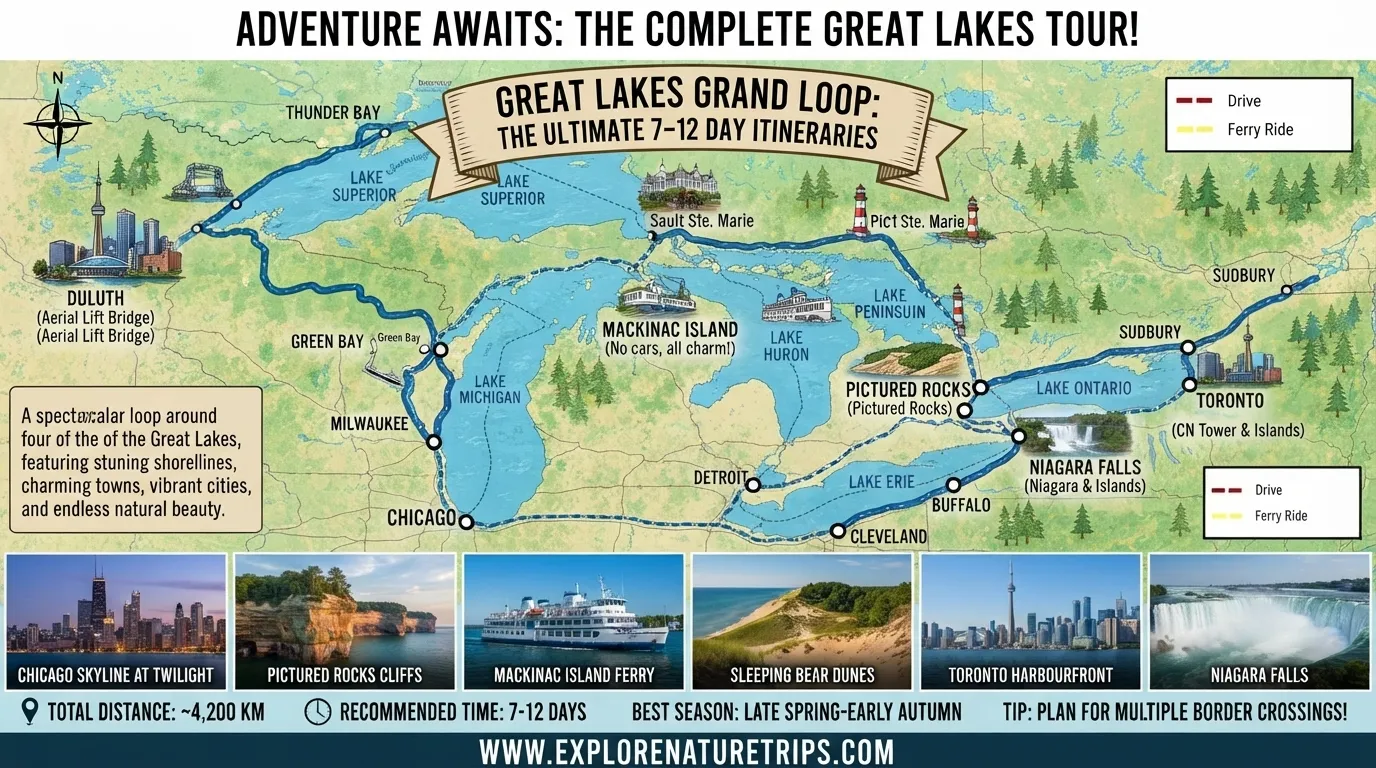
Planning a Great Lakes road trip can feel overwhelming because the region covers 5 massive lakes, multiple states and Canadian provinces, major cities, national parks, beaches, waterfalls, islands, scenic drives, and hundreds of possible stops.
You do not need to visit every shoreline to have a memorable trip. A better approach is to choose a route based on the time you have and the experiences you want most.
A complete Great Lakes circuit can exceed 3,000 miles, while a more focused road trip can cover roughly 1,400 miles in 7–10 days. Shorter trips can concentrate on Lake Michigan, Lake Erie, or the Lake Superior region.
The five Great Lakes are Lake Superior, Lake Michigan, Lake Huron, Lake Erie, and Lake Ontario. Together, they contain about 21% of the world’s surface freshwater and touch 8 U.S. states and 2 Canadian provinces.
Which Great Lakes Road Trip Is Best?
There is no single best route for everyone. Your ideal itinerary depends on your available days, starting city, and whether you prefer cities, hiking, beaches, waterfalls, islands, or scenic drives.
| Trip length | Best route style | Approx. focus |
|---|---|---|
| 5 days | Chicago–Detroit–Cleveland | Cities, culture, food |
| 7 days | Michigan + Lake Superior | Dunes, waterfalls, hiking |
| 7–10 days | Southern Great Lakes loop | Michigan, Ohio, Indiana |
| 8–10 days | Lake Michigan loop | Beaches, dunes, islands |
| 10 days | Lake Superior route | Superior shoreline and wilderness |
| 12 days | Multi-lake road trip | All 5 Great Lakes highlights |
| 2 weeks | Extended Great Lakes itinerary | More parks, towns, and scenic stops |
For first-time visitors, a 7–10 day itinerary provides a good balance between driving and sightseeing without trying to complete the entire Great Lakes circuit.
Great Lakes Road Trip Route at a Glance
One practical route combines major destinations around Lake Michigan, Lake Huron, Lake Erie, and Lake Superior:
Chicago → Sleeping Bear Dunes → Traverse City → Mackinaw City → Mackinac Island → Upper Peninsula → Pictured Rocks → Marquette → Duluth → Detroit → Cleveland → Toledo → Chicago
You can shorten this route by removing the Upper Peninsula and Lake Superior section, or extend it by adding Toronto, Niagara Falls, Manitoulin Island, or other Lake Ontario destinations.
The 5 Great Lakes to Know
Before choosing a route, it helps to understand what each lake offers.
- Lake Michigan: beaches, dunes, Chicago, Traverse City, Mackinac Island, and Indiana Dunes.
- Lake Superior: rugged shoreline, waterfalls, Pictured Rocks, Apostle Islands, Marquette, and Duluth.
- Lake Huron: Mackinac Island, Manitoulin Island, coastal towns, and scenic Michigan routes.
- Lake Erie: Cleveland, Toledo, beaches, Niagara Falls connections, and cultural attractions.
- Lake Ontario: Toronto, Niagara Falls, Thousand Islands, and eastern Ontario scenery.
You do not have to drive around all five. Choosing one or two regions often creates a much more relaxed vacation.
Best 7-Day Great Lakes Road Trip
A week is long enough to experience several of the region’s best outdoor destinations without spending every day behind the wheel.
Day 1: Chicago
Start in Chicago, especially if you enjoy architecture, food, museums, and lakefront attractions.
Spend the first day around:
- Millennium Park
- Cloud Gate
- Grant Park
- Chicago River
- Lake Michigan waterfront
- Art Institute of Chicago
An architecture river cruise can also fit well into the first day.
For a short visit, concentrate your sightseeing around the downtown area instead of crossing the city repeatedly.
Day 2: Chicago to Michigan
Leave Chicago and head toward Michigan.
One option is to include Indiana Dunes National Park before continuing toward the Michigan shoreline.
Indiana Dunes is only about 50 miles from Chicago, making it an easy addition to the route.
If you want more time in Chicago, you can skip the dunes and drive directly toward Michigan.
Day 3: Sleeping Bear Dunes and Traverse City
Continue toward Sleeping Bear Dunes National Lakeshore.
The dunes rise approximately 450 feet above Lake Michigan and provide one of the most distinctive landscapes on the route.
The Dune Climb is approximately 3.5 miles round trip, although you can explore the area without completing the entire climb.
Another scenic option is the 7-mile Pierce Stocking Scenic Drive.
Continue to Traverse City, where you can explore the waterfront, Old Mission Peninsula, Leelanau Peninsula, and nearby wineries.
The area has 40+ wineries within roughly 45 minutes, making it particularly attractive to travelers interested in food and wine.
Day 4: Mackinac Island and Mackinaw City
Drive north toward Mackinaw City and the Mackinac Bridge.
The Mackinac Bridge is approximately 5 miles long and connects Michigan’s Lower and Upper Peninsulas.
From Mackinaw City, consider visiting Mackinac Island.
The island works particularly well as a day stop because it adds a distinctive island experience without requiring a major change to your route.
If your schedule is tight, you can continue across the bridge instead and spend more time in the Upper Peninsula.
Day 5: Pictured Rocks and the Upper Peninsula
The Upper Peninsula changes the character of the trip.
Instead of busy cities, you get forests, waterfalls, rocky shorelines, and Lake Superior scenery.
A major highlight is Pictured Rocks National Lakeshore.
Its sandstone cliffs extend for approximately 15 miles along Lake Superior.
Popular experiences include:
- Scenic overlooks
- Waterfalls
- Hiking
- Kayaking
- Lake Superior beaches
- Boat tours
You can base yourself around Munising or continue toward Marquette.
Day 6: Lake Superior to Duluth
Continue west toward Marquette and then toward Duluth.
The drive provides an opportunity to experience the changing scenery around Lake Superior.
In Duluth, explore:
- Canal Park
- Lakewalk
- Aerial Lift Bridge
- Lake Superior waterfront
- Lake Superior Maritime Visitor Center
If you prefer hiking over city sightseeing, use more of this day for North Shore parks.
Day 7: Minnesota North Shore
The final day can focus on the North Shore of Lake Superior.
Potential stops include:
- Split Rock Lighthouse
- Gooseberry Falls
- Tettegouche State Park
- Palisade Head
- Grand Marais
- Artist’s Point
Cascade Falls is another worthwhile stop, with a loop featuring 7 waterfalls in under 1 mile.
If you have extra time, extend the trip beyond 7 days rather than rushing back.
Best 8–10 Day Lake Michigan Road Trip
A Lake Michigan-focused route is one of the easiest ways to experience a large portion of the Great Lakes without attempting a complete circuit.
A useful loop is:
Chicago → Indiana Dunes → Holland → Traverse City → Sleeping Bear Dunes → Mackinaw City → Mackinac Island → Door County → Milwaukee → Chicago
Why Choose Lake Michigan?
This route combines:
- Big-city attractions
- Beaches
- Sand dunes
- Islands
- Lighthouses
- Small towns
- Wineries
- Scenic lakefront drives
It is especially suitable for travelers who want a mixture of nature and easy-to-reach attractions.
Sleeping Bear Dunes
Spend enough time here for at least one major hike or scenic drive.
The 450-foot dunes are the area’s signature feature, while Pierce Stocking Scenic Drive provides a shorter sightseeing option.
Traverse City
Traverse City is useful as a base for exploring Michigan’s northwestern Lower Peninsula.
The surrounding region has 40+ wineries within 45 minutes, while summer brings additional activity to the area.
Mackinac Island
Add Mackinac Island if you want to break up the driving.
You can also use Mackinaw City as a gateway to the Upper Peninsula.
Door County
After exploring northern Michigan, continue toward Door County, Wisconsin.
The area fits naturally into a Lake Michigan road trip because of its coastal scenery, small communities, beaches, and lighthouses.
Milwaukee and Chicago
Finish the loop through Milwaukee before returning to Chicago.
This creates an itinerary with a clear beginning and ending point, which can simplify rental-car logistics.
Best 10-Day Lake Superior Road Trip
Lake Superior deserves its own itinerary because the shoreline is so large that trying to combine every highlight with all four other lakes can make a trip unnecessarily rushed.
A 10-day Lake Superior route can include:
Duluth → Apostle Islands → Upper Peninsula → Pictured Rocks → Marquette → Sault Ste. Marie → Lake Superior Provincial Park → Thunder Bay → Sleeping Giant → Duluth
Duluth
Begin with the Lake Superior waterfront and Canal Park.
The city is a practical starting point because it provides urban amenities before you move into more remote areas.
Apostle Islands
The Apostle Islands provide opportunities for kayaking, boat trips, beaches, and sea caves.
Weather matters here, particularly for water-based activities. Guided kayaking can be a sensible choice for travelers who are unfamiliar with Lake Superior conditions.
Pictured Rocks
Return to the Michigan side for 15 miles of sandstone cliffs at Pictured Rocks National Lakeshore.
Allow a full day if hiking, kayaking, or boat sightseeing is a priority.
Marquette
Continue to Marquette, where you can combine Lake Superior scenery with a more developed town environment.
Sault Ste. Marie
Sault Ste. Marie creates a natural transition point between Michigan and the Canadian side of Lake Superior.
Thunder Bay and Sleeping Giant
Continue around the northern shoreline toward Thunder Bay and Sleeping Giant.
This portion is best for travelers who want longer scenic drives and fewer urban stops.
Great Lakes Road Trip Including Niagara Falls
Travelers who want a stronger eastern Great Lakes experience can combine Lake Erie and Lake Ontario.
A useful route is:
Cleveland → Erie → Niagara Falls → Toronto → Thousand Islands → Kingston
This route can work in approximately 7–9 days, depending on how many nights you spend in each destination.
Cleveland
Cleveland provides a strong starting point for the Lake Erie portion.
Major attractions include:
- Rock & Roll Hall of Fame
- West Side Market
- Cleveland Museum of Art
- Ohio City
- Tremont
The Rock & Roll Hall of Fame deserves around 3–4 hours if you want to explore it properly.
The West Side Market has 100+ vendors, making it a useful food stop.
Niagara Falls
Continue toward Niagara Falls for one of the most recognizable attractions in the Great Lakes region.
Potential experiences include:
- American Falls
- Bridal Veil Falls
- Horseshoe Falls
- Niagara Gorge
- Niagara Parkway
- Journey Behind the Falls
From Toronto, Niagara Falls is approximately 80 miles away and can take about 90 minutes by road under suitable conditions.
Toronto
Toronto adds a major city experience to the route.
Consider:
- CN Tower
- Distillery District
- Harbourfront
- Toronto Islands
- Kensington Market
Thousand Islands and Kingston
After Toronto, continue east toward Thousand Islands and Kingston.
This section works well for travelers who want to replace some city time with islands, waterfront scenery, and historic communities.
Great Lakes Road Trip Through Manitoulin Island
Another strong Lake Huron route connects Toronto with the Bruce Peninsula and Manitoulin Island.
A representative route is:
Toronto → Tobermory → Manitoulin Island → Sault Ste. Marie
The Toronto-to-Manitoulin portion is approximately 225 miles, while Manitoulin Island to Sault Ste. Marie is around 180 miles.
Tobermory
Tobermory is a useful stop before crossing to Manitoulin Island.
The nearby Bruce Peninsula National Park provides access to the Grotto and Lake Huron scenery.
Manitoulin Island
Manitoulin Island provides a quieter alternative to major cities and heavily visited attractions.
Build extra time into this section if you want to stop frequently for viewpoints, walks, or small communities.
Sault Ste. Marie
Continue toward Sault Ste. Marie after exploring the island.
This also allows you to connect the Lake Huron portion with a larger Lake Superior itinerary.
Great Lakes Road Trip Driving Distances
Driving distances are important because the Great Lakes region can look deceptively compact on a map.
Here are some of the useful route measurements from the itineraries:
| Route | Approx. distance/time |
|---|---|
| Chicago → Traverse City | 4.5 hours |
| Traverse City → Detroit | 3.5 hours |
| Detroit → Cleveland | 2.5 hours |
| Cleveland → Toledo | 2 hours |
| Toledo → Chicago | 3.5 hours |
| Toronto → Niagara Falls | 80 miles / 90 minutes |
| Toronto → Manitoulin Island | 225 miles |
| Manitoulin Island → Sault Ste. Marie | 180 miles |
| Sault Ste. Marie → Marquette | 228 miles |
| Marquette → Duluth | 252 miles |
| Chicago → Toledo | 244 miles |
| Toledo → Toronto | 288 miles |
These numbers are useful for planning, but actual journey times can change because of traffic, border procedures, weather, construction, ferry schedules, and stops.
How Many Days Do You Need?
Your ideal trip length depends on whether you want to explore deeply or simply see major highlights.
5 Days
Choose a compact route such as:
Chicago → Detroit → Cleveland → Toledo → Chicago
This works best for travelers who prioritize cities, museums, architecture, music, food, and cultural attractions.
7 Days
Choose:
Chicago → Michigan → Mackinac Island → Upper Peninsula → Lake Superior
This gives you a stronger balance between cities and nature.
8–10 Days
An 8–10 day Lake Michigan loop provides more time for beaches, dunes, wineries, islands, and small towns.
10 Days
A dedicated Lake Superior itinerary is better if your priority is wilderness, waterfalls, scenic drives, hiking, and rugged shoreline.
12 Days
A 12-day multi-lake route gives you enough flexibility to combine Chicago, Michigan, Niagara Falls, Ontario, Manitoulin Island, Lake Superior, and major cities.
Trying to see every major attraction in less time can turn the trip into a driving marathon.
Best Time for a Great Lakes Road Trip
The most useful travel window depends on your priorities.
June to August
This is the main summer season.
Expect better conditions for:
- Beaches
- Hiking
- Kayaking
- Boat tours
- Island trips
- Scenic drives
The tradeoff is greater demand and potentially higher accommodation prices.
September to Early October
This period can be excellent for travelers who prefer:
- Fall colors
- Cooler weather
- Fewer crowds
- Scenic driving
October
October can be particularly attractive for foliage-focused trips.
However, conditions become less predictable as the month progresses.
November to April
Winter changes the nature of the trip significantly.
Snow, cold temperatures, shorter daylight hours, and seasonal closures can affect road-trip plans.
For a first Great Lakes road trip focused on outdoor sightseeing, summer or early fall is generally the simpler choice.
Where Should You Stay?
Accommodation strategy depends on your route.
For a multi-stop trip, avoid changing hotels every night whenever possible.
Instead, choose 2-night bases around major regions.
Useful bases include:
- Chicago
- Traverse City
- Munising
- Marquette
- Duluth
- Grand Marais
- Detroit
- Cleveland
- Toronto
For example, staying 2 nights around Munising lets you experience Pictured Rocks without packing and unpacking immediately.
Similarly, 2 nights in Grand Marais gives you time for the Minnesota North Shore instead of treating it as a rushed driving stop.
In Traverse City, the cited hotel range is approximately $150–$250 per night, although prices vary considerably by season and property.
Great Lakes Road Trip Packing Essentials
Your packing list should match the activities you plan to do.
For Hiking
- Comfortable hiking shoes
- Lightweight layers
- Water bottle
- Small daypack
- Rain protection
For Lake Activities
- Quick-drying clothing
- Water shoes
- Sun protection
- Dry bag
- Extra layers
For Long Drives
- Offline maps
- Car charger
- Snacks
- Reusable water bottle
- Physical or digital copies of important travel documents
Remote portions of the Upper Peninsula and Lake Superior region can have less reliable cellular coverage, so downloading maps before leaving major towns is a useful precaution.
Practical Great Lakes Road Trip Tips
Do Not Overload Every Day
A common mistake is planning five or six major attractions every day.
A better schedule usually has:
1 major attraction + 1–2 smaller stops + flexible driving time.
This leaves room for weather, unexpected viewpoints, meals, and spontaneous discoveries.
Reserve Popular Summer Accommodation Early
For summer camping and popular destinations, reservations 2–4 weeks ahead can be useful.
The busiest locations may require even more planning.
Check Ferry Schedules
Ferries can be important for routes involving:
- Mackinac Island
- Manitoulin Island
- Tobermory
- Apostle Islands
Do not build a tightly timed itinerary around a ferry without checking the operating schedule first.
Carry the Right Travel Documents
If your route crosses between the United States and Canada, make sure you have the required travel documents before starting the trip.
Allow Extra Time for Border Crossings
A route that looks short on a map can take considerably longer when crossing an international border.
Keep Your Route Flexible
Lake Superior and the Great Lakes generally can experience rapidly changing weather.
Having one flexible day can prevent a bad-weather day from ruining your entire itinerary.
Great Lakes Road Trip: Best Stops by Interest
| If you enjoy… | Prioritize… |
|---|---|
| Beaches | Lake Michigan |
| Sand dunes | Sleeping Bear Dunes |
| Waterfalls | Upper Peninsula + North Shore |
| Hiking | Pictured Rocks + Tettegouche |
| Islands | Mackinac + Manitoulin + Apostle Islands |
| Big cities | Chicago + Detroit + Toronto |
| Architecture | Chicago |
| Music history | Detroit |
| Museums | Chicago + Cleveland |
| Scenic cliffs | Pictured Rocks |
| Wildlife and wilderness | Lake Superior |
| Wine | Traverse City region |
| Major waterfall attraction | Niagara Falls |
| Coastal towns | Grand Marais + Door County |
A More Relaxed 10-Day Itinerary
If you want one balanced plan rather than choosing between multiple routes, this schedule combines the strongest recurring stops.
| Day | Destination | Main experience |
|---|---|---|
| 1 | Chicago | Architecture + lakefront |
| 2 | Chicago | Museums + city attractions |
| 3 | Sleeping Bear Dunes | Dunes + Traverse City |
| 4 | Traverse City | Wineries + Lake Michigan |
| 5 | Mackinac Island | Island + Mackinaw City |
| 6 | Pictured Rocks | Cliffs + waterfalls |
| 7 | Marquette | Lake Superior |
| 8 | Duluth | Canal Park + waterfront |
| 9 | North Shore | Waterfalls + scenic drive |
| 10 | Grand Marais | Hiking + Lake Superior |
This route deliberately avoids trying to squeeze Toronto and Niagara Falls into the same 10 days. If those destinations are your priority, use an eastern Great Lakes itinerary instead.
What Makes the Great Lakes Different From a Normal Road Trip?
The biggest advantage is variety.
A single trip can move from a major city to a national lakeshore, then from sand dunes to waterfalls, from an island to a historic lighthouse, and finally to a rugged freshwater coastline.
You also have a choice between short regional loops and enormous multi-state routes.
That means the Great Lakes can work equally well for a long weekend extension, a 7-day adventure, a 10-day outdoor trip, or a 12-day multi-lake vacation.
The key is not trying to do everything.
Frequently Asked Questions
How many Great Lakes are there?
There are 5 Great Lakes: Lake Superior, Lake Michigan, Lake Huron, Lake Erie, and Lake Ontario.
How long should a Great Lakes road trip be?
A 7–10 day trip is a practical length for experiencing several major destinations without spending the entire vacation driving. A more extensive multi-lake route can take 12 days or more.
Can you drive around all 5 Great Lakes?
Yes, but a complete circuit can exceed 3,000 miles. A shorter route focusing on selected lakes is generally more comfortable.
What is the best Great Lake for a road trip?
Lake Michigan is convenient for a first trip because it combines Chicago, beaches, dunes, Traverse City, Mackinac Island, and other accessible destinations.
Is Lake Superior worth adding to a Great Lakes road trip?
Yes, especially if you enjoy hiking, waterfalls, cliffs, scenic drives, and wilderness. However, the distances are substantial, so give the Lake Superior section enough time.
How far is Niagara Falls from Toronto?
Niagara Falls is approximately 80 miles from Toronto, with a typical drive of around 90 minutes under favorable conditions.
How long is the Mackinac Bridge?
The Mackinac Bridge is approximately 5 miles long and connects Michigan’s Lower and Upper Peninsulas.
How long is Pictured Rocks?
The sandstone cliffs of Pictured Rocks National Lakeshore extend approximately 15 miles along Lake Superior.
What are the Sleeping Bear Dunes?
Sleeping Bear Dunes National Lakeshore is known for its enormous Lake Michigan sand dunes, which rise approximately 450 feet above the lake.
Is 5 days enough for a Great Lakes road trip?
Yes, if you choose a compact route. A Chicago–Detroit–Cleveland itinerary works better in 5 days than attempting to visit all five lakes.
What is the best season for a Great Lakes road trip?
June through September generally provides the most convenient conditions for outdoor activities. September and early October can be especially appealing if you want fall scenery and fewer summer crowds.
Should I plan every day of the road trip?
No. Leave some flexibility for weather, ferry schedules, traffic, scenic stops, and unexpected discoveries. A road trip is more enjoyable when every hour does not have to be planned.

Hi, I’m Marcus! I love exploring the outdoors and discovering incredible places. Through ExploreNatureTrips blog, I share my travel experiences, useful tips, and recommendations for the best sights, trails, and destinations to visit.
One Comment