Pacific Northwest Travel Guide for First-Time Visitors
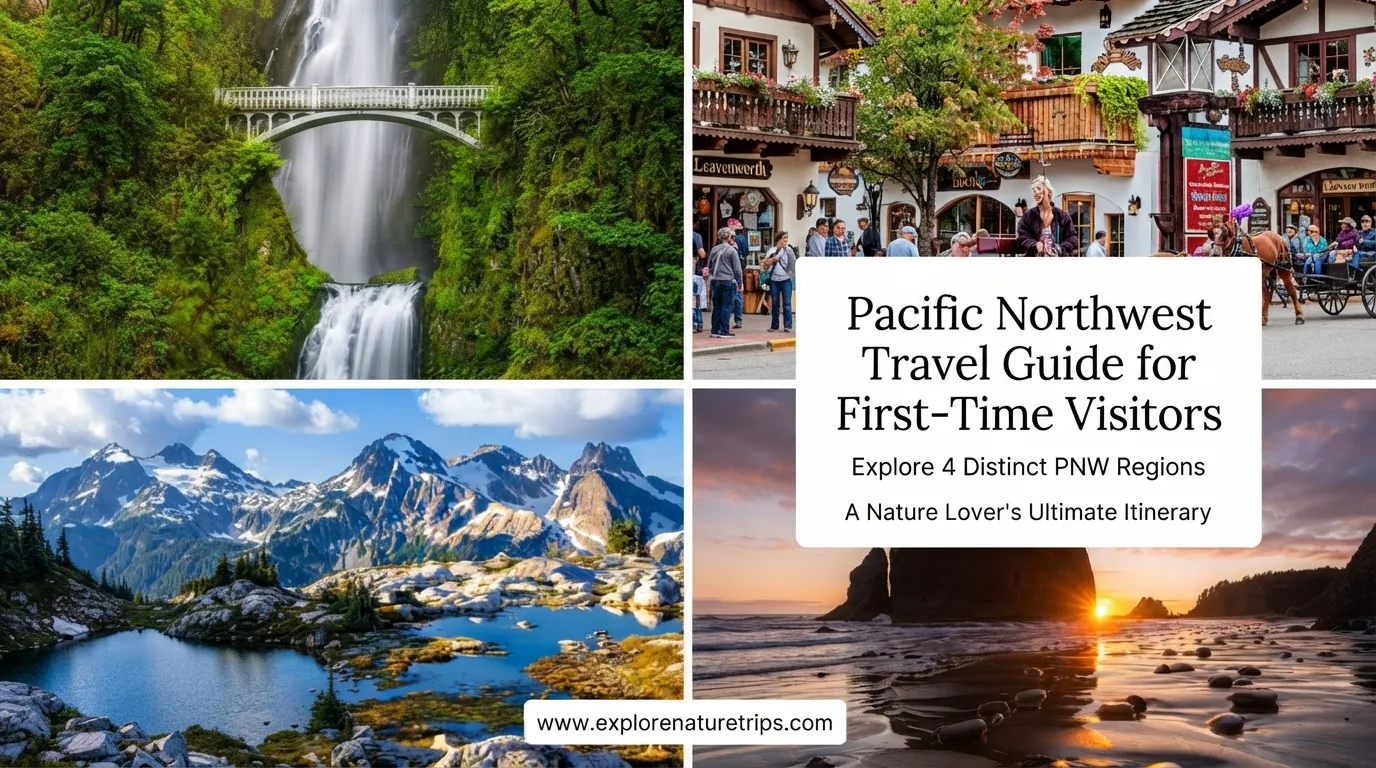
What Is the Pacific Northwest?
The Pacific Northwest (PNW) is a remarkably diverse travel region covering Oregon, Washington, and British Columbia, Canada. Within that area, first-time visitors can combine major cities, rugged coastlines, rainforest, mountains, desert landscapes, national parks, islands, and scenic roads.
That variety is what makes planning both exciting and slightly difficult. You can spend your trip exploring cities such as Seattle, Portland, and Vancouver, or build a road trip around places such as Olympic National Park, Mount Rainier, Crater Lake, the Oregon Coast, and the North Cascades.
For a first visit, it is better to choose a manageable route rather than trying to see everything. A 7–10 day trip works well for concentrating on Oregon or Washington, while a broader Oregon-and-Washington itinerary can take 2–3 weeks.
When Is the Best Time to Visit the Pacific Northwest?
There is no single best season for every traveler. Your ideal timing depends on whether you want hiking, coastal scenery, winter sports, flowers, quieter roads, or city experiences.
Summer: June to August
Summer is the main outdoor travel season. Typical temperatures in the guide are 70°F to 85°F (21°C to 29°C).
This period works particularly well for:
- Hiking
- Beach trips
- National parks
- Scenic drives
- Outdoor exploration
- Mountain activities
The trade-off is crowds. Popular places such as Olympic National Park and Mount Rainier can become busy, so accommodations and tours should be arranged well ahead of time.
Fall: September to November
Fall brings temperatures around 50°F to 70°F (10°C to 21°C). October is highlighted for colorful foliage.
It can be a good choice if you want:
- Cooler hiking conditions
- Fall scenery
- Wine tasting in the Willamette Valley
- Fewer crowds
- Coastal exploration
Winter: December to February
Lowland temperatures are generally around 35°F to 50°F (2°C to 10°C). Rain is common in lower elevations, while higher areas receive snow.
Winter is particularly suitable for:
- Skiing
- Snowboarding
- Mountain scenery
- City trips combined with nearby winter activities
Spring: March to May
Spring temperatures are listed around 45°F to 65°F (7°C to 18°C).
The season brings:
- Cherry blossoms
- Wildflowers
- Coastal trips
- Gardens
- Fewer crowds before summer
How Long Should You Spend in the Pacific Northwest?
Your trip length should determine how much territory you attempt to cover.
| Trip Length | Best Approach |
|---|---|
| 3–4 days | Focus on one city and nearby attractions |
| 7–10 days | Choose Oregon or Washington |
| 2 weeks | Build a larger regional loop |
| 2–3 weeks | Combine major Oregon and Washington highlights |
For example, Portland can work as a base for Mount Hood, the Columbia River Gorge, and Willamette Valley, while Seattle provides access to destinations around Puget Sound and nearby mountain areas.
Seattle: A Strong Starting Point
Seattle is one of the major cities of the Pacific Northwest and an important starting point for exploring Washington.
The city combines urban attractions with access to mountains, islands, and outdoor areas.
Things to See in Seattle
Pike Place Market is one of the city’s best-known attractions, with food, seafood, flowers, local artisans, and street activity.
The Space Needle is another signature attraction. American Sky describes it as 605 feet tall, with views toward Elliott Bay and the Cascade Mountains.
Other notable stops include:
- Chihuly Garden and Glass
- Seattle Waterfront
- Olympic Sculpture Park
- Pioneer Square
- Chinatown
- Pacific Science Center
- Seattle Great Wheel
- Kerry Park
Pike Place Market is also described as having more than 200 local artisans.
Seattle can also serve as a starting point for:
- Mount Rainier
- Olympic Peninsula
- San Juan Islands
- North Cascades
Portland: Food, Parks and Outdoor Access
Portland provides a different city experience, with a strong emphasis on food, green spaces, independent businesses, and access to nearby landscapes.
One of its best-known attractions is Powell’s City of Books, while the International Rose Test Garden contains more than 10,000 rose bushes and blooms from approximately May through October.
Other Portland-area interests include:
- Washington Park
- Forest Park
- Craft breweries
- Food trucks
- Saturday Market
- Willamette Valley wine country
- Columbia River Gorge
- Mount Hood
Forest Park is especially useful for travelers who want outdoor activity without immediately leaving the city. American Sky notes that it has 70 miles of trails.
Vancouver, British Columbia
Vancouver adds a Canadian dimension to a Pacific Northwest itinerary.
The city combines urban attractions with easy access to mountain and outdoor experiences.
Popular Vancouver Experiences
- Granville Island
- Stanley Park
- Grouse Mountain
- Vancouver waterfront
- Public markets
- Mountain activities
Stanley Park covers approximately 1,000 acres, while Grouse Mountain is described as being around 15 minutes from downtown. Whistler is approximately 2 hours away.
If you want to extend the journey into the Canadian Rockies, one suggested route is:
Vancouver → Whistler → Kamloops → Jasper → Banff
This route combines the Sea-to-Sky Highway with the landscapes and national parks around Jasper and Banff.
Pacific Northwest National Parks and Natural Areas
The PNW’s biggest attraction is arguably its range of landscapes.
You can move from rainforest to alpine terrain, coastal beaches, volcanic mountains, and high desert within the same broader region.
Olympic National Park
Olympic National Park combines:
- Mountains
- Forests
- Coastline
- Hoh Rainforest
- Hurricane Ridge
- Rialto Beach
- Ruby Beach
American Sky notes that the park covers approximately 60 miles of Pacific coastline and includes three major ecosystems: mountains, forests, and coast. Mount Olympus reaches 7,980 feet.
For a first visit, the combination of rainforest and coastline makes Olympic particularly useful because you can experience two very different environments within one destination.
Mount Rainier National Park
Mount Rainier reaches 14,411 feet and dominates the surrounding landscape.
Important places include:
- Paradise
- Sunrise
- Narada Falls
- Wildflower meadows
- Glaciers
- Forests
Narada Falls drops approximately 188 feet, while Sunrise provides one of the high viewpoints accessible within the park.
Crater Lake National Park
Crater Lake is one of Oregon’s defining natural attractions.
The lake occupies the volcanic caldera formed after Mount Mazama collapsed following an eruption approximately 7,700 years ago.
Useful numbers for planning include:
- Nearly 2,000 feet deep
- 33-mile Rim Drive
- 30+ viewpoints
- 16 hiking trails
- 1.1-mile Cleetwood Trail
These figures make Crater Lake especially suitable for travelers who want scenic driving combined with shorter hiking opportunities.
North Cascades
North Cascades National Park offers a dramatically different landscape, including:
- Alpine lakes
- Snowfields
- Waterfalls
- Forests
- Mountain peaks
- Glaciers
The guide identifies 30+ glaciers and approximately 700 miles of hiking trails. The North Cascades Highway provides access to numerous scenic viewpoints.
The Pacific Northwest Coast
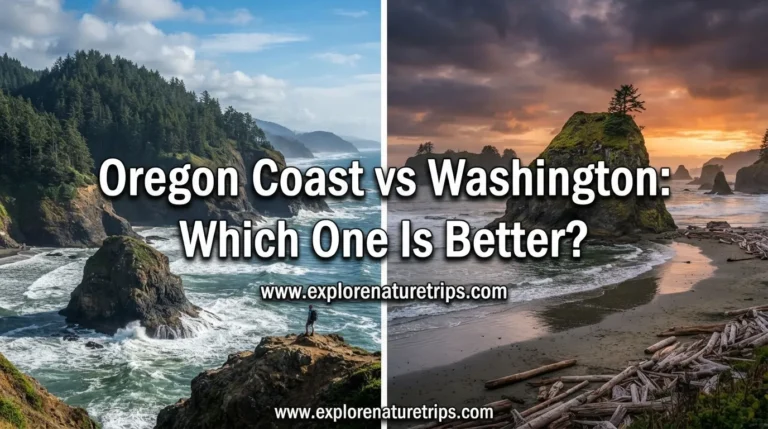
The coastline deserves more than a quick stop. It includes beaches, sea stacks, small towns, islands, lighthouses, and scenic roads.
Cannon Beach
Cannon Beach is one of Oregon’s signature coastal destinations.
The beach is approximately 4 miles long, while Haystack Rock rises about 235 feet above the shoreline.
Nearby experiences include:
- Haystack Rock
- Ecola Park
- Hug Point
- Coastal viewpoints
- Tide pools
- Rock formations
Oregon Coast
A practical coastal route is:
Astoria → Cannon Beach → Newport → Bandon → Brookings
This route provides a progression through coastal towns and scenery, with stops such as Yaquina Head Lighthouse, Shore Acres State Park, and the Samuel H. Boardman Scenic Corridor.
San Juan Islands
The San Juan Islands offer another coastal experience near Washington.
The archipelago contains approximately 172 islands and reefs, with ferries serving the four main islands:
- San Juan
- Orcas
- Shaw
- Lopez
Wildlife opportunities include spotting Orcas, Minke whales, and Humpback whales.
Mountains, Volcanoes and Waterfalls
The Pacific Northwest is particularly valuable for travelers who want several types of mountain scenery in one trip.
Mount Hood
Mount Hood reaches 11,245 feet and is surrounded by 12 glaciers.
The Mount Hood Scenic Byway is approximately 100 miles long and passes through forests, fruit-growing areas, and mountain landscapes.
Columbia River Gorge
The Historic Columbia River Highway Scenic Byway runs approximately 70 miles.
Along the route, travelers can see forests, the Columbia River, viewpoints, and several waterfalls.
Multnomah Falls is approximately 620 feet high.
Mount St. Helens
Mount St. Helens provides an opportunity to understand the geological history of the region.
Its major eruption occurred in 1980. According to the guide, the eruption killed 57 people and destroyed or flattened more than 200 square miles of forest.
The 51-mile Spirit Lake Memorial Highway provides access through the volcanic blast zone and toward Mount St. Helens National Monument.
Best Scenic Drives for a First Trip
Road trips are one of the most practical ways to experience the region because attractions are spread across Oregon and Washington.
| Scenic Drive | Approx. Length | Main Experience |
|---|---|---|
| Historic Columbia River Highway | 70 miles | Gorge & waterfalls |
| Cascades Lakes Scenic Byway | 66 miles | Lakes & mountains |
| Mount Hood Scenic Byway | 100 miles | Mountain & forests |
| Pacific Coast Scenic Byway | 743 miles | Oregon & Washington coast |
| North Cascades Scenic Byway | 138 miles | Mountains & waterfalls |
| Chinook Scenic Byway | 92 miles | Mount Rainier region |
| Spirit Lake Memorial Highway | 51 miles | Mount St. Helens |
The 743-mile Pacific Coast Scenic Byway is the longest of these routes and can be driven in sections rather than attempted in one continuous journey.
A 7–10 Day Oregon Route
If you have roughly one week, keeping the itinerary concentrated in Oregon makes the trip more manageable.
A suggested route is:
Portland → Mount Hood → Bend → Crater Lake → Oregon Dunes → Cannon Beach → Portland
The listed driving distances include:
- Portland → Mount Hood: 90 miles
- Mount Hood → Bend: 133 miles
- Bend → Crater Lake: 90 miles
- Crater Lake → Oregon Dunes: 160 miles
- Oregon Dunes → Cannon Beach: 185 miles
- Cannon Beach → Portland: 81 miles
American Sky recommends 7–10 days for this Oregon-focused itinerary.
A 7–10 Day Washington Route
For a Washington-focused trip, a similar timeframe can cover several major landscapes.
Suggested route:
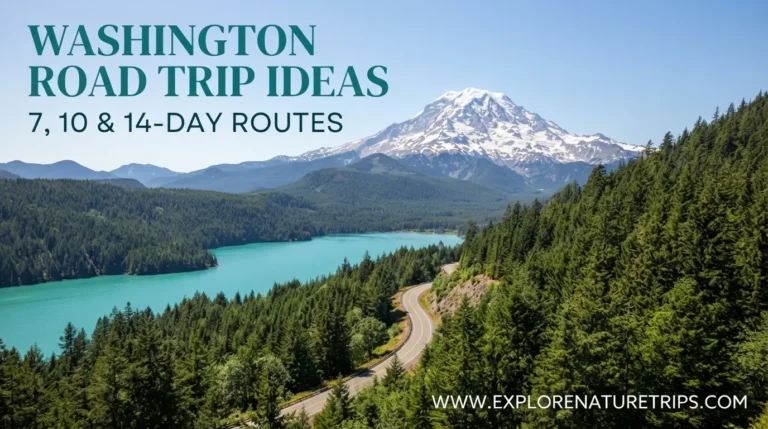
Seattle → North Cascades → Mount Rainier → Mount St. Helens → San Juan Islands → Seattle
Key route distances listed by American Sky include:
- Seattle → North Cascades: 127 miles
- North Cascades → Mount Rainier: 196 miles
- Mount Rainier → Mount St. Helens: 145 miles
- Mount St. Helens → San Juan Islands: 258 miles
- San Juan Islands → Seattle: 80 miles
The suggested duration is 7–10 days.
A 2–3 Week Oregon and Washington Road Trip
Travelers with more time can connect Oregon and Washington.
The broader itinerary starts in Portland and finishes in Seattle, or can be reversed.
Major stops include:
Portland → Mount Hood → Bend → Crater Lake → Oregon Dunes → Cannon Beach → Mount St. Helens → Mount Rainier → Olympic National Park → San Juan Islands → North Cascades → Seattle
The suggested timeframe is 2–3 weeks.
This itinerary works because it combines several different PNW experiences:
- City life
- High mountains
- Volcanoes
- Coastal scenery
- Rainforest
- Islands
- National parks
- Scenic highways
A Practical First-Time Planning Strategy
A successful first visit does not require seeing every attraction.
Choose Your Main Experience
Start by asking what you most want from the trip:
| Your Priority | Focus On |
|---|---|
| City + food | Seattle or Portland |
| Coast | Oregon Coast, Cannon Beach, Olympic Peninsula |
| Mountains | Mount Rainier, Mount Hood, North Cascades |
| Rainforest | Olympic National Park |
| Volcanoes | Mount Rainier, Mount St. Helens, Mount Hood |
| Scenic driving | Columbia River Gorge, Pacific Coast, North Cascades |
| Canadian extension | Vancouver, Whistler, Jasper and Banff |
| Islands | San Juan Islands |
Keep the Route Logical
Avoid crossing the same area repeatedly just to add another attraction.
A base-and-day-trip approach can be easier than changing hotels every night. For longer road trips, group destinations geographically.
Allow Time for Scenic Stops
Distances on a map do not tell the whole story. Coastal viewpoints, waterfalls, mountain overlooks, ferries, hiking trails, and wildlife stops can make a relatively short drive take much longer.
For that reason, an itinerary that looks impressive on paper can become exhausting if every day is packed.
What Should You Pack?
Weather can change quickly across the region, so clothing should be adaptable.
A practical packing list includes:
- Waterproof jacket
- Comfortable walking shoes
- Layered clothing
- Warm layer for mountains
- Daypack
- Reusable water bottle
- Hiking essentials
- Weather-appropriate outdoor clothing
The first-time visitor guidance particularly emphasizes waterproof clothing and layers, especially during wetter seasons.
Where Should You Stay?
Your accommodation strategy should match your itinerary.
In cities, staying centrally can reduce unnecessary driving and make walking easier.
For outdoor-heavy trips, staying closer to the national park, coast, or mountain area can give you more time at the destination.
Accommodation styles mentioned across the include:
- Hotels
- Unique local properties
- Bed-and-breakfast-style stays
- Camping
- Cabins
- Yurts
Camping can be especially appealing when the purpose of the trip is to experience the region’s forests, mountains, and scenery.
Common First-Time Mistakes to Avoid
Trying to See Everything
The PNW is too diverse to experience properly in a very short trip. Pick a region and explore it thoroughly.
Underestimating Driving
A route can look simple on a map but include mountain roads, coastal stops, ferry connections, viewpoints, and hikes.
Ignoring the Weather
Rain, snow, changing temperatures, and elevation can affect outdoor plans. Pack layers and waterproof clothing.
Packing Too Many Stops Into One Day
A scenic destination is not something you need to rush through just to reach the next location.
Forgetting Ferry Connections
Routes involving the San Juan Islands or Bainbridge Island need additional planning around ferry travel.
Treating Summer Like the Quiet Season
Summer is the busiest period. Popular parks and accommodations can fill quickly, so planning is important.
FAQs
How many days do you need for the Pacific Northwest?
A 7–10 day trip works well when concentrating on Oregon or Washington. A broader Oregon-and-Washington road trip is better suited to approximately 2–3 weeks.
What states and areas are considered the Pacific Northwest?
The guides define the main region around Oregon, Washington, and British Columbia, Canada.
What are the main Pacific Northwest cities?
The major cities highlighted by the guides are Seattle, Portland, and Vancouver.
What is the best season for a Pacific Northwest road trip?
Summer, from June through August, offers mild temperatures of roughly 70–85°F, but it is also the busiest period. Fall and spring offer cooler conditions and fewer crowds.
Is the Pacific Northwest good for a road trip?
Yes. The region’s attractions are spread across cities, coastlines, mountains, forests, parks, and islands, making road trips a practical way to connect different landscapes.
What are the best national parks for a first visit?
The guides particularly highlight Olympic National Park, Mount Rainier National Park, Crater Lake National Park, and North Cascades National Park. Each provides a different combination of mountains, forest, coastline, rainforest, or volcanic scenery.
How long is the Pacific Coast Scenic Byway?
The American Sky guide lists the Pacific Coast Scenic Byway at approximately 743 miles, stretching along Oregon and Washington’s coast.
How high is Mount Rainier?
Mount Rainier reaches 14,411 feet, making it the tallest peak in the Cascade Mountains according to the American Sky guide.
How deep is Crater Lake?
Crater Lake is described as nearly 2,000 feet deep. Its 33-mile Rim Drive provides numerous viewpoints around the lake.
What should you pack for the Pacific Northwest?
Bring waterproof clothing and layers. Weather can change quickly, particularly when traveling between lowland cities, coastal areas, and higher mountain elevations.
Final Thoughts
The Pacific Northwest is best experienced as a collection of different landscapes rather than as a checklist of attractions. Seattle, Portland, and Vancouver provide strong city bases, while Olympic National Park, Mount Rainier, Crater Lake, North Cascades, Mount Hood, the Oregon Coast, and San Juan Islands add completely different outdoor experiences.
For a first trip, start with 7–10 days and concentrate on one state or a compact route. If you have 2–3 weeks, you can build a much larger Oregon-and-Washington road trip.
Most importantly, leave enough room to enjoy the scenery. The best Pacific Northwest itinerary is not necessarily the one with the most stops; it is the one that gives you enough time to experience the coast, forests, mountains, cities, and scenic roads without turning the vacation into a race.
Hi, I’m Marcus! I love exploring the outdoors and discovering incredible places. Through ExploreNatureTrips blog, I share my travel experiences, useful tips, and recommendations for the best sights, trails, and destinations to visit.
One Comment